Key Points
-
Microsoft plans to make its Maia chips the main inference system for its own products.
-
Nvidia’s sales to its largest cloud customers more than doubled last quarter.
-
Nvidia stock trades for around 14 times next fiscal year’s expected earnings.
- Motley Fool Issues Rare “Total Conviction” Buy Alert ›
Microsoft (NASDAQ:MSFT) now has a third generation of its own artificial intelligence (AI) chip. The tech giant announced Maia 300 on Monday and said it will ramp up its Maia chips starting in 2027 to make them the main system running AI in its own products.
That might sound like trouble for Nvidia (NASDAQ:NVDA). The AI chip leader gets around half its revenue from big cloud companies like Microsoft, a group it calls hyperscale customers.
Missed Nvidia in 2009? This Rare Signal Is Flashing Again. In 2009, a “Double Down” signal flashed for a little-known chipmaker called Nvidia. For the first time in years, that same “Total Conviction” signal is flashing for a company 1/100th the size of Nvidia. Continue »
But I don’t think the news matters much for Nvidia shares. The company’s quarterly revenue is over five times what it was right before Microsoft’s first Maia chip launched in late 2023. And Microsoft still buys Nvidia’s chips.
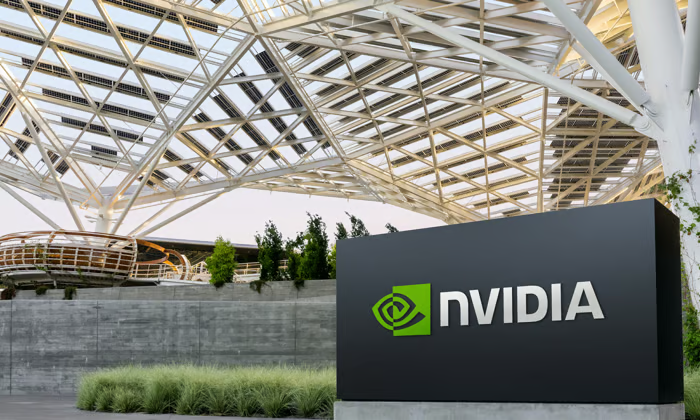
Image source: Nvidia.
A narrow role for Maia
In the announcement, Microsoft said it will make Maia “the primary inference system for Microsoft products and services.” Inference means using an AI model once it’s been trained.
Microsoft also said it expects Maia 300 to generate 40% more tokens (units of AI output) per megawatt than top systems built around graphics processing units, the type of chip Nvidia sells. Still, that’s Microsoft’s own estimate for a chip that isn’t set to start production deployments until 2027.
Meanwhile, CEO Satya Nadella said on Microsoft’s Julyearnings callthat the company will be one of the first cloud providers to deploy Nvidia’s next-generation Vera Rubin systems. Management guided for capital expenditures of over $50 billion in the quarter that ended in September.
That would be up from $41 billion in Microsoft’s fiscal fourth quarter of 2026 (the period ended June 30, 2026), which was itself up from $24.2 billion a year before. Around two-thirds of that quarter’s spending went toward shorter-lived assets, mostly chips.
Nvidia’s growth hasn’t slowed
The first Maia chip launched in November 2023, and Maia 200 followed in January 2026. In the quarter ending right before the first one came out, Nvidia’s fiscal third quarter of 2024 (the period ended Oct. 29, 2023), revenue was $18.1 billion.
Showing how little in-house chips have slowed Nvidia since then, the company took in $96.2 billion in the fiscal second quarter of 2027 (the period ended July 26, 2026). That was up 106% year over year — faster than the 85% growth in fiscal Q1. Earnings per share jumped 128%. What’s more, hyperscale customers, the ones with the most reason to buy fewer Nvidia chips, more than doubled their spending to $48.7 billion.
Nvidia’s fiscal Q3 guidance of around $108 billion points to growth of about 89%. And for fiscal 2028, chief financial officer Colette Kress said on the Augustearnings callthat the company expects revenue to rise about 70% — a forecast she described as held back by supply. Fiscal 2028 includes most of 2027, the year Microsoft plans to start ramping Maia up.
But what if more customers follow?
True, Amazon and Alphabet design their own AI chips, too. And Nvidia’s sales are concentrated, with one direct customer making up 16% of revenue in fiscal Q2. If its top buyers shifted most of their AI work to their own chips, Nvidia’s growth could slow quickly.
But Nvidia’s sales outside the hyperscale group are growing even faster. Revenue from its other data center customers (AI cloud providers, businesses, and governments) climbed 138% year over year to $40.3 billion. Hyperscale customers’ share of data center revenue dropped from around 59% a year earlier to about 55%.
On Nvidia’s Augustearnings call CEO Jensen Huang described many custom chips as “inference-specific chips for one cloud or one service.” He called Nvidia’s product “an entire AI factory platform that spans the entire AI life cycle that you can use in any cloud.”
I’d say Maia matches his description. Microsoft built it to power Microsoft’s products.
In the end, custom chips like Maia might take some work from Nvidia. But the stock arguably isn’t priced as if Nvidia will keep all of it.
Shares trade near $226 as of this writing, about 6% off the record close they set on Oct. 6. That price is about 14 times what analysts expect Nvidia to earn on average in fiscal 2028 (the 12 months through January 2028). For Microsoft’s fiscal 2028 (ending June 2028), the same number is about 23 times earnings.
I think Nvidia’s price is cheap for a company still guiding for growth around 90%. It remains the chip stock I’d consider buying now.
Should you buy stock in Nvidia right now?
Before you buy stock in Nvidia, consider this:
The Motley Fool Stock Advisor analyst team just identified what they believe are the 10 best stocks for investors to buy now… and Nvidia wasn’t one of them. The 10 stocks that made the cut could produce monster returns in the coming years.
Consider when Netflix made this list on December 17, 2004… if you invested $1,000 at the time of our recommendation, you’d have $379,123!* Or when Nvidia made this list on April 15, 2005… if you invested $1,000 at the time of our recommendation, you’d have $1,408,822!*
Now, it’s worth noting Stock Advisor’s total average return is 950% — a market-crushing outperformance compared to 215% for the S&P 500. Don’t miss the latest top 10 list, available with Stock Advisor, and join an investing community built by individual investors for individual investors.
*Stock Advisor returns as of October 12, 2026.
Daniel Sparks and his clients do not have positions in any of the stocks mentioned. The Motley Fool has positions in and recommends Alphabet, Amazon, Microsoft, and Nvidia. The Motley Fool has a disclosure policy.