As artificial intelligence (AI) features that read and use messaging conversations become more common, messaging apps are grappling with how much access to allow. Some messaging apps have blocked AI from accessing chats, citing security, while others have actively opened them to outside AI. Some are restricting access by outside AI while moving to prioritize their own AI in chats.
◇ Signal blocks AI, while KakaoTalk issues a “security alert” over outside AI

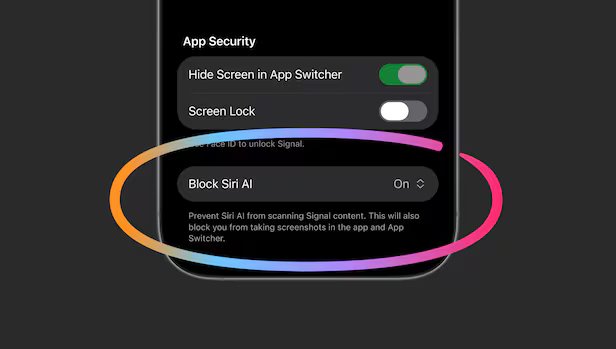
Messaging app Signal recently introduced measures to prevent AI assistants from capturing on-screen content in its iOS and Android apps, Reuters and other foreign news outlets reported on the 23rd. For its iOS 27 app, Signal added a “Block Siri AI” setting and enabled it by default. When the setting is on, screenshots are blocked within the app, preventing Siri AI from scanning the screen and reading conversations. On Android, the app automatically enables its “Screen Security” feature when it detects an AI attempting to read the screen. That feature also works by blocking screenshots.
Signal said it chose the approach because operating system (OS) companies “do not provide developers with a way to restrict AI access without significantly harming the core user experience.” That means it had no choice but to block users from taking screenshots as well. Meredith Whittaker, president of the Signal Foundation, said AI agents offered by OS companies including Google, Apple and Microsoft (MS) are undermining messaging apps’ ability to protect privacy.
In Korea, an outside AI assistant was recently stopped from accessing KakaoTalk conversations. Pickle, an AI assistant created by Korean founders, unveiled a feature on the 11th that reads KakaoTalk chats and sends messages on users’ behalf, but discontinued the integration a day later. Pickle told users at the time that it was “temporarily disabling the feature because the integration with KakaoTalk is slow.” The move is seen as reflecting concerns that its method of accessing user accounts without prior consultation with Kakao could lead to privacy and terms-of-service issues.
Regarding Pickle’s access to KakaoTalk chats, a Kakao representative said, “We understand that users are granting Pickle the permissions of a KakaoTalk sub-device, allowing Pickle to control KakaoTalk remotely.” The representative added, “Unexpected problems involving users’ personal information security could arise, so we plan to review and address any potential issues under relevant policies and laws from the standpoint of user protection.” Kakao also advised users in a notice on its PC version: “Do not share passwords or verification codes with AI.”
◇ Telegram “opens wide” … WhatsApp, KakaoTalk and Line focus on “their own AI”

Messaging apps are taking different approaches to AI access to chats. Unlike Signal, Telegram has actively opened its chats to outside AI. In May, Telegram introduced a “conversation automation” feature that lets users connect an outside AI chatbot to their accounts and have it reply to messages. The AI can read and reply to messages only in chats authorized by the user. Telegram is known as a secure messaging app, but it has chosen to take a more open approach to AI features. In announcing the conversation automation feature in May, Telegram said, “Telegram is the only platform where all AI models can compete freely.”
Some platform companies are restricting access by outside AI while seeking to bring their own AI into chats. Meta added its own AI, “Meta AI,” to WhatsApp while restricting the use of outside AI. In October last year, it prohibited outside AI agents from using the WhatsApp Business application programming interface (API), leaving “Meta AI” as the only AI that could be used on WhatsApp. Following an antitrust investigation by the European Commission, it provisionally allowed outside AI access to WhatsApp in the European Union (EU), while appealing the commission’s order.
Kakao plans to begin a closed beta test (CBT) next month for “Kanana Space,” an AI agent that uses the context of conversations to send messages or help manage schedules. Kakao plans to develop Kanana Space further so it can carry out tasks such as ordering, sending gifts, making reservations and transferring money with a single spoken command. In effect, Kakao is bringing its own AI into chats while reviewing potential issues with outside AI agents accessing KakaoTalk.
LY Corporation is also focusing on bringing its own AI agent, “Agent i,” into chats. The company said it would introduce a feature by the end of March next year that lets users summon “Agent i” in Line’s one-on-one or group chats to get answers suited to the context of the conversation and delegate tasks such as adding events to a calendar.