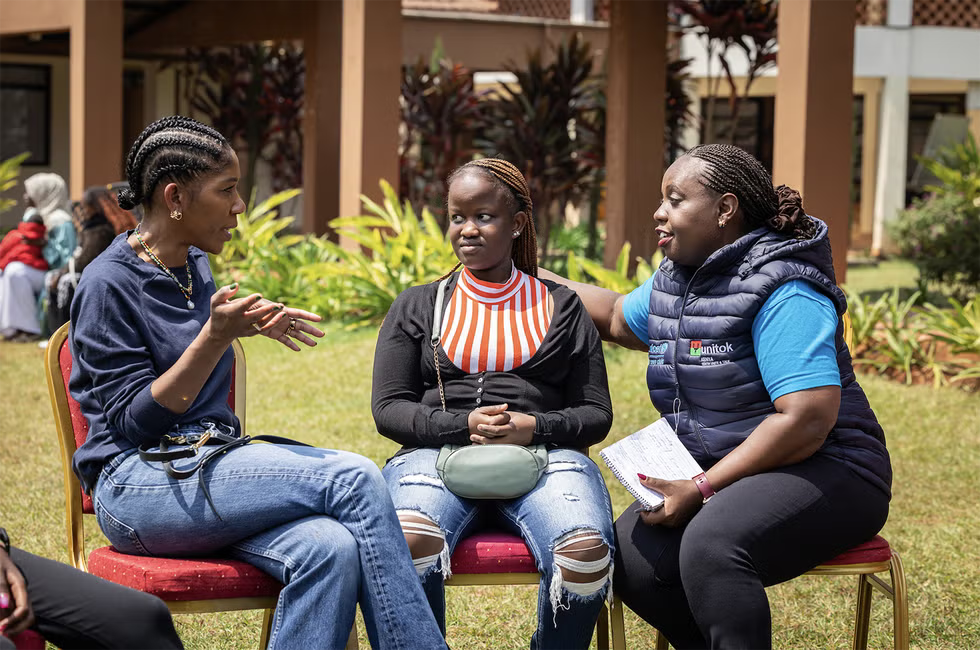
There’s a strong and surprising sense of familiarity when I arrive at Katilu Girls School in Lodwar, Kenya where Year 10 and 11 STEM students are waiting to welcome us. I’ve come all this way to meet the young women taking part in Power4Girls, a new humanitarian programme created by UNICEF in partnership with Louis Vuitton, the latest initiative in what has been the longest-standing collaboration between a luxury house and humanitarian organisation.
‘I want to be the next Elon Musk,’ Chantal, 17, says with a mischievous eyebrow raised, waiting to see my reaction, as if daring me to utter a politely patronising word of condescension. ‘But I want to be a force for good,’ she continues with a smile. ‘Imagine the good I could do with all that money.’
Her classmate Precious adds, ‘It’s about changing the impossible into, “I am possible,”’ quoting one of the school’s many self-affirming slogans.

As the only journalist in a group of seven, a Black American woman by way of London, I’m painfully aware of ‘the danger of a single story’, as Chimamanda Ngozi Adichie so accurately put it, that has distorted the world’s view of most African countries for more than a century. I’m also acutely conscious of how many authors and journalists before me have depicted young women in African countries as downtrodden victims of all manner of societal ills, including female genital mutilation and poverty, reinforcing damaging stereotypes in the process.
As I get to know the girls, Adichie’s words hover in my mind: ‘Like our economic and political worlds, stories too are defined by the principle of nkali: How they are told, who tells them, when they’re told, how many stories are told, are really dependent on power.’
Power, how to nurture it and give it to others, is ultimately what we’re here in Turkana to talk about today. And I see glimmers of my younger self in their youthful precociousness and delightfully clear ambitions — less so in their subject areas of interest (the group I’m meeting with are all lovers of chemistry, biology and physics. I, meanwhile, was terrible at science). Their enthusiasm is contagious.


Together the girls form a tableau of joyful, bright-eyed wholesomeness, with their uniforms and beautiful smiles. But they also have a clear-eyed sense of the challenges they face each day, reeling off a list that includes financial pressures, gender discrimination, early pregnancy and marriage.
‘I’d like to be a civil engineer, but back home they’ll tell me engineering is for men and boys, you know. So I have the urge to fight that,’ Precious says.
She and her classmates know what a privilege it is to attend their school, an opportunity many can’t afford, with many having travelled a considerable distance, away from their families to get there.
It takes a three-hour drive from Lodwar Airport through the Turkana desert in northern Kenya to the school to begin to appreciate the landscape in which these girls are growing up. The journey is so far removed from my day-to-day life in London that it’s disorienting. There’s the geographic distance (I’ve travelled 7,118 kilometres to get here), but also the stark contrast between the two places in all sorts of other obvious ways.

Turkana is one of the most remote and underdeveloped regions of Kenya, bordering Ethiopia and South Sudan, and one of the most arid parts of the world, placing it on the front lines of climate change, with extreme heat and drought.
Camels saunter up and down the highway, while the occasional motorbike zooms past.
One of the central tenets of Power4Girls is that girls wield an enormous power to change their communities and are already organising everywhere. ‘They’re not waiting for permission to change the systems that limit them,’ says Lauren Rumbe, UNICEF’s Associate Director, Gender Equality, who has travelled here from New York. And no wonder, with only 1% of global aid reaching girl-led groups, the stakes are too high to wait for systemic change. This idea feels especially resonant in a year in which young people have driven global protest movements that have influenced elections and impacted governments. Throughout our trip, news of Gen Z-led protests in India peppered small talk and headlines.
‘We aim to support 100,000 girls each year by giving them access to greater education, health, nutrition, and gender-based violence prevention in a country where the population is generally quite young, with a median age of 20,’ says Leslie Laborosse, Corporate Partnership Lead of UNICEF France.


Adolescent girls are among Kenya’s most vulnerable groups, and the work of empowering them is largely made possible by an expansive local and global network of women. And it’s these women who become the most powerful image of what’s possible for the students in the programme and the values of Power4Girls itself.
‘Kenya is a country in rapid social transformation and it’s quite important for the future of Africa. And here there are stunning examples of women’s leadership at the most senior levels. If you look at the Supreme Court, the media, business and even in social activism there’s a very active young feminist movement and young feminist organising, especially in the major cities. But all of that exists alongside very high rates of violence and widespread poverty particularly for girls and young women,’ says Jessica Horn, an African feminist thought leader and former Regional Director for the Ford Foundation East Africa. ‘Adolescent girls who make up a 1/5th of the total population in large part still don’t have the ability to make decisions and control what happens to their own bodies. And that gets in the way of their dreams and ability to thrive and contribute to society,’ Horn says.
There’s a collective fierceness to the motley, impressive group of UNICEF women who I shadow throughout the trip: in addition to Rumbe and Laborosse, there are Susan Kariuki, Adolescent Development Specialist, who is all quiet discernment and care; Adolescent Girls Specialist Tannistha, who has a distinct mix of good humour and fearlessness; Education Officer Rommanah Somba, full of welcoming enthusiasm; and Education Officer Margaret Njayakio’s wealth of knowledge.

They work in partnership with the region’s formidable educators and advocates, including Salome Ewoi, the Senior Principal at Katilu Girls. ‘I’m so happy that so many of our guests are the girl child,’ Salome, tall and regal with a crown of braids, says, looking at us with an approving smile.
Last year, her students had a completion rate of 96%, with 470 girls receiving a ‘girl-centred’ curriculum that highlighted ‘digital skills, STEM education, confidence and decision-making, and reproductive health’, she said. Her success rate is remarkable when you consider that 1 in 5 girls in rural regions of Kenya don’t make it past primary school. She points out that adolescent girls face a unique set of barriers. ‘It becomes hard to keep the girls enrolled when they reach 16 to 18,’ she says.
Salome doesn’t have one mantra, but many for her students to absorb, and places her spirited words on placards all over the school grounds. ‘Learning is a treasure that will follow its owner everywhere,’ one reads, while another states plainly: ‘The More you learn, the more you earn.’ While discussing their hopes and dreams, the girls recite the slogans like affirmations. ‘Child marriage ruins the future of our girls,’ another says.

When I ask Salome’s students what the biggest pressures are that they face, the answers are a mix: ‘Exams,’ Precious says. ‘Not having school fees or sanitary towels,’ another adds. Later, we travel to Lodwar Senior School, a two-hour drive away, where a student named Anne admits she is rarely able to attend classes during her monthly cycle, while her schoolmate, Joy, tells me how she worries about a friend who has had to drop out of school after becoming pregnant.
‘Girls don’t live single-issue lives,’ Rumbe says.
This is partly why Power4Girls takes on a range of shapes and formats, from peer-to-peer support groups for adolescents with disabilities and their caregivers to Huru Global, which works to tackle period poverty by manufacturing reusable sanitary pads.
Rumbe and team are going about their work during a time when UNICEF and other humanitarian organisations have seen a 20 to 30% reduction in funding due to varying political reasons. This means private sector contributions from companies such as Louis Vuitton can be game-changing; in this case, enabling the programme to operate in 120 countries in South America, Africa and Asia.
Ultimately, the goal is to enable 100,000 girls each year to express their leadership. ‘We’ve been reaching out to girls in school and out of school to try to support them in their voice and agency,’ Kariuku says.
For Precious, who hopes to one day join her cousin in Canada and attend university, the stakes are personal: ‘Our dreams should matter.’
ELLE Collective is a community of fashion, beauty and culture lovers. For access to exclusive content, events, inspiring advice from our Editors and industry experts, as well as the opportunity to meet designers, thought-leaders and stylists, become a member today HERE.
Kenya Hunt is the Editor-in-Chief of ELLE UK. Her career spans working for some of the world’s most influential women’s titles on both sides of the Atlantic from her post-graduate days as an Assistant Editor at the seminal magazine, Jane, to her time as Deputy Editor of Grazia UK and ELLE UK. As the founder of R.O.O.M. Mentoring, she advocates for greater diversity within the fashion industry by providing a supportive network for some of the many talented aspiring designers, journalists and image makers of colour London has to offer. In 2021, she was recognised by The British Fashion Council for her work and given a Global Leader Of Change Award at its annual Fashion Awards. An American based in London, she lives south of the river with her husband and two sons. Her critically-acclaimed book, Girl: Essays on Black Womanhood (HarperCollins/HQ), is out now.