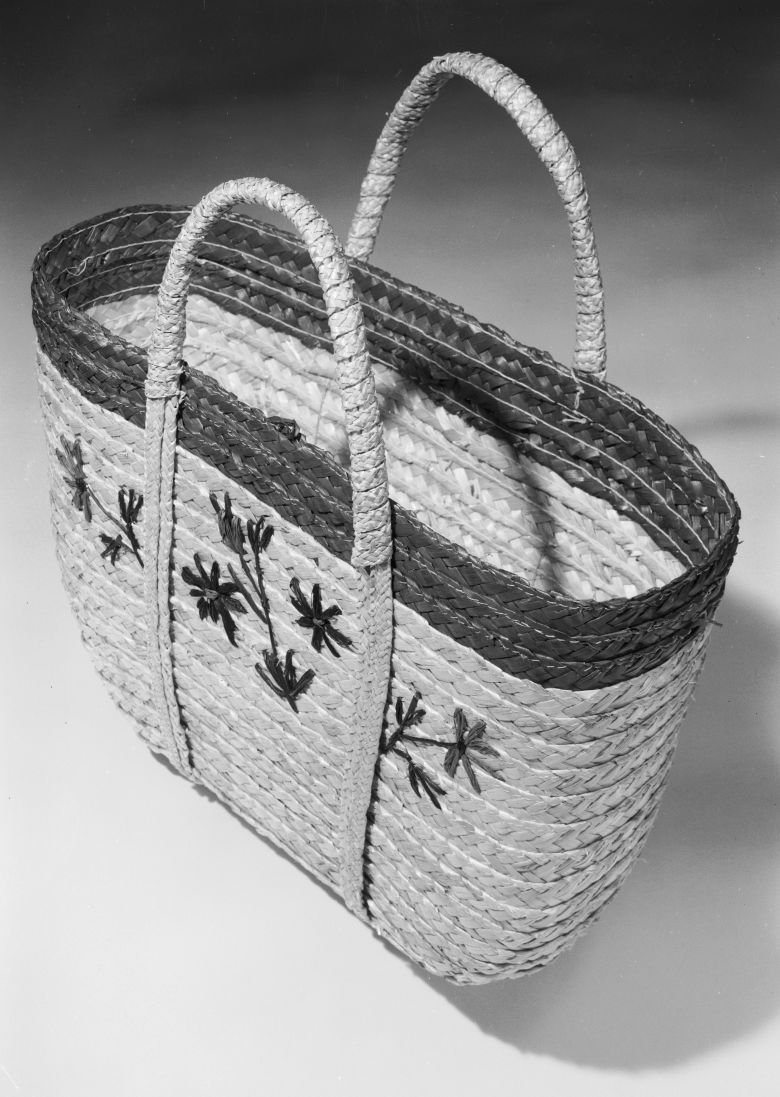
In Europe this summer, it was a sight almost as ubiquitous as the sun: fashionistas weaving their way down Mediterranean beach promenades, London high streets and haute couture centers in Paris carrying earthy-colored, basket or crochet-patterned bags.
The rise of raffia bags was first ignited by 1960s fashion trendsetters like Brigitte Bardot and Jacqueline Kennedy. Once a casual holiday accessory, raffia totes and clutches have blossomed into mass-market must-haves and cornerstone items for luxury fashion houses; Prada, Saint Laurent and Loewe represent just a few of the designer brands to curate raffia products that retail with four-figure price tags.
Yet ask buyers where the intricately arranged palm fibers draped over their shoulders come from, and many might struggle to answer. Though 80% of global raffia demand is sourced from Madagascar, according to the country’s Economic Development Board, the East African country’s age-old connection to the natural material is relatively unknown globally.
In Madagascar, the perception could not be more different. Raffia is woven into the cultural fabric of Malagasy life, explains multidisciplinary designer Domi Sanji, an organic embodiment of the national concept of “fihavanana” — enshrined into the country’s constitution — that emphasizes kinship, community and mutual respect.
“It (raffia) is the root of our identity, that’s the reason why it is very present in our everyday life,” Sanji, based in the country’s capital Antananarivo, told CNN.
“It is an expression of how to make society, how we live in society, and the way that the fibers are linked together. It is something from the spirit of Malagasy people: a wish to make society be together, to link each other.”


Raffia is a fiber harvested from the colossal leaves of raffia palms, a tree native to Madagascar and other regions of tropical Africa, as well as parts of Central and South America. Fronds as long as 20 meters (66 feet), among the largest found anywhere, are pruned before their underside epidermal layers are peeled off.
These supple green strips are sun-dried, cultivating the tan and beige colors synonymous with many eventual products, with the resulting strands then bundled and passed on to the central cogs in the raffia supply chain: the artisans.
Weaving or crocheting fibers into bags, hats, home decor and a range of other goods is a skilled, labor-intensive process for specially trained craftspeople. It can take days and tens of thousands of stitches for an artisan to handmake one raffia hat.
Yet there are concerns that raffia, some of those who weave it, and its surrounding landscapes are being exploited amid global demand for the fiber. Roughly 75% of Madagascar lives below the poverty line, according to the United Nations, a vulnerability that has contributed to overharvesting and an opaque supply chain marked by poor working conditions, explains Eileen Akbaraly, an Italian Indian social entrepreneur who grew up in Madagascar.
Concentrated harvesting along Madagascar’s east coast contributed to 4.85 million hectares (12 million acres) of tree cover loss since 2000, a Global Ecology and Conservation report found in 2023.
“Everyone is there and everyone is exploiting it,” Akbaraly told CNN. “It’s pretty horrible.”

Seeking to remedy two problems in one fell swoop, Akbaraly founded Antananarivo-based fashion brand and social enterprise Made For A Woman in 2019 to spotlight and empower the artisans propping up raffia’s global success while implementing a traceable, sustainable supply chain for the natural fiber.
Today, more than 90% of the company’s roughly 1,000 employees are women, with the majority coming from vulnerable communities, including domestic abuse survivors and sex workers, Akbaraly said.
B Corp certified, a verification based on adherence to high social and environmental standards, Made For A Woman trains artisans in the skills needed to craft made-to-order products while also offering access to healthcare, education, social services and childcare, on top of equitable wages.
“My job here is to give opportunities to other people and show them how incredible they are,” Akbaraly said.
“My biggest moment where I’m just like, ‘Wow, I’ve done it,’ is being able to be in meetings with people or surrounded by people where I’m listening to them and I can feel that they feel empowered … that they’re starting to understand their gift and what they’re capable of.”

That commitment underpins the brand’s effort to develop Madagascar’s first fully transparent and trackable supply chain for raffia. Traceability did not exist when Made For A Woman launched, said Akbaraly, who — after much searching — found what she believed to be the only supplier with social certification: Kalfane Fils, based in the northern city of Mahajanga.
Under World Fair Trade Organization verification, the brand’s entire business — supply chain included — has been independently audited and deemed committed to fair trade. Akbaraly hopes it can serve as a blueprint for the wider industry.
“It’s so important to know where your materials come from because they become who you are,” she said.
“They are a representation of everything that you do. I don’t understand how people can work on materials and not understand where they come from.”
Made For A Woman applies the same principle to its worldwide consumer base. Each handmade product, from a bag made exclusively from recycled raffia (£667/$891) to a cotton-raffia dress that takes months to weave (£1,283/$1,714), ships with a QR code on the label that buyers can scan to find out more about the Malagasy artisans, raffia harvesters and ecosystems that sculpted their purchase.
It is a form of Digital Product Passport (DPP) that Akbaraly believes has the potential to revolutionize the way consumers engage with fashion brands, healing a “disconnect” between the two groups at either end of the supply chain.
“There’s so much beauty throughout the supply chain … [If] You create beautiful stories that are authentic and real, and you sell that to consumers, then consumers are obviously going to start caring more and they’re also going to start seeing themselves differently.”

In doing so, Akbaraly hopes to redefine the very concept of luxury, all while working alongside some of the biggest luxury brands in the industry.
Made For A Woman has partnered with two long-established luxury fashion houses: France’s Chloé and Italy’s Fendi, as well as Italian luxury fashion retailer Modes, yet Akbaraly does not see those collaborations as a betrayal of her principles. Instead, she sees them as an opportunity to dismantle the facades of branded luxury.
“People who buy brands fall in love with the illusion of what they could be and the kind of world they could be part of, but it’s an illusion. It’s not real. So how can you call that luxury?” she questioned.
“The true value of luxury products comes from the earth itself; from human hands, from materials, from treating people and the planet correctly … creating a place that is better for ourselves and future generations. That’s what I consider luxury.”
Sanji, who specializes in heritage revitalization, agrees. Luxury, he said, is not Paris or Milan but in “the spirit of the artisan,” and the global demand for raffia presents an opportunity for his country to position itself at the heart of it all.
Because while Madagascar is well known for its rich biodiversity (roughly 92% of its plant, mammal and reptile life is not found anywhere else on the planet) and, begrudgingly for Sanji, a 2005 titular animated comedy about escaped New York zoo animals, it is rarely associated with elegance and fashion.
In empowering local artisans and spotlighting the story behind the bag, Made For A Woman is helping to change that narrative, believes Sanji.
“We have so much more to tell the world,” he said. “Raffia is telling the story about the beginning of something, of a new way to see that Madagascar is more than a country of raw materials: it is also a country of luxury.”