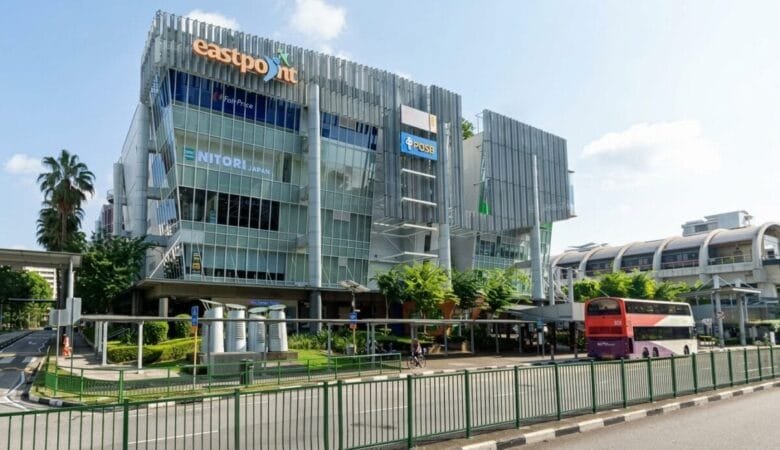

Link REIT added Singapore’s Eastpoint Mall to its portfolio this month (Image: Google)
Link REIT held its distribution steady at HK127.25 cents per unit for the six months to September as a 20.8 percent cut in administrative costs offset a decline in revenue, according to results released on Thursday.
Net property income slipped 0.8 percent to HK$5.1 billion ($654.5 million) as new and renewed leases at the trust’s Hong Kong shopping centres were signed at an average 7.5 percent below previous rents, the results showed.
Link also agreed on 30 October to sell five logistics warehouses in mainland China for RMB 1.1 billion ($165.3 million), according to the results.
“We are seeing early signs of stabilisation in parts of our core portfolio, although we expect our income to continue to edge down mainly in our Hong Kong retail segment which accounts for approximately half of our portfolio,” Link chair Duncan Owen said in a statement.
Hong Kong Rents Slide
Revenue from Link’s Hong Kong retail portfolio fell 3.0 percent to HK$3.6 billion, with leases signed during the half carrying a steeper discount to previous rents than the 6.4 percent recorded a year earlier, according to the results.

John Saunders, executive director and chief investment officer of Link REIT’s manager (Image: LAML)
Average monthly rent fell to HK$59.4 per square foot from HK$60.1 at the end of March, while occupancy slipped to 97.0 percent from 97.8 percent.
Tenant sales slipped 0.2 percent, an improvement from the 2.1 percent decline a year earlier, as food and beverage sales grew 2.5 percent while supermarket and foodstuff sales fell 2.2 percent.
Car parks, which the trust says account for nearly one-fifth of its revenue, brought in a flat HK$1.2 billion, as a 4.2 percent rise in hourly income offset a 1.6 percent fall in monthly income.
The softness at Link’s malls contrasts with an economy that grew 5.2 percent in the third quarter from a year earlier, according to the government’s advance estimate, although private consumption rose only 2.8 percent. On Friday the Hong Kong Government raised its 2026 full-year real GDP growth forecast to 4.8 percent from the 3.5 percent to 4.5 percent predicted earlier, noting “a further pick-up in already buoyant external trade growth and solid domestic demand.”
Hong Kong retail sales rose 6.4 percent in value in September, the 17th straight monthly increase, led by jewellery and watches at 20.3 percent, the Census and Statistics Department said. Those categories account for just 0.7 percent of the base rent Link collects, while supermarket sales fell 1.0 percent citywide and online sales rose 12.0 percent to 13.1 percent of the total.
Overseas Recovery
Net property income from Link’s international portfolio of 12 assets in Australia, Singapore and the UK rose 5.1 percent to HK$636 million, even as revenue slipped 0.3 percent to HK$926 million following the sale of its Swing By@Thomson Plaza property.
Australian retail leases were signed 17.8 percent above previous rents with occupancy at 99.8 percent, while in Singapore, where Jurong Point is now Link’s only wholly owned mall, retail leases were signed 8.0 percent higher at 99.2 percent occupancy.
In mainland China, revenue fell 2.9 percent and net property income 1.2 percent in renminbi terms, but both rose in Hong Kong dollar terms, by 2.9 percent and 5.0 percent, as the renminbi strengthened against the Hong Kong dollar.
Net gearing fell to 23.3 percent from 23.9 percent at the end of March, while the average borrowing cost rose to 3.29 percent from 3.22 percent a year earlier as the Hong Kong Monetary Authority held its base rate at 4.25 percent last month.
Link’s portfolio was valued at HK$213.3 billion at the end of September, down 1.5 percent from March, with net asset value per unit slipping 1.3 percent to HK$56.99. The Hong Kong properties were worth HK$157.0 billion, a 5.4 percent decline from HK$165.9 billion a year earlier.
Selling Below Book
The RMB 1.1 billion price for the mainland warehouses is about 3.4 percent below their 30 September valuation, according to the results, which put the portfolio’s occupancy at 97.5 percent. Three of the warehouses are in the Yangtze River Delta, while the other two are in Guangdong province, with Link holding a 75 percent in those properties, and the sale is due to complete in the first quarter of 2027, subject to regulatory approvals.
Link paid RMB 947 million in 2022 for the three Yangtze River Delta warehouses, based on an agreed property value of RMB 1.1 billion. It paid RMB 766 million for 75 percent stakes in the two Greater Bay Area properties in October 2021, according to its annual report for the period.
The sale price is roughly half the HK$2.5 billion of property value Link took on when it bought the five warehouses, according to Mingtiandi calculations. The trust had already marked the portfolio down, valuing it at HK$1.6 billion at the end of March from HK$2.2 billion in September 2025, its interim results presentation showed.
The trust said in late October that it would sell 700 Nathan Road sale in Mong Kok for HK$2.3 billion – 61 percent below the HK$5.9 billion it paid to acquire the property in 2016.
In July Link sold half of Sydney’s 100 Market Street for A$225.9 million ($158.7 million), a price that values the office tower about a third below the A$683 million it paid in 2019.
Link spent about HK$1.5 billion buying back 38.3 million of its units during the half and plans to repurchase at least HK$1 billion and up to HK$2 billion more in the second half if the unit price remains attractive, the trust’s manager said in the results announcement.
The trust also agreed last week to buy 50.1 percent of the Eastpoint Mall purchase in Singapore’s Simei district for S$239.5 million ($187.3 million)..
Tougher Year Ahead
Link expects full-year earnings to be no higher than last year’s, the results said, with Hong Kong retail reversions broadly in line with the 8.2 percent decline recorded in the year to March.
The outlook for the following year is less comfortable. Link said the 2027 -2028 financial year would be “challenging” as its income is rebased, and leases covering 15.3 percent of its Hong Kong retail floor area expire before the end of this financial year, with another 31.3 percent due to expire in the following 12 months.