Israel owes an enormous debt of gratitude to the United States – to Democratic and Republican administrations, to president Joe Biden for standing beside us after the horror of October 7, to President Donald Trump for confronting Iran and advancing the Abraham Accords, to Evangelical Christians who have defended the Jewish state when others abandoned it, and above all to the American people.
Yet gratitude must never become submission, because Israel’s prime minister must be chosen by Israelis in Jerusalem, not by a president, donors, or political strategists gathered at Mar-a-Lago.
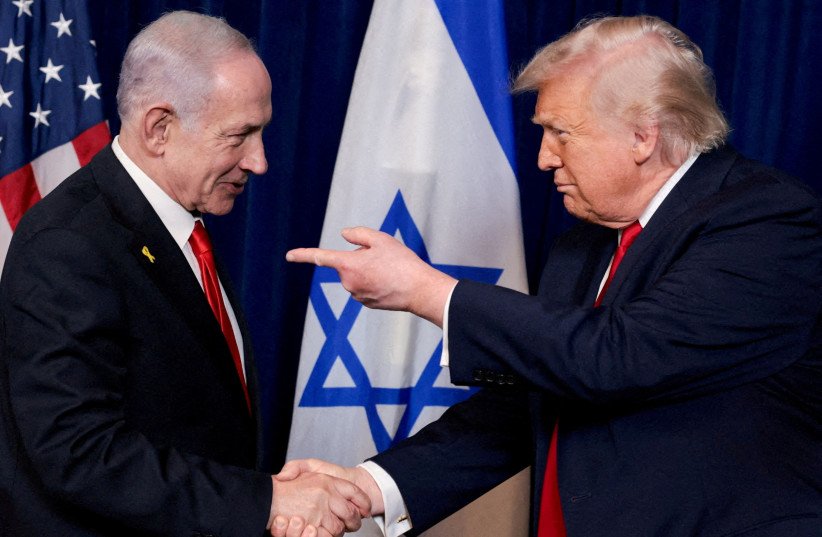
Trump has said that staying out of Israel’s October 27 election would be appropriate. He has also suggested that he might endorse someone. More recently, he shared an article highlighting a poll favorable to Prime Minister Benjamin Netanyahu’s bloc.
That may not constitute a formal endorsement, but in a close election, it is political intervention by suggestion. Our country is not a client state, an Evangelical political project, or a Trump-branded Middle Eastern property. Gaza is not an empty beachfront awaiting luxury towers, and Israel is not a corporation whose controlling shares belong to foreign patrons.
We are a sovereign democracy whose citizens bury the dead, send children to war, and live with the consequences.

Trump understands the power of uncertainty. By saying that he may endorse a candidate without naming one, he encourages every Israeli contender to seek his approval. Netanyahu can present himself as Trump’s natural partner. His challengers must assure Washington that they will protect the alliance.
Trump gains leverage before casting a single political coin. This is not merely affection for Netanyahu. Trump values loyalty, public credit, and the image of being the decisive dealmaker. He sees diplomacy through transactions, leverage, and visible victories.
That approach can produce breakthroughs, as the Abraham Accords demonstrated. But nations are communities of memory and responsibility, not properties to be acquired, redesigned, and branded.
Netanyahu understands this theater. For years, he has used photographs, speeches, and meetings with American presidents to reinforce the argument that only he can manage Israel’s most important alliance. His message is familiar: Without me, Israel will be isolated. Without me, Washington will turn away. Without me, the country is unsafe.
That is not democratic confidence. It is manufactured dependency. Israel’s future also cannot be managed by a narrow diplomatic circle embodied by Netanyahu’s longtime confidant Ron Dermer, despite his experience.
Dermer helped cultivate American and Gulf relationships. But diplomacy conducted mainly through leaders, billionaires, investment channels, and palace intermediaries leaves ordinary citizens outside the room. Israel needs institutions, public accountability and many voices, not one prime minister, one emissary, and one foreign patron.
Gadi Eisenkot’s political rise
The rise of Gadi Eisenkot exposes the weakness of that argument. Israelis themselves have presented another credible leader: a former military chief with decades of security experience, personal sacrifice, and a reputation for sobriety. Recent polling has placed Eisenkot’s Yashar Party near or ahead of Likud, and one survey showed him leading Netanyahu as the public’s preferred prime minister.
Americans do not have to support Eisenkot. Trump does not have to like him. Evangelical donors do not have to agree with every decision he may make. But they must respect the possibility that Israeli citizens, after October 7, want a different kind of leadership less theatrical, less divisive and more accountable.
Trump should promise not to endorse a candidate. American political organizations and major donors should show the same restraint. They may support Israel and advocate for their beliefs, but money, access, and presidential prestige should not select its government.
Israeli candidates must also stop campaigning as applicants for American approval. They should tell voters what they will do about security, diplomacy, living costs, national service, social inclusion, and the failures of October 7. Their mandate must come from Israelis.
The next government should protect the American alliance as a relationship between democratic nations, not political personalities. Israel worked with Biden despite disagreements. It can work with Trump without surrendering its independence. Institutional alliances endure; personality arrangements collapse.
Eisenkot should make this principle central to his campaign. He can thank Trump for his contributions, honor Evangelical friendship, and recognize Biden’s support during Israel’s crisis while stating clearly that no outside leader will receive a veto over Israeli democracy. That position is not anti-American. It is the foundation of an alliance between equals.
I write as an Ethiopian-born Israeli-American who loves both countries. America taught me the importance of constitutional government and peaceful transfers of power. Israel taught me that Jewish sovereignty carries responsibility.
Those lessons lead to the same conclusion: Friends may advise, assist, and disagree, but citizens must decide. Israel’s election belongs to the nurse in Jerusalem, the reservist returning from Gaza, the struggling family in Beersheba, the Arab teacher in Nazareth, and the Ethiopian-Israeli mother whose children serve a country that still too rarely allows her community to represent it.
My teacher, Rabbi Jonathan Sacks, z”l, expressed this principle clearly: “Whoever governs in Israel does so only under the authority delegated by God on the one hand, the people on the other.” That covenantal principle applies equally to domestic politicians and foreign benefactors. Israel’s democratic authority comes from its people, not from Mar-a-Lago, royal palaces, billionaires, or political donors.
President Trump may be Israel’s friend. Evangelical Christians may be among Israel’s most loyal supporters. President Biden and millions of Americans deserve our gratitude.
But none of them is Israel’s kingmaker. Let the citizens of Israel choose. If they choose Gadi Eisenkot, Washington should respect that decision.
Israel’s future must be decided in Jerusalem, not at Mar-a-Lago.
The writer is a former New York City Supreme Court detective, an investigator and educator in conflict resolution and restorative peace, and a moral diplomacy expert. His upcoming book, Moral Diplomacy for a Broken World, is inspired by the late Rabbi Jonathan Sacks.