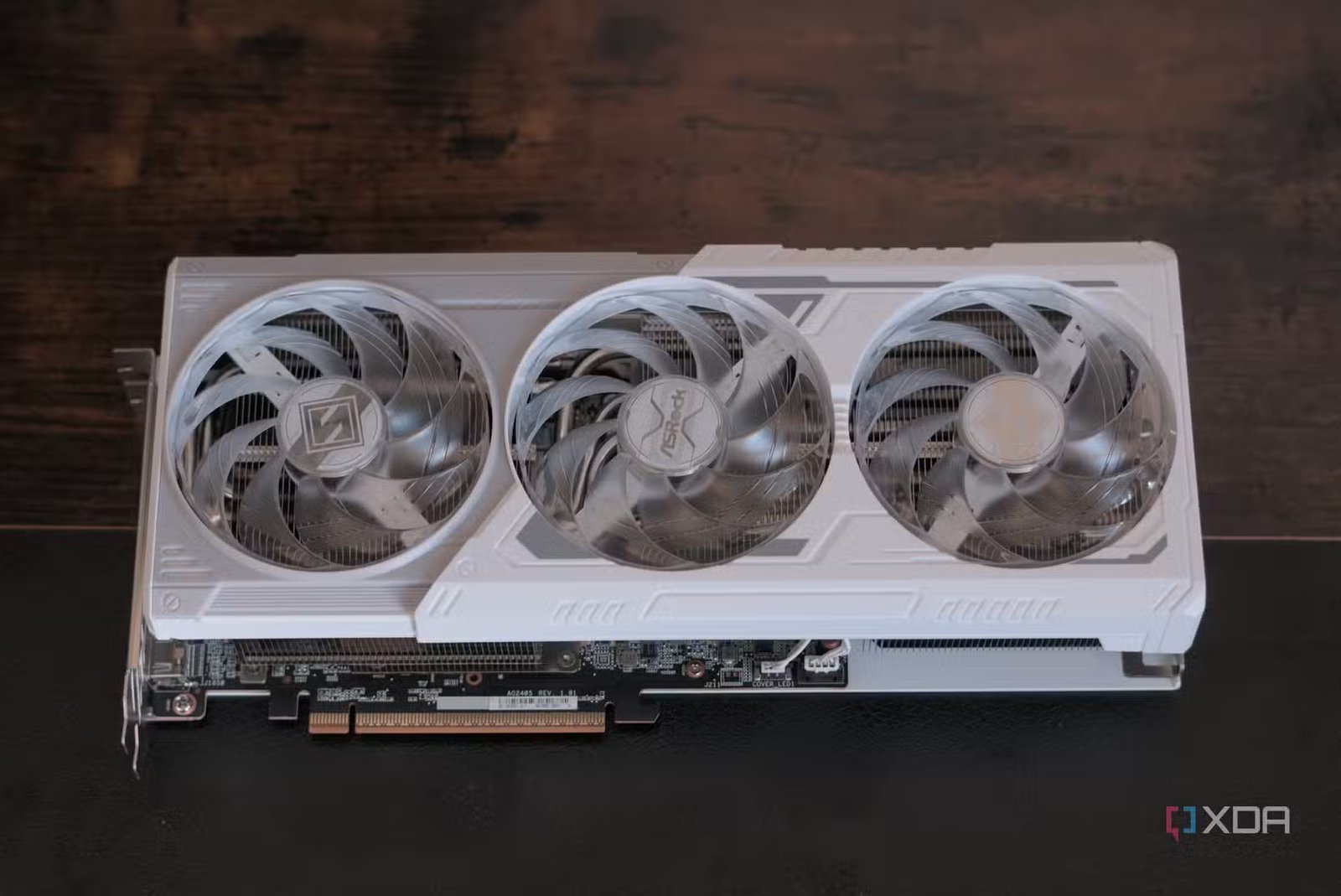
My GeForce RTX 4070 Ti Super has given me no room for complaints for about two years. It has handled both halves of my work during this time by driving my 1440p QD-OLED by delivering frame rates that justify its cost, and by running the large local models that I could’ve only dreamt of running on an 8GB graphics card. I have no plans to replace it, but if it died tomorrow and I had to buy a card for the same two jobs, I wouldn’t buy a GeForce.
Nvidia’s natural successor to my card is the RTX 5070 Ti, and the cheapest one in the US hit about $1,340 at the beginning of November. Bear in mind, that’s the same card that launched at a recommended MSRP of $749, and it now costs about $340 more than the RTX 5080’s launch price. In this dysfunctional market, though, none of the equivalent Blackwell cards retail at prices that a customer would find justifiable, and the only card that I would buy right now is the one that most would rule out for that kind of workflow without a second look.
The RX 9070 XT keeps pace with the 5070 Ti at 1440p
I wouldn’t expect it to go neck-and-neck with RTX on ray tracing, though

It wouldn’t be a fair evaluation to weigh a GPU that isn’t almost as good, if not better, than my existing 4070 Ti Super when it comes to gaming at 1440p. For their 2026 GPU hierarchy, Tom’s Hardware recently retested 48 GPUs across 11 raster and 8 ray-traced titles to see how well the consumer cards from the last three generations hold up in current games.
In terms of raw rasterization performance, the 9070 XT, for the most part, is an outright upgrade over my card, delivering an average of 12% more frames at 1440p and trailing the 5070 Ti by just 0.3 fps.
Ray tracing, of course, has always been Nvidia’s X-factor when it comes to gaming, so it’s no surprise that the 9070 XT slips here, landing 7.5% behind my card and 16% behind the 5070 Ti. However, in real-world gaming scenarios, that itself only amounts to a drop of 4.5 fps, from my card’s 60fps average to 55.5 fps across Tom’s ray tracing suite.
16GB of VRAM is what my local AI stack needs, and AMD sells it for less
The same capacity as the 5070 Ti, and the same as my own card
When it comes to local AI inference, VRAM is the metaphorical currency that determines what you can run, and memory bandwidth decides how quickly it runs. The 9070 XT, the RTX 5070 Ti, and my 4070 Ti Super all carry 16GB on a 256-bit bus, so the same models can fit comfortably on all three.
That also covers dense models in the 20B class at Q4_K_M, and with llama.cpp’s –n-cpu-moe flag, much larger mixture-of-experts models that keep some expert weights in system RAM. It’s the one trick I use to run Qwen3.6-35B-A3B at UD-IQ4_XS, which is a 35B model, on my laptop’s 8GB RTX 3070, so 16GB leaves plenty of room.
For token generation, the only place where the cards differ is bandwidth. The 5070 Ti’s GDDR7 delivers 896 GB/s, which is 40% more than the 9070 XT’s 640 GB/s of GDDR6. My 4070 Ti Super sits at 672 GB/s, so effectively the 9070 XT is within 5% of the card that I’m accustomed to running my entire local AI stack on. Besides, when a local model crawls on my machines, the reason for it is a model spilling out of VRAM, and not anything relating to bandwidth.
AMD’s AI software isn’t the catch it used to be
ROCm runs on Windows now, and Vulkan covers the rest

One of the major issues I have when I see home labbers and local AI enthusiasts generally hesitating from investing in an AMD GPU is when they argue that ROCm is in every way inferior to CUDA when it comes to local AI inference, and that an AMD card is a genuinely unfit choice for running models at home. The reason why it’s a flawed idea is the fact that it’s operating on a very dated presumption.
The idea that ROCm is unfit for local AI inference seems to be a hangover from its infancy, when getting a consumer Radeon card working meant a rabbit hole of workarounds. That hasn’t been true for well over a year. The last time it looked true was when the 9070 XT launched in March 2025, because RDNA 4 cards shipped without ROCm support during that time.
That, however, was a period that lasted less than three months, and AMD effectively closed that gap with ROCm 6.4.1 in May 2025. Right now, ROCm 7.2 is a single release for both Linux and Windows that installs alongside the Adrenalin driver, and AMD lists the 9070 XT as supported for both the HIP SDK and PyTorch on Windows.
For most of what I would personally do, though, I wouldn’t even need ROCm. Llama.cpp ships ready-made Vulkan builds for Windows, and Phoronix’s October testing revealed that its Vulkan back-end generated more tokens per second than ROCm, which only led on time to first token (TTFT).


8.5/10
- Shader Units
-
128
- Ray Accelerators/Cores
-
64
The 9070 XT covers both jobs, as long as CUDA isn’t one of them
For someone who cares only about rasterization and finds that RDNA 4 covers most of the features they care about on Nvidia’s side of the aisle, the RX 9070 XT makes a lot of sense given the current market conditions. However, it’s worth noting that some of the other miscellaneous features that I’d personally find myself missing when it comes to gaming are the DLSS overrides in the Nvidia app, which let me force the latest DLSS models into games that shipped with older versions, and RTX HDR, which turns my SDR games into HDR on my QD-OLED.
It’s also worth being honest about CUDA’s position when it comes to AI though, given the fact that it’s more mature and still has the deeper ecosystem. If your work lives in CUDA-only research code, it gives you little reason to transition to ROCm, which would introduce some unpleasant friction. For someone who self-hosts and runs their models via a runtime like Ollama or llama.cpp, though, software itself is no longer a good reason to skip a good deal on a Radeon card.