Thank you for subscribing to my posts. If you’re not yet a paying supporter, please consider becoming one. That’ll allow you to DM me with questions and comments. Your contribution will help cover the cost of the data I use in my posts, which I fund out of my own pocket. Thanks so much for your support and feedback!
When markets nosedive into the close on a Friday, that’s always ominous. Some of the worst stock market routs in history have followed this, notably Black Monday way back in 1987. Markets certainly tanked into the close on Friday and now everyone’s puffing their cheeks – me included – wondering how bad things are going to get next week.
This post outlines what I see as the three principal risk factors. First, there’s no doubt in my mind that the Fed caused last week’s sell-off, which has been building for many weeks. The root cause is that Fed rhetoric hasn’t acknowledged this month’s fall in oil prices, which has pulled down breakeven inflation and thus spiked real interest rates. Instead, what markets got was a Fed doubling down on hawkish messaging, even after the sell-off intensified this past week. Markets need a dovish pivot before the blackout starts next Saturday. Without that, things are going to get ugly. Second, when markets start to move erratically, which they did increasingly in the course of the week, risk of a credit event builds. That’s because sharp moves can blow up highly-leveraged carry trades, which are wide-spread and basically a bet volatility stays low. The blow-up of the basis trade in the Treasury market in March 2020 is the most notorious example. Third, there’s a risk we return to a “hot” war with Iran at any moment. The blockade remains in place and Iran’s attacks on Western ships continue. This kind of situation can easily escalate into all-out war, which would lift oil prices. I outlined in this post and accompanying live stream the risk from another oil price spike for gold. A ten percent spike in oil prices would drag gold down another four percent and chaotic trading conditions in the current setting could make that worse.
Here’s those three points in detail:
-
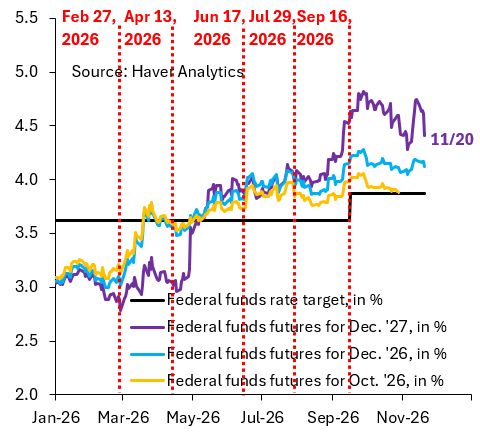
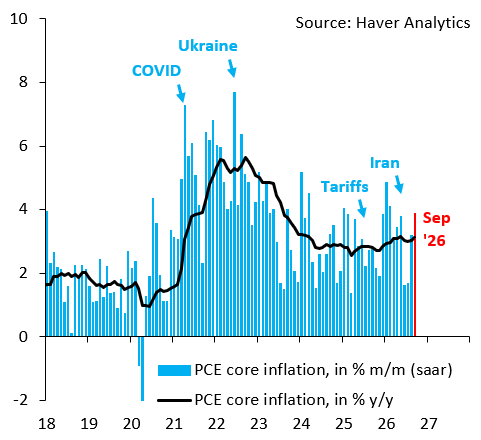
The Fed needs to do a dovish pivot: there’s no secret about what markets think needs to happen. The black line in the chart above is the Fed’s policy rate and the orange, blue and purple lines are what interest rate futures price for meetings this past October, the upcoming meeting in December and cumulatively all the way through the end of 2027. As the sell-off intensified this week, markets went from pricing almost 100 basis points in hikes through end-2027 to now nearer 50. The Fed needs to validate this dovish shift before the blackout starts on Saturday and – more importantly – provide some clarity on what’s really going on with inflation. I started yesterday’s live stream with the chart below, where the black line is year-over-year inflation and the blue bars are the corresponding month-over-month impulses. If you look between the never-ending stream of supply shocks in recent years, the monthly pace of inflation falls back to where it was before COVID. So the argument that inflation is running out of control is highly contestable. Warsh needs to come off the fence and push back on all the hawkish nonsense getting so much airtime, none of which adequately accounts for the role of supply shocks.
-
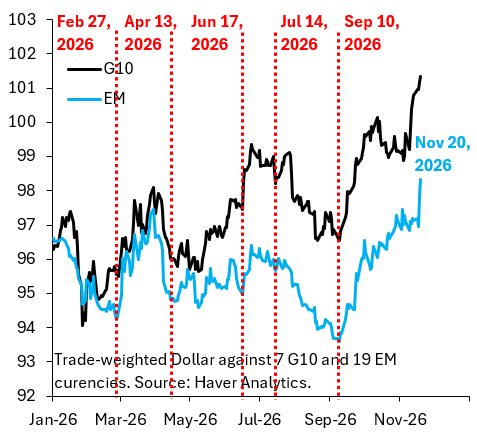
Risk of a credit event: last week saw a disorderly rise in the Dollar versus emerging markets (EM) as the blue line in the chart below shows. One of the biggest carry trades out there is to be short the Dollar and long EM currencies. The fact that the Dollar rose so sharply against EM is a sign of capitulation and liquidation in this particular carry trade. This will be happening across all carry trades out there, which are basically a bet that volatility stays low. The Fed with its backward-looking and tone-deaf hawkishness is causing this and with this – inevitably – grows the risk of a serious credit event.
-
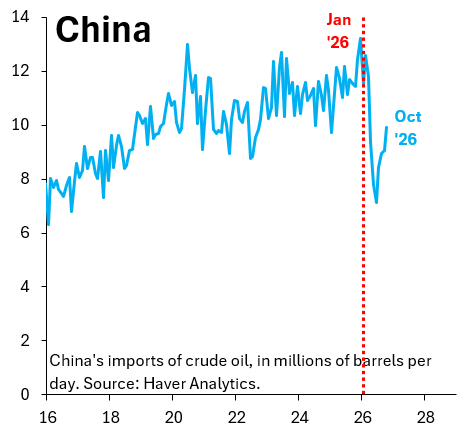
A return to “hot” war with Iran: there’s been a lot of negative chatter on the blockade in the wake of the midterms, but it remains in place and Iran’s oil exports are shut down. The easiest way to see that is to look at China’s imports of oil, which remain about two million barrels per day below pre-war levels as the chart below shows. Since China was the principal buyer of Iran’s exports of two million barrels per day before the war, this is an easy way to confirm the blockade is holding. This means Iran’s economy continues to get squeezed, which incentivizes the IRGC to keep launching attacks on Western ships. So the risk of a return to “hot” war is real and constantly in the background. Needless to say, in the current setting this could have horrendous consequences for markets.
The single biggest risk for next week is the Fed. We’ve had mounting signs of market distress for several weeks now and – instead of listening to those – Fed speakers have doubled down on their hawkish messaging. That’s no way to conduct policy and needs to be fixed with a dovish pivot ahead of the blackout that starts next Saturday.