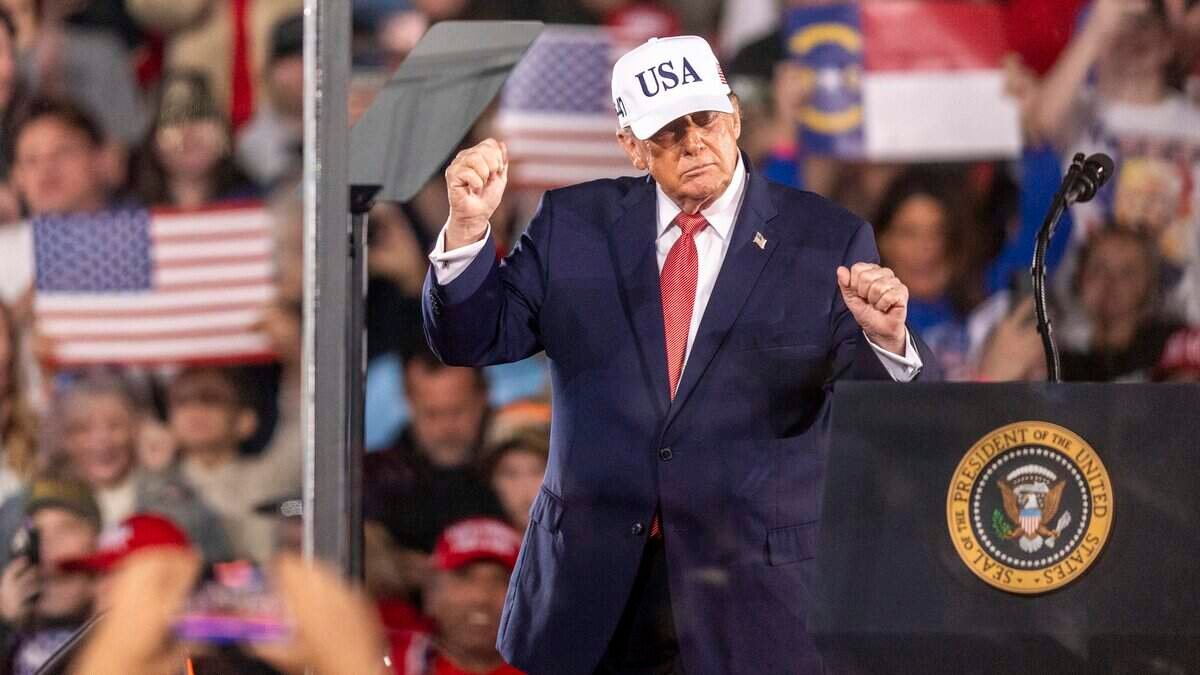
President Donald Trump dances while leaving the stage following a rally for Republican candidates at Pitt-Greenville Airport in Greenville on Tuesday afternoon, Oct. 20, 2026.
tlong@newsobserver.com
As President Donald J. Trump crisscrossed the country in rally after rally to support Republican candidates, he told voters to go to the polls thinking he was in the race.
It looks as if a lot of them did in North Carolina — and that’s why they voted for Democrats.
“He’s very much on the ballot, even if they say he’s not,” said Linda Sue Hall, a Morrisville resident and onetime independent voter who now supports only Democrats. “I don’t think there is a disassociation between a local Republican and a truehearted supporter of Trump.”
The first thing many voters in the state’s two largest population centers in Raleigh and Charlotte said in talking with McClatchy reporters wasn’t how much they liked or hated a candidate on the ballot, it was how much they hated what Trump had done since retaking the White House.
The war with Iran that pushed up gasoline prices. The tariffs. His name on the Kennedy Center. The lies and insults.
Although some voters said they were casting ballots for Republicans, few of them said anything about the rest of the candidates, be they Republican or Democrat.
Kim Brooks, 72, a Democrat and a semiretired painter in Graham, the Alamance County seat, voted for Trump in 2024, he said.
“Kamala Harris didn’t say anything I wanted to hear,” Brooks said.
This time, he voted a straight Democratic ticket.
“Just too much corruption in the White House as far as Republicans,” he said. “Everybody’s struggling. Food, drink, everything’s going up.”
That meant Brooks, who had voted for Trump only in 2024, was now voting against Republicans who hold seats in Congress and the state legislature. They include U.S. Rep. Richard Hudson, state Sen. Amy Galey and state Rep. Dennis Riddell.
Blue wave materializes
Signs of a stronger-than-expected blue wave were showing shortly after polls closed Tuesday. Former Gov. Roy Cooper was won the race for North Carolina’s open Senate seat over former Republican National Committee Chairman Michael Whatley, marking the first time since 2008 that the state has elected a Democrat to the Senate.
Democrats also showed unexpected gains in other North Carolina congressional races. In Western North Carolina, Democrat Jamie Ager secured a win over Republican Jennifer Balkcom, flipping a U.S. House seat that has been a GOP stronghold for over a decade.
In the 13th Congressional District, which covers much of the Raleigh suburbs, Democrat Paul Ballinger was slightly ahead of incumbent Republican Brad Knott as of 11:45 p.m. Incumbent Republican Richard Hudson was also fighting for his political life against Democrat Richard Ojeda II in the 9th Congressional District.
The victories and tight contests may have been driven by independents and swing voters, several of whom spoke with McClatchy reporters and said they were leaning toward Democrats after years of splitting their ballots.
Anthony Hinton, a lifelong Southeast Raleigh resident, said he “stepped away” from politics for a few years before this election, voting for a mix of Republicans and Democrats in the 2024 election. Though he hadn’t voted for Trump before, Hinton said the president’s theatrics pushed him toward Democrats this year.
“Why vote for somebody who uses you as a pawn, and when he doesn’t win, he gets mad and sabotages people?” Hinton said. “Nothing he says is a reality. Watching him is like watching your favorite movie, you know?”
Vincent Karuza, an unaffiliated voter from Charlotte, said he was “voting out of obligation” for Democrats, though he thinks both are “horrible.”
“All I’m really hoping for is obstructing what the Trump administration is trying to accomplish overall,” he said. “With the war, commitments to sending as much to Israel as possible, and the way ICE (Immigration and Customs Enforcement) is being run.”
Shifting the balance of power
Democrats, too, said they were motivated to try to shift the balance of power away from the president.
John Lynch, 69, a computer engineer in Durham and a Democrat, said his top goal in voting was swinging Congress away from Trump.
“Trump’s come out stronger in his second term and so this is the first chance for voters to react to that,” Lynch said. “Putting his name on everything that he can find to put his name on and chiming in on everything under the sun. I don’t think any other president in our history has tried to put their name on as many things as he has.”
Terri Blake and her brother Clinton, both retirees in Durham and Democrats, also immediately brought up Trump. Terri called him “that fool at 1600 Pennsylvania Ave.”
“There’s no such thing as a Republican Party anymore,” she said. “It’s MAGA in control and that is a dangerous situation.”
Still, Republicans turned out in North Carolina’s suburbs. Some expressed frustration with their party, but they said handing government’s reins to Democrats would be far worse. Others said they feared Democrats would revive past policies that Trump has reversed, such as increasing immigration.
Donnie Howell, 67, a Republican and textile worker from Graham, voted straight Republican.
“It’s sort of like the lesser of two evils,” he said. “Whoever is in control, both of them drag us down, but it seems like the Republicans do have Christian values and I don’t see that on the Democrat side.”
A voter from Willow Springs, who identified herself only as Jennifer, said she voted mainly for Republicans, but felt as if she was picking from “the best of bad options.” Cultural issues drove her vote, she said.
“You can have compassion for someone and still not support it, like with illegal immigration, or trans(gender) issues,” she said.
Joanna Orsini, a Morrisville resident who voted for Republicans, said, “In the last 15 years, I’ve seen a radical change in our society, and I’m extremely disturbed. I have young grandchildren, great grandchildren, and I hope they’d still be living in a free America when they grow up.”

Lily Carey is the environment and climate change reporter for The News & Observer. She covers environmental issues, extreme weather, the energy industry and more in the Triangle and Eastern North Carolina.
Dan Kane began working for The News & Observer in 1997. He covered local government, higher education and the state legislature before joining the investigative team in 2009.