Key Points
2026 hasn’t been the best year for Nvidia (NASDAQ: NVDA). While it’s up 13% versus 11% from the S&P 500 (SNPINDEX: ^GSPC), Nvidia investors don’t expect market-beating performance; they expect market-crushing performance. When you look at Nvidia’s results, it’s easy to see it should be doing better, as it grew revenue at 106% in the second quarter (Q2).
Over the long term, company growth and stock performance tend to be highly correlated, so what’s up with the disconnect? I believe it’s just the market lagging behind, and history tells us that right now is an incredible buying opportunity.
Missed Nvidia in 2009? This Rare Signal Is Flashing Again. In 2009, a “Double Down” signal flashed for a little-known chipmaker called Nvidia. For the first time in years, that same “Total Conviction” signal is flashing for a company 1/100th the size of Nvidia. Continue »
Nvidia is trading at a major discount
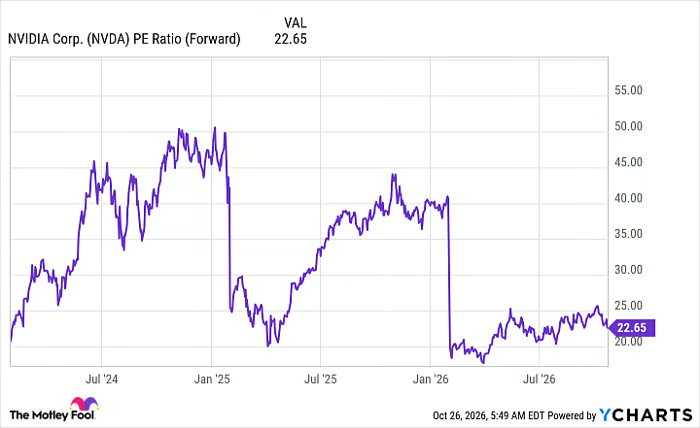
The best way to value Nvidia from a current and historical perspective is to utilize the forward price-to-earnings (P/E) ratio. This metric uses analysts’ estimates for the full fiscal year to price the stock, so it bakes in some growth. At the start of a fiscal year, these measures tend to look pretty cheap, as there is a full year’s worth of growth ahead. When you get halfway through the fiscal year (Q3 results aren’t available yet), this starts to become a more conservative estimate, as only six months of growth are projected. So, sometimes stocks start to look a tad expensive toward the end of the year.
In both 2024 and 2025, Nvidia’s stock reached 40 times forward earnings before the year was over. That’s not the case this year.
NVDA PE Ratio (Forward) data by YCharts.
At just under 23 times forward earnings, Nvidia hasn’t seen the end-of-year rally it normally does. This raises the question of why, and I think it’s simply because the market is trying to call Nvidia’s bluff (even if it’s wrong). The S&P 500 trades at about 19.2 times forward earnings, so Nvidia trades at only a slight premium to the broader market. This is essentially the market conveying that after this year, it expects market-average growth from Nvidia.
But according to Nvidia and Wall Street analysts, that’s a gross error. Nvidia itself told investors during its Q2earnings callthat it expects 70% revenue growth next year. It’s rare for a company to provide next-year guidance six months before the year begins, but it shows the confidence Nvidia has in its future growth. This is likely because many of its clients have locked in orders for next year, giving it high visibility of what’s to come. Wall Street analysts are also bullish, expecting 68% revenue growth next fiscal year.
All of this adds up to a company that will deliver excellent growth next year, which should result in huge returns.
Nvidia has major upside
If we value Nvidia’s stock using next fiscal year’s estimates, the stock trades for just 13.3 times earnings.
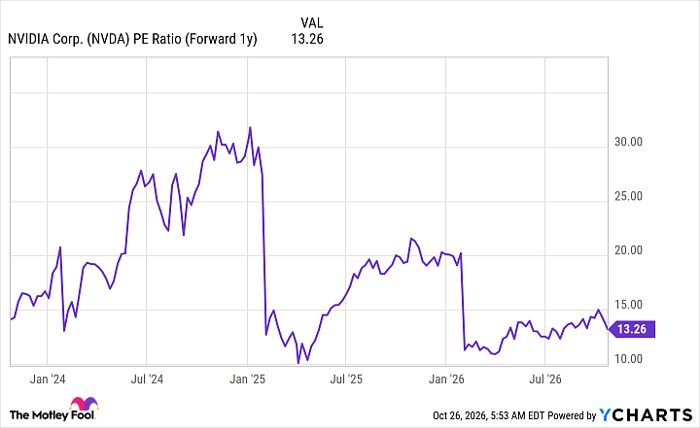
NVDA PE Ratio (Forward 1y) data by YCharts.
So, if Nvidia hits all projections and the stock doubles, that means it would only trade for 26 times trailing earnings. That’s a reasonable price tag for a company of Nvidia’s stature and pedigree, so expecting the stock to rise significantly over the next year isn’t out of the question. As a result, I think the historical record is pretty clear that the future is bright for Nvidia.
But that’s just 2027. Beyond 2027, there’s a broad expectation for the AI build-out to last through at least 2030, giving Nvidia even more time to capitalize on a generational growth opportunity. There are few better buys in the market than Nvidia right now, and investors shouldn’t wait around too long; now is the time to strike.
Should you buy stock in Nvidia right now?
Before you buy stock in Nvidia, consider this:
The Motley Fool Stock Advisor analyst team just identified what they believe are the 10 best stocks for investors to buy now… and Nvidia wasn’t one of them. The 10 stocks that made the cut could produce monster returns in the coming years.
Consider when Netflix made this list on December 17, 2004… if you invested $1,000 at the time of our recommendation, you’d have $334,793!* Or when Nvidia made this list on April 15, 2005… if you invested $1,000 at the time of our recommendation, you’d have $1,257,420!*
Now, it’s worth noting Stock Advisor’s total average return is 874% — a market-crushing outperformance compared to 209% for the S&P 500. Don’t miss the latest top 10 list, available with Stock Advisor, and join an investing community built by individual investors for individual investors.
*Stock Advisor returns as of November 1, 2026.
Keithen Drury has positions in Nvidia. The Motley Fool has positions in and recommends Nvidia. The Motley Fool has a disclosure policy.