
Quick overview
- Gold (XAU/USD) is trading at approximately $4,180.55, having risen after breaking above a descending trendline and reclaiming short-term moving averages.
- The U.S. dollar has weakened slightly, and markets are pricing in a 17% probability of a rate hike in October, while December’s probability remains high at 83%.
- Institutional demand for gold ETFs has surged, with record inflows in September, indicating strong portfolio demand despite rising Treasury yields.
- China continues to increase its gold reserves, marking the 23rd consecutive month of growth, which supports the structural demand for gold.
Gold (XAU/USD) is currently trading at about $4,180.55, having risen after reclaiming the short-term moving averages and breaking above a descending trendline. The U.S. dollar has weakened slightly, along with a decrease in Treasury yields. This has slightly improved the fundamental backdrop for gold. Markets have priced in only about a 17% probability of a rate hike in October. Although, the probability of a December hike is about 83%.
I am moderately bullish on the near term outlook of gold, as it currently trades above the trendline and support at $4,179. The next area of resistance is at $4,227.37. ETF inflows, along with Chinese buying, have been providing a better structural backdrop.
October Fed Pause Looks Increasingly Likely
A softening in the expected timing of the next U.S. Federal Reserve rate increase has supported gold, with the odds of a hike at the October 27-28 FOMC meeting falling to 17%, suggesting a more dovish sentiment, at least in the short-term.
However, it is important to note that while the odds of a hike in October have diminished, the odds of a hike in December have remained high at 83%, meaning the market is pushing the expected next hike further out as opposed to fully removing it. That removal of some of the immediate pressure is providing a better backdrop for gold.
Musalem Keeps December Risk Alive
St. Louis Fed President, Alberto Musalem, said that further policy restraint would be required to bring inflation back down to the Fed’s target of 2% and reinforce longer-term tightening risks.
Musalem stopped short of saying an October hike was necessary and instead struck a tone that reflected current market expectations. However, Musalem’s comments suggest that the Fed is not yet at the point where they feel they can officially say inflation is no longer a risk. This makes December very much in play, and for the time being, the improvement in the gold price is very much reliant on whether yields continue to decline.
Labor Market Gives the Fed Room to Wait
Current trends in the labor market indicate that the Fed can likely remain on the sidelines regarding further tightening. September’s increase in non-farm payrolls was very disappointing, with only 29K new jobs added. At the same time, weekly initial jobless claims fell to 197K, while continuing claims rose to about 1.72 million.
This combination is consistent with weaker hiring and the absence of a broad-based wave of layoffs. From the Feds perspective, this paves the way for a pause in October. For gold, this is a better scenario compared to last month, when a strong jobs report and higher inflationary expectations resulted in a sharp increase in rate hike expectations.
ETF Demand Is Becoming a Major Bullish Pillar
The most important structural trend continues to be institutional demand. In September, global, physically-backed, gold ETFs added approximately $10 billion (67 tonnes) bringing total holdings to a record high of 4,256 tonnes.
Third quarter ETF inflows hit a record $31 billion with holdings increasing by 211 tonnes. The inflows were made despite a rising 10-year US Treasury yield and a stronger U.S. Dollar.
This leaves me to believe that, for a good portion of investors, gold is not just a simple rates trade. Amidst restrictive financial conditions, portfolio demand remains strong.
China Extends Its Buying Streak
China is another important element of the gold story. For a 23rd consecutive month, September showed the People’s Bank of China increasing its official gold reserves to 77.47 million fine troy ounces from 76.73 million ounces in August.
September’s increase of 740,000 ounces (about 23.0 tonnes) supports the view that China’s gold buying is structural.
Central Banks Still See Gold as a Strategic Asset
The ongoing trend among central banks is constructive for gold. While it is expected that central bank demand would slow to around 720 metric tons in 2026 compared to 2025, it is expected that the levels would be much higher compared to before 2022.
Comments by central bankers during the LBMA conference reinforced gold’s role as a reserve diversifier due to rising government debt, geopolitical division and fragmentation as well as sovereign credit risk.
Lower Oil Reduces Some Inflation Pressure
Geopolitical risk eased a little when President Trump said there would be no U.S. attack on Iran before the midterm elections, which pushed oil prices down.
This is a mixed development for bullion. Lower geopolitical risk may decrease safe-haven demand for bullion, but lower oil prices alleviate some inflation risk and make an immediate Fed hike less likely. In the present situation, the rates effect may dominate the haven effect, and therefore lower oil prices may be beneficial for bullion.
Gold Technical Analysis: $4,227 Is the Next Breakout Test
Gold is currently trading at $4,180.55 on the 1-hour chart after pushing above the descending trend line and both the 20 and 50 SMA. What is important to note is that this is the first meaningful improvement in the technical structure in a few days, and that also includes the retaking of the $4,179 area.
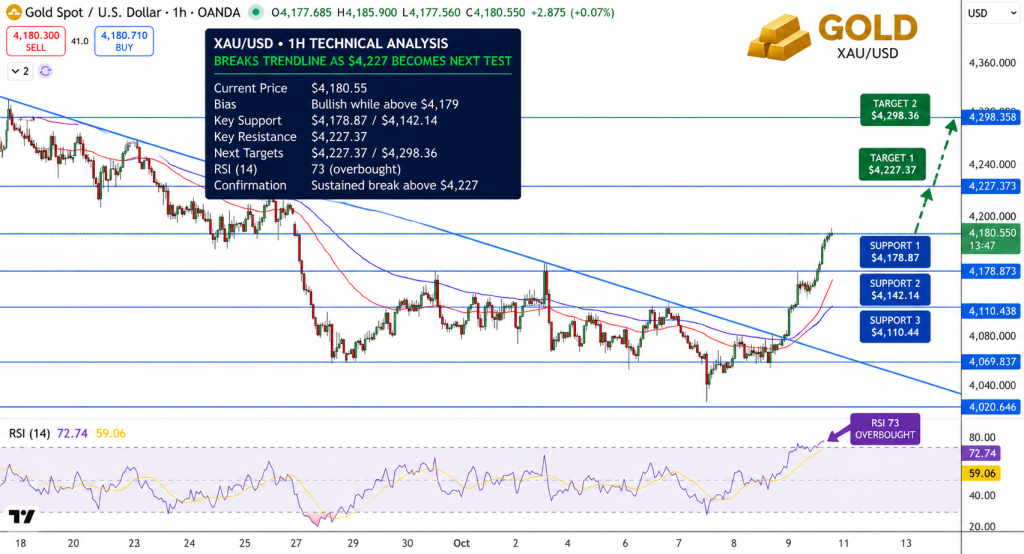
First, I’m looking for resistance at the $4,227.37 area. Should price break above, then look for resistance at $4,298.36. The $4,178.87 area is now the first support, with $4,142.14 and $4,110.44 coming into play with a breakdown and a loss of the $4,179 area and the broken trendline.
RSI is around the 73 level, and is well above its signal line around the 59 area, and is showing the bulls are in control. I will remain bullish as long as gold trades above the $4,179 area and the descending trendline. I’d also look for a break below $4,142 to negate the bullish breakout, and above $4,227 to support the bulls for a move to the $4,298 area.
Resistance: : $4,227, $4,298
Support: $4,179, $4,142, $4,110
Frequently Asked Questions
Why is gold stronger today?
Softer Treasury yields and a weaker USD, as well as decreased expectations for near-term Fed rate hikes, have helped support gold. Demand for gold ETFs and central banks’ gold purchasing continue to reinforce gold.
Is the Fed still a risk for gold?
Yes. While October looks increasingly like a pause, markets still assign a high probability for a December hike.
What is the key XAU/USD breakout level?
Resistance is seen at $4,227.37. A break above that level opens the way to $4,298.36.

Arslan Ali Butt
Lead Markets Analyst – Multi-Asset (FX, Commodities, Crypto)
Arslan Ali Butt serves as the Lead Commodities and Indices Analyst, bringing a wealth of expertise to the field. With an MBA in Behavioral Finance and active progress towards a Ph.D., Arslan possesses a deep understanding of market dynamics.
His professional journey includes a significant role as a senior analyst at a leading brokerage firm, complementing his extensive experience as a market analyst and day trader. Adept in educating others, Arslan has a commendable track record as an instructor and public speaker.
His incisive analyses, particularly within the realms of cryptocurrency and forex markets, are showcased across esteemed financial publications such as ForexCrunch, InsideBitcoins, and EconomyWatch, solidifying his reputation in the financial community.