RBI Gold Falls in forex reserves drops below 14% after price correction
India’s gold reserves have witnessed a significant decline in their share of the country’s foreign exchange reserves, falling below 14% as international gold prices corrected sharply from their January 2026 record high.
The latest data highlight an important development in India’s reserve composition. Interestingly, the Reserve Bank of India (RBI) has not significantly reduced its physical gold holdings. Instead, the decline largely reflects the impact of falling gold prices on the overall valuation of its reserves.
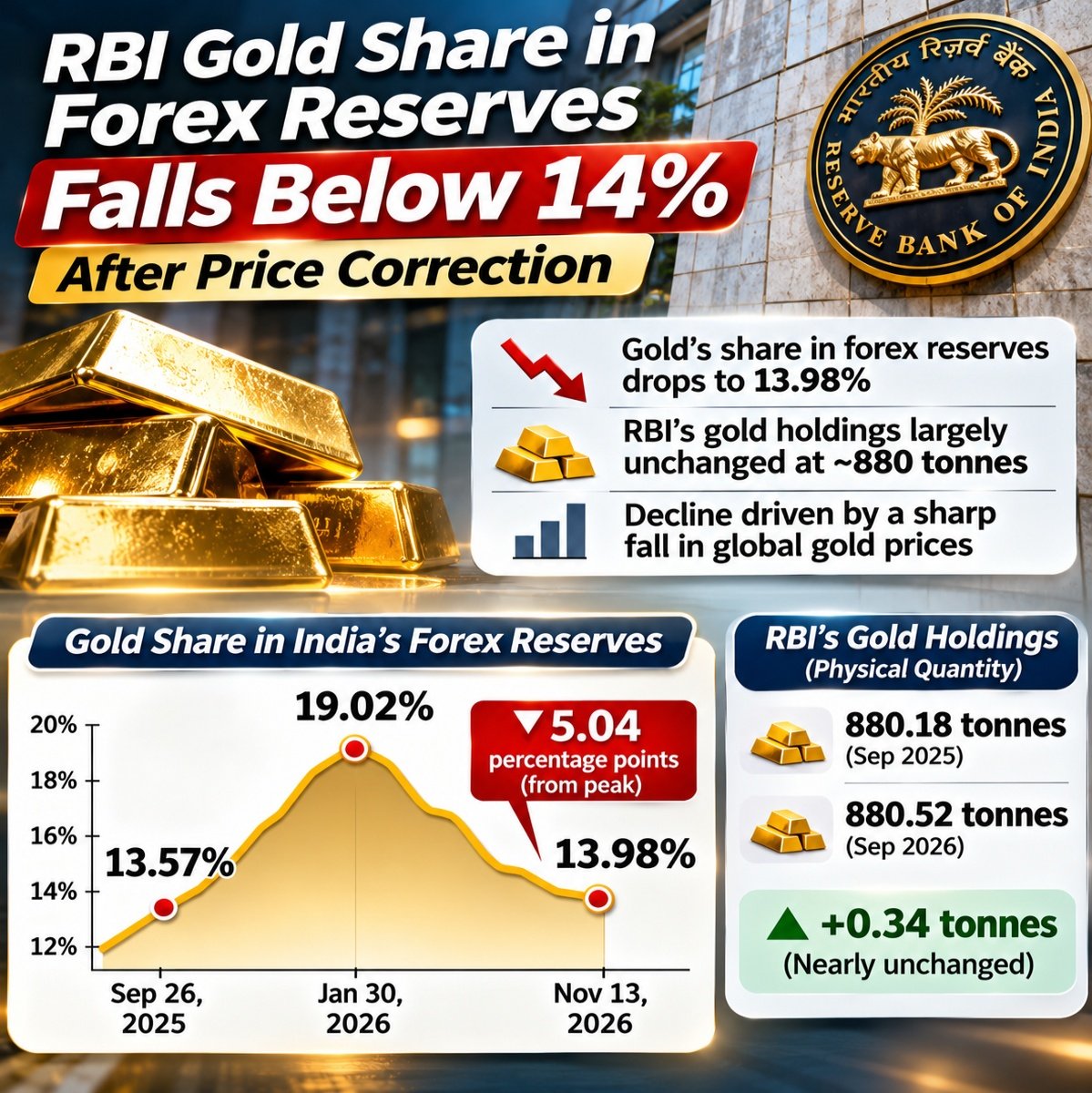
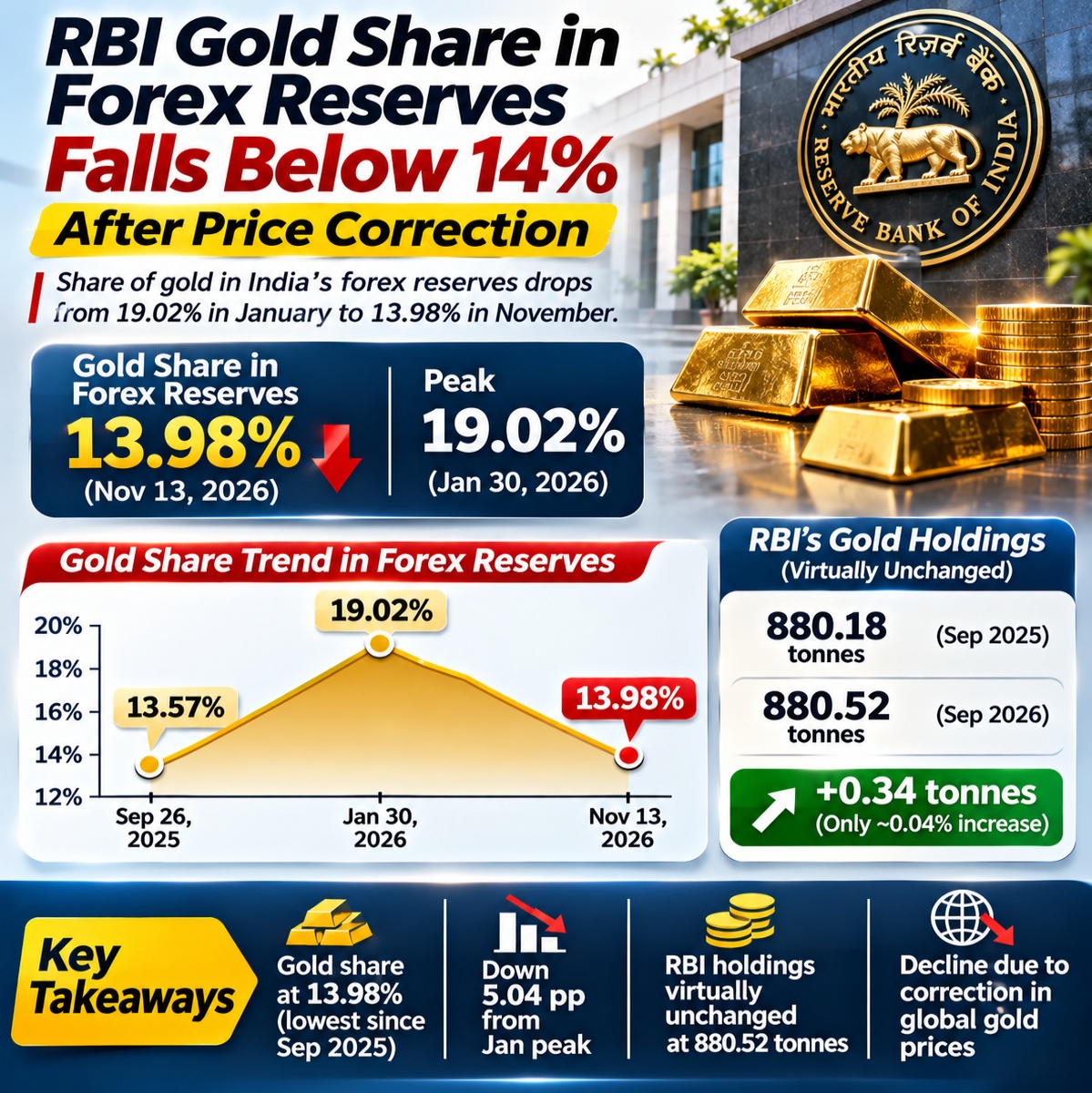
According to Businessline’s analysis of RBI data, gold accounted for 13.98% of India’s foreign exchange reserves as of November 13, 2026, marking its lowest share since September 26, 2025.
Track Live : NSE Commodity Option Chain — Live MCX Options Data for Crude Oil, Gold, Silver & More
RBI gold holdings remain virtually unchanged despite falling valuation
The latest figures indicate that the RBI’s physical gold holdings have remained almost unchanged over the past year.
| Period | RBI gold holdings |
|---|---|
| End-September 2025 | 880.18 tonnes |
| End-September 2026 | 880.52 tonnes |
| Net increase | 0.34 tonnes |
The RBI’s gold holdings increased by just 0.34 tonnes during this period.
This suggests that the reduction in gold’s share of forex reserves is primarily linked to valuation changes rather than a substantial reduction in the quantity of gold held by the central bank.
In simple terms, the RBI continues to hold almost the same quantity of gold, but the decline in its international market price has reduced its contribution to the overall value of India’s reserves.
RBI gold share falls from 19.02% to 13.98%: Key details
Gold’s contribution to India’s foreign exchange reserves increased sharply during the rally in international bullion prices.
It reached 19.02% at the end of January 2026 before declining over subsequent months.
| Date | Gold’s share in forex reserves |
|---|---|
| September 26, 2025 | 13.57% |
| January 30, 2026 | 19.02% |
| March 31, 2026 | 16.70% |
| September 30, 2026 | 14.38% |
| November 13, 2026 | 13.98% |
The decline from January’s peak to November 13 represents a contraction of 5.04 percentage points.
Track Live : Nifty Levels Today | Sensex Levels Today | Bank Nifty Levels Today
Why did gold’s share in India’s forex reserves decline?
The main reason is the correction in international gold prices after the metal reached a record high in January 2026.
Gold prices faced pressure from several global developments:
-
Rising US Treasury yields increased the opportunity cost of holding non-interest-bearing gold.
-
A stronger US dollar made gold more expensive for buyers using other currencies.
-
Expectations of tighter US monetary policy weighed on bullion demand.
-
Profit booking followed the sharp rally in gold prices.
-
Changes in the valuation of other foreign exchange reserve assets also influenced gold’s overall share.
The RBI’s half-yearly report noted that international gold prices averaged around $4,721 per troy ounce in April 2026 before easing to approximately $4,319 in September, a decline of around 9%.
Gold prices fall sharply from January’s record high
The correction in international bullion prices has been the biggest factor behind the decline in gold’s contribution to India’s reserves.
After reaching a record high of approximately $5,595 per ounce in January 2026, gold prices experienced a substantial correction.
The RBI’s own half-yearly report also highlights the decline in average international prices during April–September 2026.
Important gold-price movements
| Particulars | Gold price |
|---|---|
| January 2026 record high | Approximately $5,595 per ounce |
| April 2026 average | Approximately $4,721 per ounce |
| September 2026 average | Approximately $4,319 per ounce |
| April–September decline | Approximately 9% |
Why falling international gold prices matter for India’s forex reserves
Gold prices had climbed to a record high in January 2026 before entering a substantial correction.
When international gold prices increase, the market value of a central bank’s gold holdings rises, potentially increasing gold’s share in total foreign exchange reserves.
The reverse happens when prices decline.
Therefore, even without significant changes in physical holdings, fluctuations in global bullion prices can alter the composition and reported value of a country’s foreign exchange reserves.
For India, this highlights the importance of monitoring both physical gold accumulation and international gold price movements.
Track Live : NSE Option Chain — Live | BSE Option Chain — Live Sensex & Bankex Options Data Today
RBI moves 60 tonnes of gold from overseas vaults to India
Another important development is that the RBI has continued bringing its gold reserves back to domestic vaults.
During April–September 2026, the central bank shifted approximately 60.08 tonnes of gold from overseas storage to India.
This increased the proportion of its gold reserves held domestically to approximately 84%.
Where does the RBI store its gold?
| Storage location | March 2026 | September 2026 |
|---|---|---|
| Domestic vaults | 680.05 tonnes | 740.13 tonnes |
| Bank of England and BIS | 197.67 tonnes | 140.39 tonnes |
| Gold deposits | 2.80 tonnes | — |
| Total gold holdings | 880.52 tonnes | 880.52 tonnes |
The domestic share of RBI’s gold holdings increased from approximately 77.2% at the end of March 2026 to 84.05% at the end of September 2026.
Read More : SEBI Pre-IPO Proposal: Could the Grey Market Get a Regulated Alternative as India Hits 6,700+ Listed Firms?
India’s total foreign exchange reserves stood at $705.34 billion on November 13
The RBI’s November 20 Weekly Statistical Supplement provides the latest reserve figures available for November 13.
India’s total foreign exchange reserves stood at $705.34 billion, while gold reserves were valued at $98.61 billion.
This puts gold’s contribution at approximately 13.98%.
RBI foreign exchange reserves: November 13, 2026
| Reserve component | Value |
|---|---|
| Total foreign exchange reserves | $705.34 billion |
| Foreign currency assets | $583.45 billion |
| Gold reserves | $98.61 billion |
| Special Drawing Rights (SDRs) | $18.52 billion |
| Reserve position in IMF | $4.76 billion |
RBI is not aggressively increasing gold purchases despite global central-bank demand
Another interesting development is the difference between the RBI’s gold strategy and purchases by some other central banks.
According to the World Gold Council data cited by The Indian Express, global central banks purchased approximately 228 tonnes of gold on a net basis during 2026, while the RBI had not reported net purchases during the year up to the latest available data.
Poland and China were among the leading buyers.
| Particulars | Details |
|---|---|
| RBI gold holdings | 880.52 tonnes |
| RBI net gold purchases in 2026 | Zero, according to cited WGC data |
| Global central-bank net purchases in 2026 | 228 tonnes |
| RBI’s domestic storage share | Approximately 84% |
| RBI’s overseas gold holdings | 140.39 tonnes |
What does the decline mean for investors and the Indian economy?
For investors, the decline in gold’s share of India’s forex reserves should not automatically be interpreted as a signal that the RBI is losing confidence in gold.
The physical holdings have remained virtually stable, suggesting that the recent change is largely valuation-driven.
The development also highlights how international gold prices influence central bank balance sheets and reserve composition.
Investors tracking gold ETFs, sovereign gold exposure and bullion markets should therefore distinguish between changes in gold prices and actual changes in central bank holdings.
A decline in the RBI’s gold share does not, by itself, indicate a change in its broader reserve-management strategy.
Track Live : NSE F&O Lot Size | FII DII Data Today
Here’s what happened today and why investors are watching
Gold’s share in India’s forex reserves increased substantially during the final months of 2025 and the beginning of 2026.
The share climbed from 13.57% on September 26, 2025, to a peak of 19.02% on January 30, 2026.
However, the subsequent correction in international gold prices reversed much of that increase.
By November 13, 2026, gold’s share had fallen to 13.98%, representing a decline of 5.04 percentage points from its January peak.
This development is significant because gold valuation directly influences the reported composition of India’s foreign exchange reserves, even when the RBI does not actively buy or sell the metal.
What should investors watch next?
The next important indicators will be international gold prices, RBI gold holdings and changes in the overall foreign exchange reserve composition.
A recovery in global bullion prices could increase gold’s share again, even without additional purchases by the RBI.
Conversely, continued weakness in gold could keep its contribution to India’s forex reserves under pressure.