
NEW YORK — General Motors plans to lean into artificial intelligence and vehicle software for future growth and development amid increasing competition abroad from Chinese automakers and a tougher U.S. market.
The Detroit automaker on Wednesday shared new details about a proprietary AI agent it’s releasing under its OnStar brand, plans for a fourth generation of more efficient all-electric vehicles and a target to cut its vehicle development time in half.
GM also reconfirmed that by 2028, it wants to have eyes-off highway driving, or “personal autonomy,” that will let drivers take their attention off the road. The automaker said that technology would start with the Cadillac Escalade IQ EV before rolling out to other, more high-volume models.
“All of these developments are building us the car of the future,” CEO Mary Barra said Wednesday during an event laying out the plans, called “GM Forward,” in downtown Manhattan.
The initiatives, which Barra, Chief Product Officer Sterling Anderson and other executives discussed at the event, are designed to streamline the automaker’s operations, while also improving the capabilities of its vehicles for customers.
“Over the last 12 months, we’ve evolved how we design, engineer and build our vehicles,” said Anderson, who led the event and who has been tasked with overseeing GM’s latest technology transformation.
GM said it is now targeting a vehicle development time of roughly two years from concept to production versus a traditional four- to five-year cycle. However, the company did not detail a timeline for reaching that goal.
The event comes as Chinese automakers are growing outside of the U.S. with rapid development times of new technologies and vehicles. Consulting firm AlixPartners said it believes China is currently bringing vehicles to market twice as fast as traditional automakers, with 40% to 50% less investment and a 30% cost advantage.
GM also continues to play catch-up to U.S. EV leader Tesla when it comes to delivering technology advancements through over-the-air updates and automated driving capabilities.
Anderson, a former Tesla executive, declined to speak specifically about how GM’s technologies will compare to the EV maker, but said GM’s systems will be able to visualize, or see, more things through the use of multiple types of sensors than a strictly camera-based system, which Tesla uses.
He also said the rapid development and new software architecture will help the company better compete against Chinese automakers abroad.
“There’s inherent virtue to speed,” Anderson told CNBC during an interview after the event. “Not just in being able to get a car out faster, it’s being able to develop a system that’s far more performant that you could have otherwise.”
Next-generation vehicles
GM said Wednesday it has major plans for its next generation of EVs and traditional vehicles with internal combustion engines.
The company said those coming vehicles — regardless of type — will have 40 times the computing power and up to 50% faster cellular connectivity than prior systems.
That computing power is expected to help the automaker with over-the-air updates, onboard diagnostics and AI, as well as other technologies such as automated driving features.
The new brain of the vehicle will launch on the $130,000 Cadillac Escalade IQ EV in 2028 before rolling out to other models, including its next generation of EVs.
CEO and Chair of General Motors Mary Barra delivers a speech during the brand’s annual technology event in New York on Oct. 21, 2026.
Charly Triballeau | AFP | Getty Images
GM said the forthcoming EVs are expected to be 25% more aerodynamic and 15% lighter and feature electric motors and battery packs that are more compact.
GM President Mark Reuss said despite lackluster consumer adoption and the automaker pulling back billions of dollars in investments in EVs, it remains committed to producing them.
“We continue to develop our future EVs and work to reduce battery costs,” Reuss said during the event. “And when the U.S. market is ready for EVs in large numbers, we will be there for them.”
AI development
GM expects to achieve such targets through the use of AI in research and development.
The company said it is developing a “new operating approach for vehicle development” that leans into enterprise AI and virtualization to increase speed.
“This concurrent engineering model allows us to innovate faster, improve continuously, and scale new technologies across our lineup with incredible agility,” the company said in a release.
From left, GM CEO Mary Barra, Chief Product Officer Sterling Anderson and President Mark Reuss at the company’s GM Forward event in downtown Manhattan on Oct. 21, 2026.
Michael Wayland | CNBC
GM used the development of its next-generation vehicles, including a new battery chemistry, as an example of how the new technologies are reshaping its vehicle development.
The company said it virtually tested more than 300,000 battery designs using its recently announced lithium manganese rich battery chemistry, or LMR, before building a single physical prototype.
Anderson said Wednesday that LMR will be the exclusive battery tech for its fourth-generation EVs. GM had previously said it wanted to use those batteries in full-size electric vehicles such as its Chevrolet Silverado and Escalade IQ beginning in 2028.
Anderson said GM is uniquely positioned to use AI compared to other automotive companies because of its more than 100 years in the industry as well as 30 years of OnStar.
“In the age of AI, data is currency,” Anderson said. “For decades, GM’s engineering, manufacturing and product teams have generated unparalleled body of data that we’re now using to build industry-leading AI tools.”
In-vehicle AI
The company is building on its internal use of AI to better shape its experiences for customers.
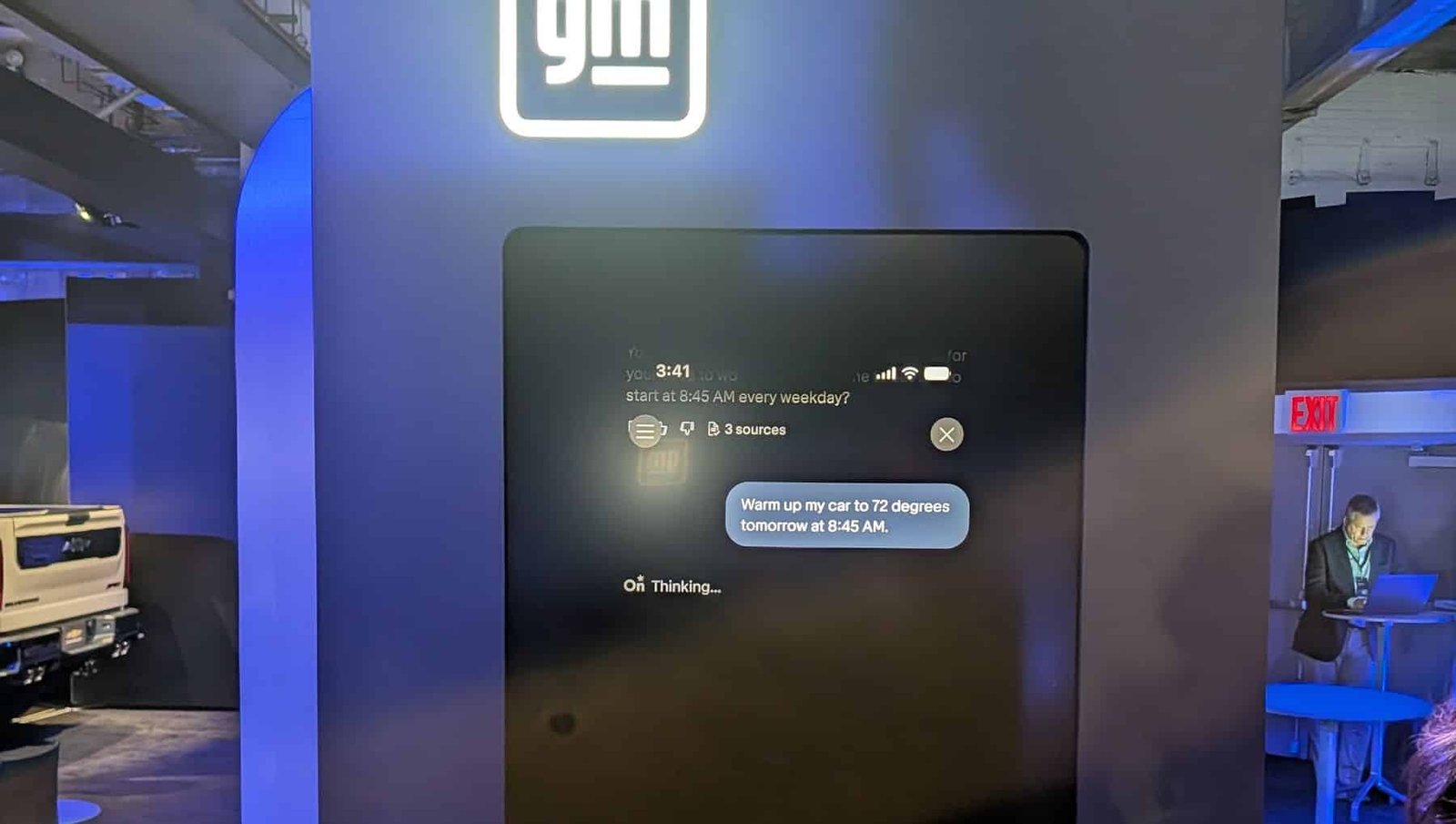
GM on Wednesday reconfirmed that it plans to launch a proprietary in-vehicle AI assistant through its OnStar technology brand.
The OnStar AI assistant is expected to launch in the coming months on the 2027 Cadillac Lyriq EV through an over-the-air update before expanding to other models.
GM currently uses Google’s Gemini for its in-vehicle AI assistant. The company told CNBC earlier this year that the GM-developed AI will be more integrated with the vehicle.
The goal for OnStar AI, which will be available through a subscription, is to help customers be productive while in the car, especially if the vehicle has self-driving capabilities that don’t require the driver or passengers to monitor the system.
GM on Wednesday also reiterated its plans to launch eyes-off highway driving in 2028. The automaker said a year ago that it wanted to launch that technology. It’s been five years since Barra said she expected the automaker to offer personal autonomous vehicles this decade.
“Our vision is that eventually every vehicle should drive itself or its occupants anywhere, and we’re investing across the self-driving stack to make that real,” Anderson said.