
Quick overview
- This week’s earnings calendar features major companies like TSMC, UnitedHealth, JPMorgan Chase, Goldman Sachs, and Morgan Stanley, focusing on semiconductor demand, healthcare performance, and U.S. banking health.
- Investors are advised to look beyond headline earnings to assess revenue growth, margins, and management guidance, as strong results may not boost share prices if valuations are already high.
- Key reports include TSMC’s insights on chip demand, UnitedHealth’s medical cost trends, and JPMorgan’s updates on consumer resilience and economic conditions.
- In the forex market, gold prices experienced volatility, while the USD/JPY pair saw significant swings influenced by U.S. yield differentials and Japanese capital outflows.
Live BTC/USD Chart
BTC/USD

Taiwan Semiconductor Manufacturing Company (TSMC), UnitedHealth, JPMorgan Chase, Goldman Sachs and Morgan Stanley headline this week’s earnings calendar, with investors watching semiconductor demand, healthcare performance and the health of the U.S. financial sector.
Earnings Calendar Highlights This Week
This week’s earnings calendar puts semiconductor demand, healthcare costs and U.S. banking profitability under the spotlight. TSMC could influence sentiment across technology stocks, while JPMorgan, Goldman Sachs and Morgan Stanley may provide a clearer picture of financial-sector strength. UnitedHealth’s medical-cost trends will also be important.
Investors should look beyond headline earnings and focus on revenue growth, margins, management guidance and forward expectations. Even strong results may fail to lift share prices if valuations already reflect optimistic forecasts or companies issue weaker-than-expected outlooks.
Key Earnings Reports
- – Taiwan Semiconductor Manufacturing Company (TSM)
- – Reporting period: Q3 2026
- – Timing: Before Market Open (BMO)
- – Key focus: Investors will assess chip demand, production capacity, margins and capital expenditure. TSMC’s results could provide insight into semiconductor demand and whether elevated infrastructure spending is translating into sustainable revenue growth.
- – Market significance: The company’s outlook may influence sentiment across semiconductor stocks and the broader technology sector.
– UnitedHealth Group (UNH)
- – Reporting period: Q3 2026
- – Timing: Before Market Open (BMO)
- – Key focus: Investors will monitor medical costs, insurance membership, earnings growth and the performance of its healthcare services business.
- – Market significance: Any signs of rising medical expenses or weaker profitability could affect sentiment toward health insurers.
– JPMorgan Chase (JPM)
- – Reporting period: Q3 2026
- – Timing: Before Market Open (BMO)
- – Key focus: Traders will look for updates on net interest income, loan growth, investment banking, credit quality and provisions for potential loan losses.
- – Market significance: As one of the largest U.S. banks, JPMorgan’s results could offer insight into consumer resilience and broader economic conditions.
– Goldman Sachs (GS)
- – Reporting period: Q3 2026
- – Timing: Before Market Open (BMO)
- – Key focus: Investors will focus on trading revenue, investment banking fees, dealmaking activity and asset management performance.
- – Market significance: The results could reveal whether stronger capital-market activity is supporting earnings or whether market volatility and subdued dealmaking remain obstacles.
– Morgan Stanley (MS)
- – Reporting period: Q3 2026
- – Timing: Before Market Open (BMO)
- – Key focus: Wealth management revenue, client assets, trading performance and investment banking activity will be important indicators.
- – Market significance: Investors will assess whether recurring wealth management income can offset fluctuations in trading and dealmaking revenue.
Forex Signals Update
Gold Capped by the 20 SMA
Gold prices experienced a volatile trading week, ultimately finishing significantly lower after an initially strong rally lost momentum. The precious metal climbed above $4,300 early in the week but later reversed sharply, ending nearly $100 below its recent highs as investors reassessed the outlook for interest rates and global risk sentiment.
The decline was largely driven by a stronger U.S. dollar, rising Treasury yields, and reduced demand for defensive assets following positive geopolitical developments in the Middle East. Despite the weakness, gold remains above the critical $4,000 support zone, which continues to define the longer-term bullish trend but it is under attack.
MAs Hold as Support for USD/JPY
Foreign exchange markets saw sharp swings. Early in the week, U.S. yield differentials and Japanese capital outflows pushed the dollar above ¥150, but disappointing U.S. jobs data triggered profit-taking, causing the USD/JPY to slide by four yen from its peak. However, the new BOJ governor the JPY has weakened and USD/JPY soared to 154 and we decided to close our buy signal for more than 80 pips as the pair found support at the 20 daily SMA (gray) and has rebounded more than 200 pips off that MA but reversed after the 25 bps rate cut from the FED. The price climbed to $164 but reversed after the BOJ meeting and fell 7 cents, breaking below the 100 daily SMA (red) as well, which has been acting as support before.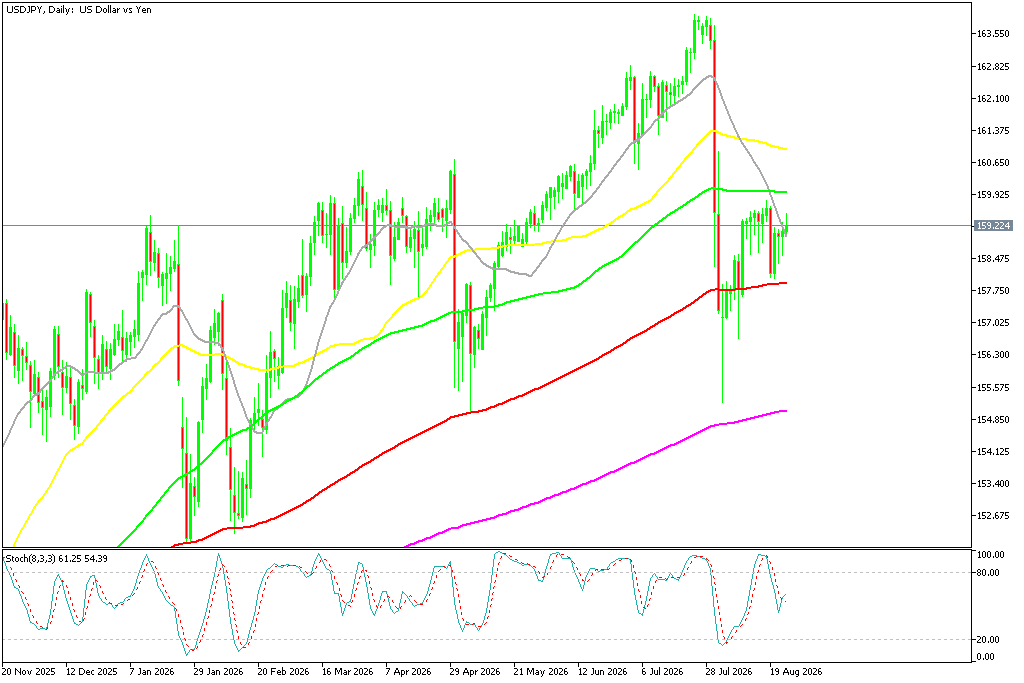
USD/JPY – Daily Chart
Cryptocurrency Update
Bitcoin Faces the 100 SMA as Resistance
Cryptocurrencies remained highly active over the summer. Bitcoin (BTC) climbed to fresh highs of $123,000 and $124,000 in July and August, supported by institutional inflows and technical strength. However, remarks from Treasury Secretary Scott Bessent ruling out U.S. increases to BTC reserves triggered a steep pullback, sending the coin down to $80K before finding support at the 100 weekly SMA (green) which might turn into resistance at 90K now, after the rebound.
BTC/USD – Daily Chart
Ethereum Returns Above $2,000
Ethereum (ETH) has been similarly strong, surging toward $4,800, its highest since 2021 and near its all-time peak of $4,860. Despite a dip last week, ETH found support at the 20-day SMA, with retail enthusiasm and renewed institutional participation driving fresh upside momentum. Last week we saw a dive below $2,000 but buyers returned and pushed the price above $2K again.
ETH/USD – Weekly Chart

Skerdian Meta
Lead Analyst
Skerdian Meta Lead Analyst.
Skerdian is a professional Forex trader and a market analyst. He has been actively engaged in market analysis for the past 11 years. Before becoming our head analyst, Skerdian served as a trader and market analyst in Saxo Bank’s local branch, Aksioner. Skerdian specialized in experimenting with developing models and hands-on trading. Skerdian has a masters degree in finance and investment.