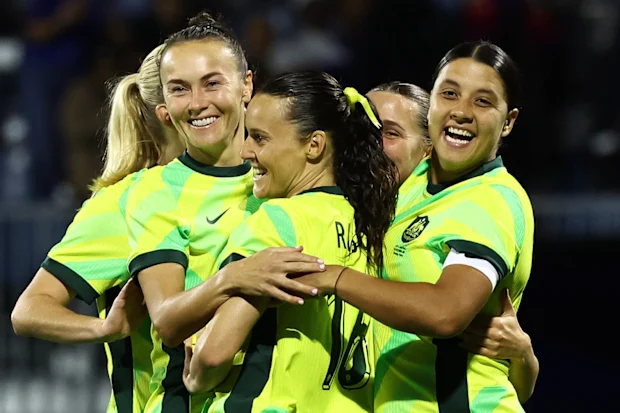
The final auditions for Australia’s World Cup team are now underway, with eight months before Joe Montemurro picks his squad to board the plane for Brazil and important questions still to be answered despite a thumping finish to this international window.
After a disappointing 4-2 defeat to Germany, the next generation of Matildas made the most of their chances and rallied together to beat Haiti 7-1.

Australia’s World Cup stars led the younger generation to victory. Getty Images for Football Australia
Players will take the lessons from this international window back to club land for now, before returning with the goal to level up in the next international break. Here is what coach Montemurro and the Matildas learned this international window.
Stacked schedule is hurting international football
It is an issue that seems to hurt every nation in the international break – players in the top leagues are becoming fatigued due to the demands of the club schedule.
Of the 24 players named by Montemurro for the Germany and Haiti games, six do not play football in the UK or Europe, meaning they only play domestically.
The rest of the squad is spread across varied leagues in the UK and Europe, with most featuring in at least two tournaments with their respective club teams.
The likes of Mary Fowler, Steph Catley, Caitlin Foord and Ellie Carpenter feature in the WSL, FA Cup and Champions League with their club teams.
Balancing those three tournaments alone is hard enough on a player’s body at club level, let alone adding the pressure and intensity of international football.
As a result, Fowler was a late withdrawal from the squad as she opted to fly home and spend time with her partner, Nathan Cleary, who is recovering from double surgery to fix broken bones in both legs.
Catley departed camp a day before facing Haiti as per Australia’s agreement with Arsenal, who wanted to ensure she maintained a manageable workload, while Foord lined up to play the full 90 minutes in both games.
Carpenter was left as an unused substitute against Haiti, while Alanna Kennedy, Katrina Gorry, Tameka Yallop, Kyra Cooney-Cross and Jada Whyman also missed the thrashing due to injury or personal reasons.
Add on the fact that Australia’s stars are frequently making the long haul trip back home from the UK and Europe, questions about their rest and recovery are a constant.
But it means that Montemurro is left with little time to implement formations and strategies with his players due to key stars needing to be managed.
In fact, he only has four more windows to work out how to do exactly how to handle the 2027 World Cup in Brazil.

Clare Wheeler looks for a pass. Getty Images for Football Australia
The gap between the bench and starting XI
There is no hiding that Australia is due to go through a transitional period over the next 12 months, with a number of big names in the twilight of their careers.
Sam Kerr has led the national team as captain for the past seven years, Catley has been a long-time defensive leader and served as vice-captain and Foord has nailed on starter in the forward line for over a decade.
The trio are all signed on to play until the end of 2028 at club level, with Kerr contracted with Gotham FC in the NWSL until December 2030. But there are still question marks about who will replace them when they finish up with the Matildas.
The gap between their skill level and those on the bench has in the past been noticeable, with little pressure on experienced stars to hold their starting role.
But Montemurro’s formation trial against Haiti showed that gap is slowly closing, with Australia’s upcoming midfielders challenging the established stars.
Clare Wheeler has shown why she should start in the midfield, making the most of Fowler, Kyra Cooney-Cross, Alanna Kennedy and Katrina Gorry’s absences.
Wheeler set up the opening goal for the match before playing a vital role in defence, which earned her praise from the Paramount+ commentary team.
“I’ve seen enough from Clare Wheeler – she has to hold down that spot,” former Matilda Grace Gill said. “I think Clare Wheeler deserves that spot.”
The experience of playing in the English second division with Nottingham Forest has paid off for Leticia McKenna and Alana Murphy, with the young pair stepping up alongside Wheeler to show what they are capable of.
While they did not get minutes against a higher ranked opponent like Germany, their confidence and skill is a promising sign for Montemurro going forward.
The defensive unit has plenty of options in terms of young talent for Montemurro to work with going forward, including Charli Grant, Wini Heatley and Jamilla Rankin.

Matildas coach Joe Montemurro during the Haiti friendly. Getty Images for Football Australia
The biggest question mark Montemurro will need to resolve is the forward line, with few young guns making their mark.
While that is not a major issue heading into the World Cup, it will be a position he will need to look for more depth in going forward.
Then comes the debate around who should be our starting goalkeeper; Mackenzie Arnold, the standout player at the World Cup, or the in-form Teagan Micah.
Ongoing concussion issues for Micah turned the attention away from that debate in this window, but it will undoubtedly arise in the next window in December.
Montemurro has kept quiet on which way he will lean come the World Cup.
The world’s best are still a level above Australia
The Matildas captured the hearts of the nation with their impressive run at a home World Cup, finishing the tournament in high spirits and in fourth place after falling to a 2-0 defeat against current world No.8 Sweden.

Caitlin Foord is challenged by Germany. Getty Images
It was no surprise to see Spain and England in the 2023 World Cup final as they are both football powerhouses and sit in first and fourth respectively on the world rankings in the men’s and women’s leagues.
As 2023 eventually proved, Australia is not quite at the same level as the world’s best.
Germany gave Australia a blunt reality check last week, with experienced stars reminded not to become complacent or too comfortable on the pitch.
The reminder will be beneficial for the Matildas heading into a World Cup year, with Germany a perfect example of how fast you can rebuild after being exposed.
The Germans travelled to Australia in 2023 as the world No.6 but failed to get out of the group stage – a first for the nation at football’s pinnacle tournament.
A review of their shocking exit resulted in a new coach being appointed, Christian Wück, and the team has since held a 10-month unbeaten record.
Only four nations in the top 10 in the world rankings have yet to qualify for next year’s World Cup, with England (No.4) and Sweden (No.8) competing in UEFA’s qualifying games, while Canada and the USA are waiting for the CONCACAF qualifiers to start.
The lessons from the Germany defeat will be vital for Montemurro, who will learn Australia’s group opponents on December 11 when the draw is unveiled in Brazil.
Until then, he will be focused on taking on the aggressive Colombian attack in the next international window.