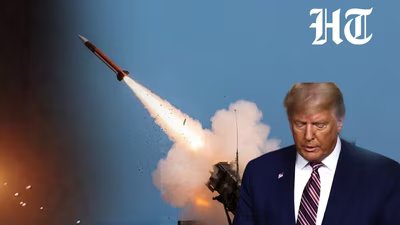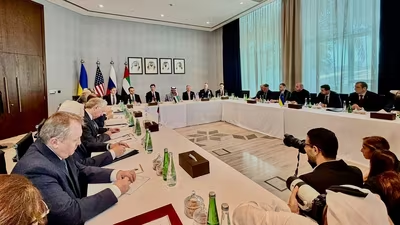
National security advisers from the European Union and five major powers — Germany, France, the UK, Italy and Poland — will represent Europe in upcoming Russia-Ukraine talks, according to a senior European official.
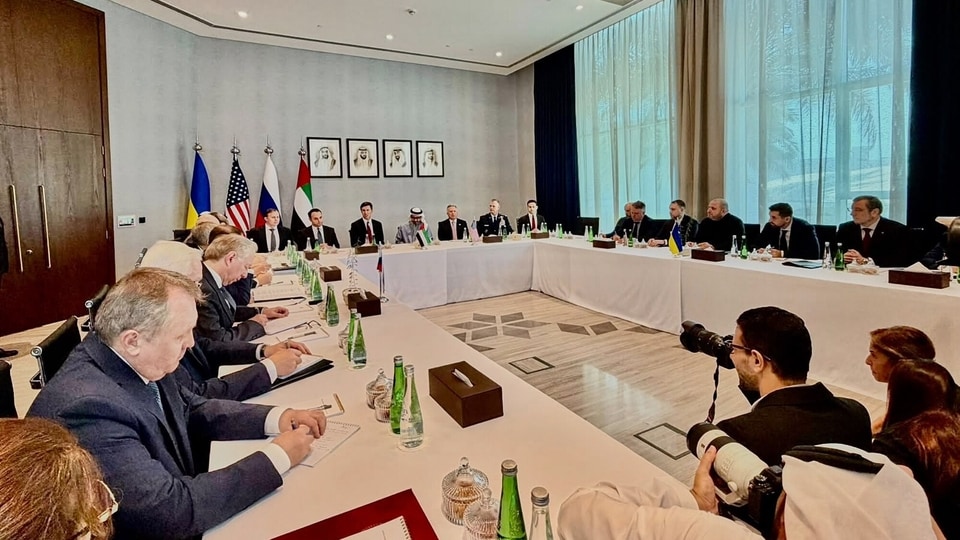
European leaders made the decision after summits on Thursday and Friday in Dublin, where support for Ukraine dominated the agenda.
Also read: Putin warns sending European troops to Ukraine after a peace deal could restart war
Ahead of the summit, Ukrainian President Volodymyr Zelenskyy urged European leaders to appoint envoys for renewed US-lead peace talks between Russia and Ukraine.
He said Russia had become more open to having Europe at the table nearly five years into Moscow’s all-out war on Ukraine. But Europe has long struggled to decide who should speak for the continent in any peace negotiations.
Also read: US envoys meet Zelensky after Putin signals no compromise
The advisers will participate in any future technical-level conversations, the official said, speaking anonymously to describe the decision. Europe has still yet to appoint any leaders to represent it in talks.
A spokesperson for the European Commission, the EU’s executive arm, said leaders would address the issue in an upcoming press conference.
EU struggles for united voice in Ukraine peace talks as US, Russia lead push
As European leaders gathered in central Dublin for back-to-back summits this week, the real action took place at a military airfield on the western edge of the Irish capital.
President Donald Trump’s two main envoys made a pit stop at Casement Aerodrome late Thursday to brief Ukrainian President Volodymyr Zelenskyy on their latest round of talks in Abu Dhabi and Moscow to end Russia’s war.
European Union leaders — who at first bickered over who would greet the Americans — dispatched a gaggle of senior security officials, who were also briefed by the delegates. They were absent from the main talks.
The spectacle of the EU scrambling for a seat at the table while the US and Russia revive sputtering efforts to end the war — the next step is Trump’s expected meeting in China next week with Vladimir Putin and Xi Jinping — lays bare the bloc’s struggle to coalesce around a policy that affects its own security.
“It’s extremely important that we have a united European voice,” Swedish Prime Minister Ulf Kristersson told reporters on Friday. “I’m very afraid of a situation where countries think they have an obligation to talk to Russia. That multitude of voices could absolutely profit Russia.”
The multitude was on display in Dublin. Germany, France and the UK — known as the E3 — variously sought to hold the reins over who talks for Europe. The so-called Berlin Group, which adds a flank of other governments, met separately. The EU institutions, the European Commission and European Council, claimed the mantle for themselves.
In the end, leaders designated the negotiating role to a group of national security advisers from the E3 plus Italy and Poland — the E5 — as well as the institutions. The team of seven designates will represent Europe in technical talks.
“Europe must speak with one clear and united voice,” Council President Antonio Costa, who chairs the meetings, said at the close of the summit.
Still, the debate dominated part of the two days of meetings and raised the risk that it could inflict damage on the EU, according to an official familiar with exchanges taking place behind closed doors.
Several leaders sought to shift the discussion to more substantive issues, warning that it’s precisely the kind of division that plays into Putin’s hands.
“The substance of any peace agreement is as important as who represents Europe,” Irish Prime Minister Micheal Martin said on his way into the meeting on Friday. “Europe needs to be very clear in terms of what would constitute a sustainable peace for the continent.”
Fears that Europe would be bullied into accepting Russian demands for changes to the continent’s security dynamic were potentially allayed in the new US diplomatic push.
“We cannot conclude this deal without the Europeans being at the table,” Jared Kushner, Trump’s son-in-law, told reporters at the airbase Thursday, offering an olive branch to the region.
Some leaders rejected the notion that Europe was getting stuck in the minutiae while global decisions were happening elsewhere. EU chiefs spent most of their time discussing the substantive issues, officials said, ranging from the continent’s security to how to fund Ukraine in 2027.
“From my point of view, there is currently no need to conduct an institutional debate,” German Chancellor Friedrich Merz told reporters Friday.
But other leaders were aware of the optics.
“This chaos is our own fault,” Slovenian Prime Minister Janez Jansa.
And despite the attendance of high-profile figures like UK Prime Minister Andy Burnham and Canada’s premier, Mark Carney, several EU leaders skipped the summit because of domestic turmoil. Premiers Pedro Sanchez of Spain, Rob Jetten of the Netherlands and Bart de Wever of Belgium all opted to tend to their wobbling or outgoing governments.
Local reporters repeatedly asked leaders whether the European Political Community — the format that drew some 50 leaders on Thursday — was a “talking shop” ill-equipped to tackle big issues. On Friday EU leaders met for an informal summit, where no official decisions can be made.
And despite efforts to patch up divisions and produce a negotiating team, leaders were left with anxiety that American diplomacy with other big powers would again leave the EU on the sidelines.
Merz warned that next week’s meeting between Trump and Putin during the Asia-Pacific Economic Cooperation summit in Shenzhen could be a “second Anchorage moment,” a reference to the August 2025 meeting in Alaska, where Trump rolled out a red carpet for Putin for talks that yielded little.
“I therefore want to state our message to the US very clearly once again: please, no surprises,” Merz said in Dublin. “Continue to play as part of ‘Team Europe’ and as part of the team alongside Ukraine — and let us work together toward a genuine peace in Ukraine.”