
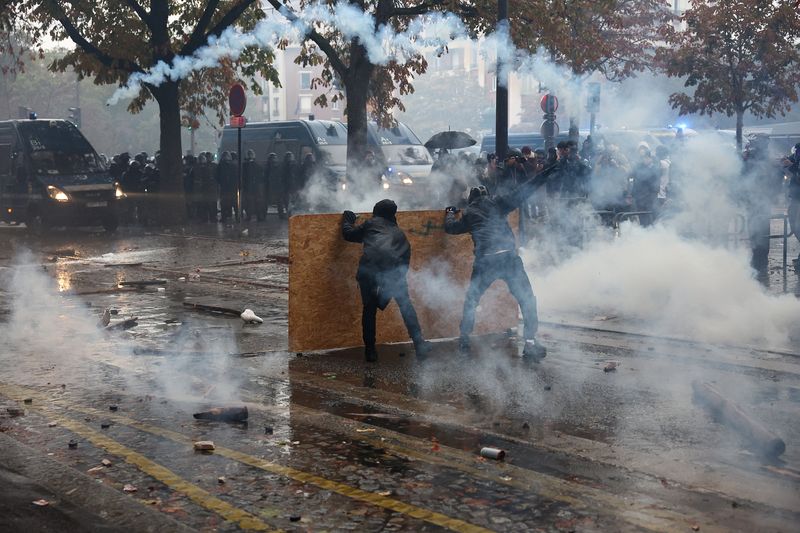
[Financial News] Large-scale protests against rising prices and deteriorating educational conditions have once again rocked France. Violent clashes between protesters and police broke out during demonstrations over the weekend, and nearly 1,000 people were arrested.
According to foreign media including Euronews on the 25th (local time), France’s Interior Ministry announced that about 410,000 people took part in the protests, while labor groups put the turnout at about 800,000.
The protests appeared largely peaceful, but violence erupted as night fell in major cities including Paris, Marseille, Bordeaux and Lyon.
In Paris, after a march from Porte d’Italie to Porte de Vincennes ended, some masked protesters set up barricades and threw projectiles at police. Police moved in to disperse them with tear gas and water cannon trucks, and even deployed counterterrorism special forces.
French Interior Minister Laurent Nuñez said, “Thousands of radical activists gathered behind the protesters, including around 500 people classified as rioters,” adding, “At least two people were seriously injured in Toulouse, Clermont-Ferrand and elsewhere, and the number of arrests will continue to rise.”
In Marseille, trash bins were engulfed in flames and roads were blocked. In Bordeaux and Lyon, standoffs with police continued, with shop display racks smashed and barricades erected.
To prevent a repeat of last week’s major unrest, in which around 2,000 shops were damaged and about 2,500 people were arrested, the French government deployed 7,000 police officers nationwide and imposed nighttime curfews in major cities. Tourist attractions such as the Louvre in Paris closed, and many shops boarded up their windows with plywood to guard against looting.
French President Emmanuel Macron said that only demonstrations organized by authorized labor unions would be permitted.
The unrest has emerged as the biggest wild card in France’s presidential election, which is six months away, and opposition candidates are focusing their attacks on the Macron government’s poor governance.
The protests appear to be spreading beyond France across Europe. On the same day, large demonstrations against government economic policies and rising prices, along with clashes with police, took place in Tirana, Albania; Brussels, Belgium; and Milan, Italy, among other cities.
In Rome, hundreds of students held a peaceful march through the streets, emphasizing that they were not rioters. Authorities closed off streets lined with luxury shops in central Rome and increased patrols around downtown landmarks, but there was an attempt to storm the Colosseum. Clashes broke out in Piazza della Repubblica as police moved to disperse the protest with batons and shields, and water cannons were also deployed.
Around 100 people were arrested in Barcelona, Spain, amid looting and arson. Catalonia’s interior minister said that 25% of the arrested protesters were minors.
In Portugal, where protests broke out over housing issues, police dismantled tents set up in the capital, Lisbon, and arrested some people; minor injuries were also reported. Portugal’s housing crisis is among the most severe in Europe: both home prices and rents have doubled since 2017, hitting young people hard. Residents oppose the government’s efforts both to make forced evictions easier and to scrap rent caps on new rental agreements. According to statistics from the Bank of Portugal, the country has a shortage of about 300,000 homes.[email protected] Yoon Jae-joon Reporter

