Want to bookmark your favourite articles and stories to read or reference later? Start your Independent Membership today.
Already a member?
Log in
The British government’s benefits system was hacked, officials have confirmed, as western nations scramble to defend their digital infrastructure from a wave of cyber attacks.
Officials at the Department for Work and Pensions, which manages Britain’s £340 billion welfare state, were forced to take services offline “as a precaution” on Friday as they scrambled to investigate a cyber incident.
On Saturday, it was confirmed their systems had been the subject of a cyber attack.
“Alongside the National Cyber Security Centre and Government Cyber Co-ordination Centre, we are working to understand the cause of an attempt to gain unauthorised access to our systems,” a spokesperson for the department said.
“The DWP has well-rehearsed plans for these scenarios, which were immediately implemented.”
The confirmation came after the UK’s former chief technology officer said he strongly suspected it was a cyber attack.
It follows a string of incidents targeting other major organisations this week, including the US Treasury, the CIA and Fifa, stoking fears about cyber resilience in the age of AI on both sides of the Atlantic.
No 10 said work was being carried out “as quickly as possible” after millions of people were left unable to access accounts or apply for benefits online, but services remained offline on Saturday.
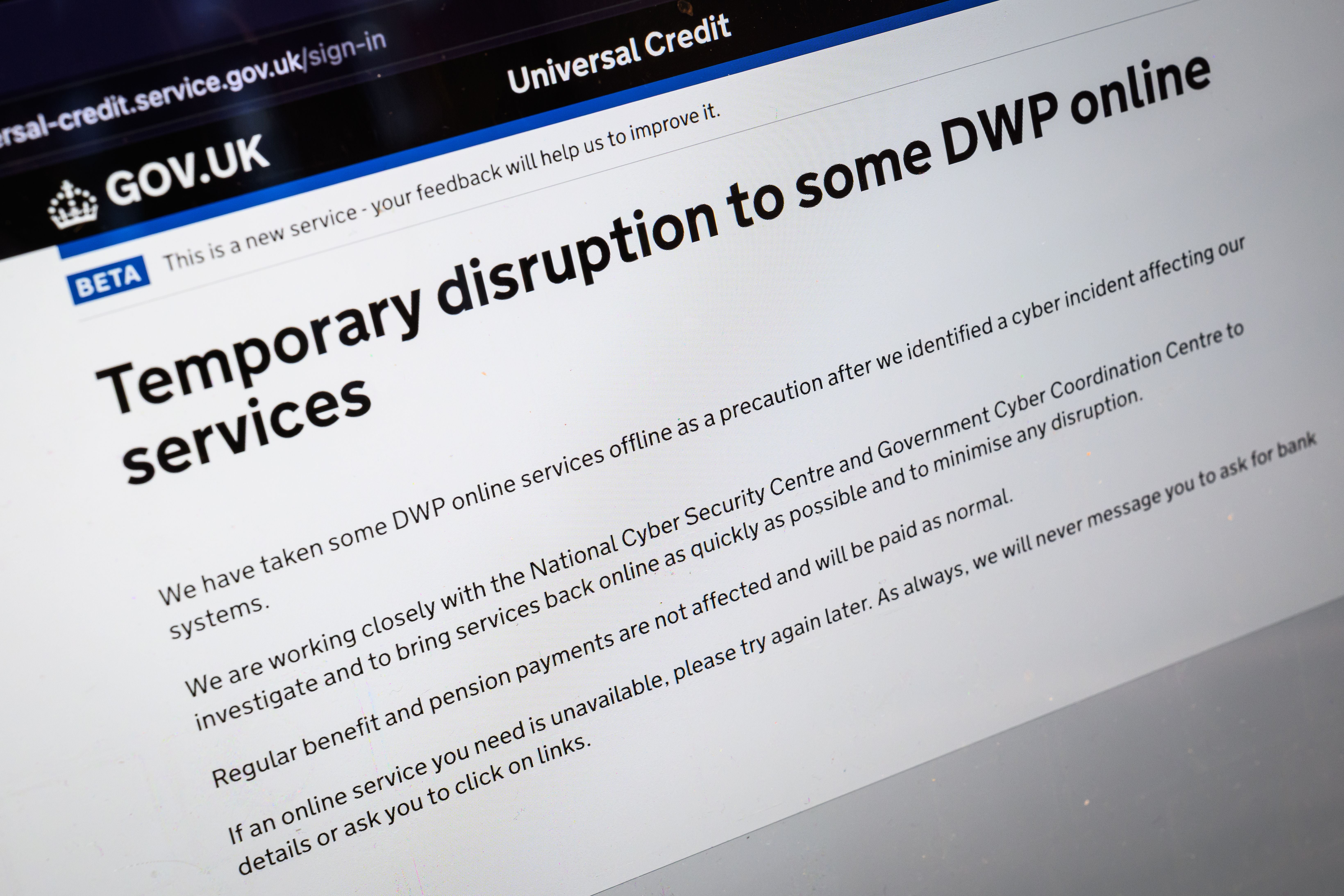
This means the UK’s 8.4 million Universal Credit claimants remain unable to access their online journals as a result of the issue, although regular pension and benefits payments are continuing.
GCHQ’s National Cyber Security Centre and Government experts are investigating the hack after unusual activity was first identified on Thursday.
The disruption came days after the US Treasury’s Financial Crime Enforcement Network said it had taken some of its services offline after a potential cyber attack that resulted in “unauthorised access” to its systems.
Football’s global governing body, Fifa, also confirmed it had been compromised this week after hackers gained access to a “limited set of personal and business information”.
US intelligence agencies were also targeted after an unclassified CIA system was breached, it was reported on Tuesday, although the attack did not involve any highly sensitive information.
It comes after the FBI was targeted in two separate breaches in recent months, while the Pentagon and the Department of Homeland Security have also been caught up in recent cyber incidents.
Microsoft experienced a major outage earlier this month that caused disruption to millions of users, although the company said the outage was a “technical issue” not related to cyber-attacks or AI agents.

The following day, the US experienced an unprecedented nationwide disruption to air traffic control centres that prompted the US Federal Aviation Administration to ground all flights. Officials said the ground stop, which caused travel chaos and thousands of flight cancellations, was caused by “incompetence” during copper wire upgrades.
Earlier this month, a number of UK meat suppliers said their fridges heated up overnight as they were affected by hacks targeting software used by supermarkets across Europe.
In recent weeks, fashion retailers Next and Asos have both separately flagged incidents that saw unauthorised access gained to some data.
The speed of AI advancements has ramped up cyber security threats in recent months. As well as identifying and exploiting weaknesses in an organisations digital defences, it is feared that rapid mathematical advances in AI models could soon be used to break down encryption used by banks and governments to protect data. This type of risk was previously not expected to materialise until the arrival of quantum computing – technology which is thought to be several years away.
The UK rolled out its “Be Ready” campaign earlier this year, urging citizens to have three days’ worth of supplies in the event of an emergency such as a cyber attack or severe weather. France has warned its own residents to have 72 hours’ worth of food, while Germany has suggested that citizens should have as much as 10 days’ worth of supplies ready.
US vice president JD Vance has insisted there is no need for Americans to stock up and “build a bunker”, but told Fox News: “We don’t see a crisis coming down, but you have to be prepared for everything. We want to make sure we prevent the worst outcomes, but we’re also prepared for the worst outcomes.”

Commons Science and Technology Committee chairwoman Dame Chi Onwurah said DWP disruption should be a “wake-up call” amid growing concerns over cybersecurity.
“People rely on these systems for some of the most essential services the state provides, and they should be able to trust that the tech and data underpinning them are secure and resilient,” she said.
“My committee has repeatedly warned that the government cannot achieve its digital transformation of public services without addressing weaknesses in its digital infrastructure and improving standards of data hygiene.
“Public bodies hold citizens’ data on trust, and that demands the highest standards.”
Responding Dame Chi’s intervention, work and pensions secretary Pat McFadden said: “When an incident like this happens, the most important thing is to take the system offline as early as possible to protect it, then to investigate the causes, and at the same time to make sure that payments to the public can continue as normal.”