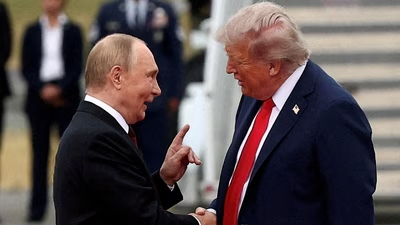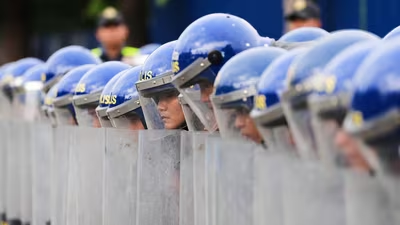
DONALD TRUMP had planned to give Manila a miss on his swing through Asia this week. When the Philippines first announced the date of its East Asia Summit (a format in which South-East Asian leaders meet interested others), it was set for five days before Mr Trump was due in China for the much higher-profile APEC summit. That was awkward for a president who dislikes long-distance travel. So the Philippines pushed back the date of its meeting, offering Mr Trump a 24-hour layover in the capital, where he lands on November 17th. Invitations to other bigwigs like the leaders of China, Japan and India, sent months earlier, had to be updated. It was a remarkable accommodation that reflects America’s enduring closeness to the Philippines. The security alliance between the two countries, which turned 75 this year, has remained surprisingly unscathed in Mr Trump’s second term, even as other alliances have been battered.
Taking a break from criticising NATO, America’s secretary of war, Pete Hegseth, has praised the Philippines as a model ally. Unlike with its richer friends, Japan and South Korea, America has not pressed the Philippines to contribute to its war in Iran or to increase its defence spending. Joint military exercises have grown in scale and sophistication under Mr Trump, as they did under President Joe Biden. After the Trump administration gutted USAID in early 2025, the Philippines was among the first countries to receive new development assistance.
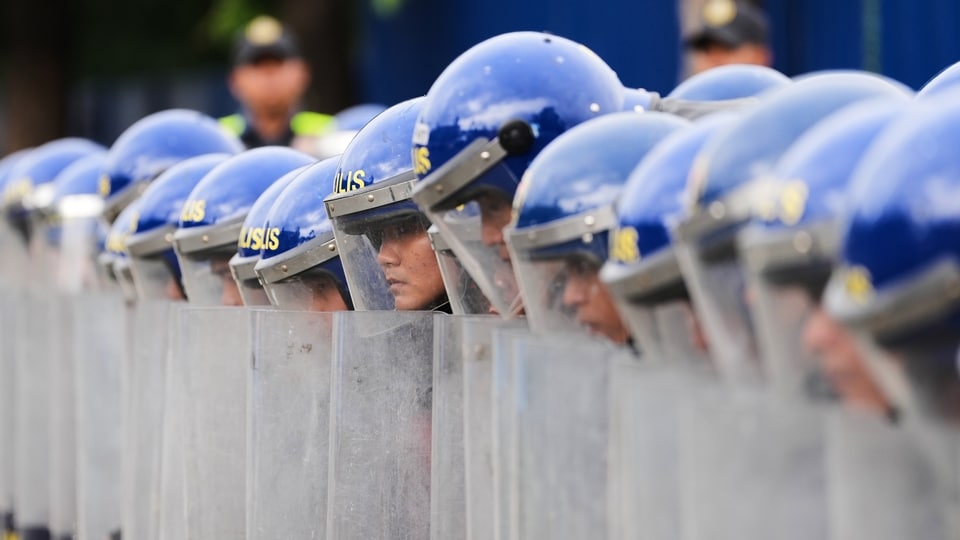
A former American colony, the Philippines signed a mutual-defence treaty with America in 1951. Filipinos refer to Uncle Sam as “big brother”. And, as is often the case between siblings, the country has felt both neglected and suffocated by America’s intermittent attention. Mr Trump will encounter some protests, as he is in most places. But the overall welcome will be warm. In a survey by the Pew Research Centre published in June 68% of Filipino respondents said they had confidence in Mr Trump to do the right thing, the highest level among the 36 countries polled. In Britain only 26% said they felt the same way.
This is partly a response to China’s bullying of its neighbours. China has become more assertive in its claims over the South China Sea, a strategic waterway that borders seven countries, including the Philippines. Chinese and Philippine sailors have skirmished at sea. America has backed its ally in these disputes, providing additional muscle to an otherwise limited response. “We are not leaving,” Elbridge Colby, the Pentagon’s third-ranking official, said in August to an audience in Manila. “We are digging in to ensure a favorable balance of power where it matters most.”
For President Ferdinand Marcos junior (pictured on an earlier visit to the White House), Mr Trump’s presence in his country will already be “most of the win”, says Greg Poling, a senior fellow at the Centre for Strategic and International Studies, an American think-tank. Mr Marcos, who is limited to a single six-year term that ends in 2028, has been in trouble recently. Severe floods in 2025 led to allegations of corruption in government-funded flood-control projects and this, in turn, spawned weeks of protests, an impeachment bid and calls for him to resign. Mr Marcos’s pledges to revitalise the Philippine economy have been discredited by surging food and energy costs. The share of Filipinos who have trust in his performance has plunged to 45%, the lowest since his election four years ago, according to OCTA Research, a Philippine pollster.
An appearance next to Mr Trump could help. Mr Marcos has staked his foreign policy on being close to America. He has opened four more Philippine military bases to American troops, which could be used as staging grounds in case of an American war against China over Taiwan. He has also allowed the Americans to bring in a Typhon missile system with the range to strike China. Not everyone is delighted by that. Some believe Mr Marcos has unnecessarily drawn the Philippines into the rivalry between America and China. Others say he is foolish to trust America.
Mr Marcos’s predecessor, Rodrigo Duterte, was an erratic authoritarian who preferred China to America. And though many in the Philippines’ political establishment now agree that Mr Duterte’s overtures to the government in Beijing brought little benefit, there are some who still believe their country (or, perhaps, their business interests) could gain from closer ties to China. Mr Duterte’s daughter, Sara Duterte, is the sitting vice-president and the front-runner to succeed Mr Marcos in 2028. She has not been stridently pro-China. But she has been critical of Mr Marcos’s foreign policy, calling it unbalanced. The Philippines, she says, should not lean on America in its troubles in the South China Sea.
To insure against problems in a second Duterte presidency, boosters of the alliance from both America and the Philippines are trying to deepen non-military ties. The Philippines in April said it would join America’s Pax Silica initiative, its effort to build tech supply chains without Chinese content. The initiative has so far produced nothing concrete for the Philippines. Mr Trump’s visit might have been an ideal opportunity to herald a new deal. But Lee Lipton, the American ambassador in Manila, has said there will be no announcement. Nonetheless, Philippine officials will be happy with a congenial visit from Mr Trump. As America’s other allies can attest, it could be a lot worse.