US President Donald Trump held off on publicly endorsing Prime Minister Benjamin Netanyahu ahead of Israel’s elections until internal polling data indicated that Netanyahu had a realistic chance of winning, political sources familiar with the contacts told Maariv.
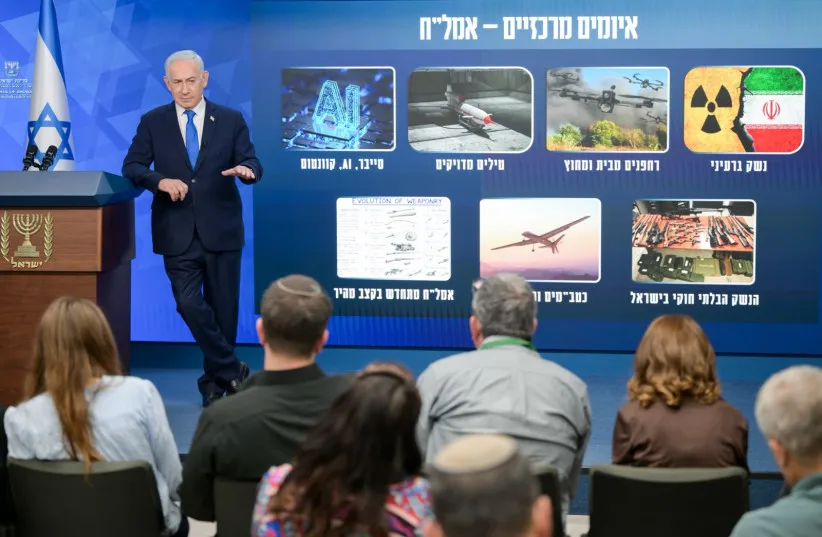
Netanyahu hadn’t held a briefing with journalists in more than a year. On Sunday, he returned to the format just nine days before the elections, stepping up efforts to achieve the goal that has defined his entire campaign: securing 61 Knesset seats for his bloc.
For more than an hour, Netanyahu laid out his security and diplomatic vision for the coming years. One of his most prominent messages, however, concerned his relationship with Trump, particularly the limits of their cooperation.
Addressing the strikes on Iran, Netanyahu made clear that Israel does not condition its actions on American approval. He said that in the past, he had not asked Trump for permission to act, but had instead informed him of Israel’s plans and offered him the opportunity to join.
“The objectives I set are not dependent on American approval,” he said. “Our need to eliminate the nuclear threat and the overall threat from Iran stands on its own. And to the extent necessary, we will act independently as well. We have already done so, and if necessary, we will do so again.”

Netanyahu outlines differences with Trump over Iran and Turkey
Netanyahu linked the continuation of the campaign against Iran to the window of opportunity remaining during Trump’s presidency.
He said Israel could advance significant security and diplomatic initiatives over the next two years, but warned that a president more hostile to Israel could subsequently be elected in Washington.
For that reason, alongside continued coordination with the US, Netanyahu wants to expand Israel’s alliance network with additional countries.
Turkey also came up during the briefing. Netanyahu acknowledged that he and Trump disagree over Turkish President Recep Tayyip Erdogan.
According to Netanyahu, Israel has already thwarted a Turkish attempt to expand its military deployment in Syria and is preparing for additional scenarios, although he personally wants to avoid a direct confrontation with Ankara.
Netanyahu said he would welcome a return to the state of relations Israel and Turkey once enjoyed, but assessed that such a development was unlikely as long as Erdogan remained in power.
He pointed to the Turkish president’s hostile statements toward Israel and his remarks about Jerusalem, making clear that Israel was taking a range of possible developments into account.
Nevertheless, Netanyahu said the disagreement over Turkey did not diminish the depth of his cooperation with Trump.
Although relations between the two leaders may have appeared to be cooling, partly because they did not meet at the UN General Assembly, they had, in fact, maintained contact out of the public eye.
Another factor in the background is criticism from the American media and opposition that Israel dragged the US into a military campaign against Iran that does not necessarily serve American interests.
Such criticism could carry a political cost for Trump, prompting him to maintain some public distance from Israel for the time being, at least until the US midterm elections are over.
Internal polling reportedly convinced Trump to endorse Netanyahu
Netanyahu had planned for Trump’s social media post, which was released under embargo, to allow journalists to leave the briefing with his security doctrine accompanied by a public endorsement from the American president.
Maariv learned that the two developments were more closely coordinated than they appeared publicly.
According to Likud officials, Trump’s announcement did not come as a surprise.
They said there had never been any doubt that Trump would back Netanyahu ahead of the elections. The main question was when he would do so.
“The very fact that Trump had refrained until now from explicitly expressing support for Netanyahu increased the media impact of the announcement,” party officials said.
Another Likud official argued that “those who concluded from Trump’s silence that he did not intend to support Netanyahu created expectations that proved unfounded, turning an expected endorsement into a major news event.”
However, political sources familiar with the contacts presented a somewhat more complicated picture.
According to those sources, Trump had indeed hesitated before publicly endorsing Netanyahu.
One reason was his experience in Hungary’s elections, where he backed Viktor Orban, who subsequently lost. The sources said Trump did not want to gamble again on a candidate who might lose.
In recent weeks, they claimed, the American president had closely monitored Netanyahu’s political standing and the balance of power between Israel’s rival political blocs.
Internal polling data presented to Trump indicated, according to the sources, that Likud and the right-wing bloc were gaining strength, that the blocs were tied and, in some surveys, that the Right had even moved ahead.
The sources said the figures convinced Trump that Netanyahu had a genuine chance of winning the elections and played a significant role in his decision to end his public silence and issue an explicit endorsement at this particular moment.

