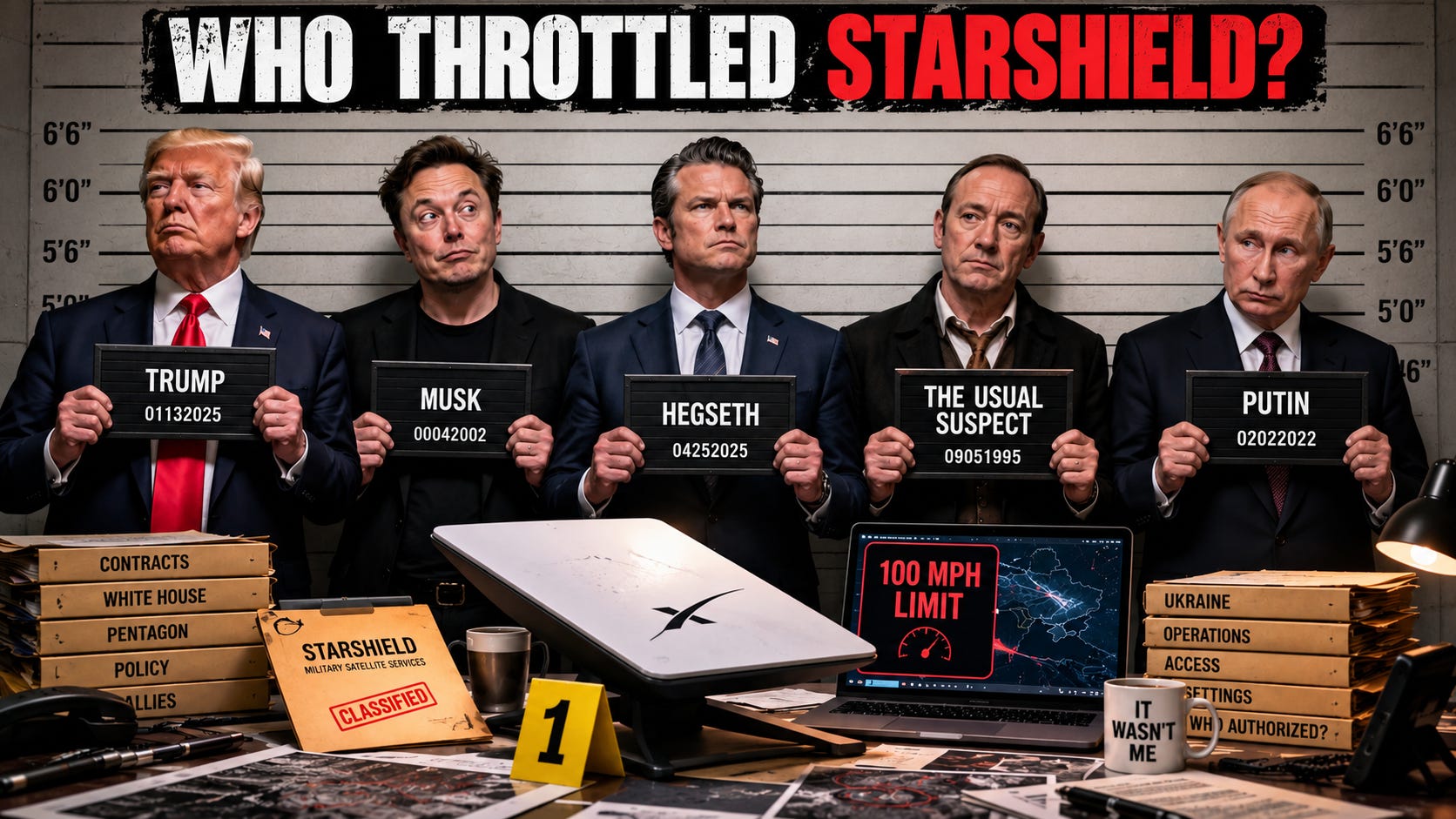
Well, that was quick. When I published my Starshield whodunit a few days ago, I had a wonderful little lineup of suspects.
Elon Musk said the US government controlled Starshield and that restrictions on speed or usage were decided by the military and, ultimately, the president.
Donald Trump said he didn’t do it.
Reuters had sources pointing toward the White House.
Ukraine was still dealing with the speed restriction.
Space Force had hundreds of millions of dollars in Starshield contracts with SpaceX and somewhere inside that tangled nonsense was the person who changed the setting.
We may now know who.
The Wall Street Journal reported Tuesday that Elon Musk personally ordered the slowdown of the military-grade SpaceX satellite service used by Ukraine. According to US officials and people familiar with the decision, Musk authorized the restriction that capped the speed at which Ukrainian hardware could remain connected, disrupting strike drones and interceptor drones defending Ukrainian cities from Russian attacks.
CBS News then independently reported that a decision by Musk led to the restrictions.
CBS says Musk held multiple conversations with administration officials before the order because he wanted to understand President Trump’s position. Some Trump administration officials were reportedly surprised by the resulting slowdown, and CBS says neither Trump nor the Pentagon specifically ordered SpaceX to cripple Ukraine’s drone operations.
So our whodunit just changed genres: We have moved from Agatha Christie to contract law. God help us all. I’m having flashbacks: Offer, acceptance, and consideration.
Identifying who ordered the slowdown raises a much more serious question:
Did Elon Musk actually have the authority to do it?
Remember what Musk said when this story first broke:
“Starshield systems are owned and controlled by the US government,” he wrote, adding that limits on speed or usage were decided by the US military and ultimately the president.
Musk was describing an operational chain of authority in which the government, rather than SpaceX, controlled the relevant restrictions.
Now The Wall Street Journal and CBS are reporting that Musk himself ordered the slowdown.
Those two things can’t both be completely true in the way they were originally presented.
Either Musk possessed authority that his public statement made sound like it belonged to the federal government, somebody in Washington authorized his decision, the affected service was contractually different from the Starshield service Musk was describing, or the reporting is wrong.
As of Wednesday morning, the administration appears to be moving toward the first explanation.
Secretary of State Marco Rubio told reporters that decisions about Ukraine’s Starlink access belong to SpaceX and Musk rather than the White House. Rubio said he wasn’t aware that the administration knew of the decision beforehand and described the restrictions as governed by a private commercial contract determining how SpaceX equipment can be used and at what speeds.
Defense Secretary Pete Hegseth has offered a similar explanation.
“We haven’t made any directives or anything like that,” Hegseth said Tuesday, while arguing that SpaceX’s terms of service give the company discretion to make certain decisions about access.
That’s a major shift from where we started.
A week ago, Musk told us Washington controlled the speed restrictions.
Now two of the highest-ranking officials in Washington are essentially saying: “Nope. Elon.”
Before we get into breach, default, performance obligations, and all the other subjects that make first-year law students reconsider a career in plumbing, there is an annoying threshold problem.
Nobody seems able to agree on what Ukraine was actually using.
Starlink is SpaceX’s commercial satellite internet service.
Starshield is the military and intelligence product built using much of the same underlying satellite infrastructure, with different terminals, security features, management and government arrangements.
Ukrainian officials, including President Volodymyr Zelenskyy, have repeatedly described disruptions affecting Starshield.
The Senate Foreign Relations Committee says the same thing.
In an October 19 letter to SpaceX, four US senators wrote that Ukraine “more recently has received access to Starshield services procured by the US Government to support Ukrainian military operations.” They specifically described the October 14 restriction on devices traveling faster than 100 mph as a Starshield restriction.
But Rubio suggested over the weekend that Ukraine never had Starshield access in the first place.
Umm, that distinction isn’t pedantic anymore. It may determine which contract governs the incident.
If Musk throttled ordinary commercial Starlink operating under SpaceX’s standard service terms, Hegseth’s argument about private terms of service becomes more plausible. If he independently degraded Starshield service that the Pentagon specifically purchased for Ukrainian military operations, we are in a completely different contractual neighborhood.
And the public procurement records tell us that the Pentagon buys a great deal of Starshield.
Space Systems Command’s current SpaceX contracting vehicle is FA254125DB021, an indefinite-delivery contract that began in July 2025.
Federal spending records currently show about $476 million obligated under six orders, with roughly $1.15 billion in potential value attached to those orders.
Several are explicitly Starshield-related.
Task order FA254126FB008 is described simply as “STARSHIELD SERVICE SUPPORT” and carries $135 million in obligations.
Task order FA254126FB019 covers commercial satellite communications services and hardware. The government says it includes SpaceX terminals, ancillary equipment and service plans for Starshield-based military requirements across the Defense Department and other federal agencies.
Then there’s FA254126FB015, which remains my favorite breadcrumb in this entire story.
The government describes it as:
“SECURE GLOBAL SATCOM VIA POOLED STARSHIELD SERVICE. ENHANCED FEATURES, SECURITY, AND CENTRAL MANAGEMENT FOR ALL MISSIONS.”
That task order carries nearly $132 million in current obligations.