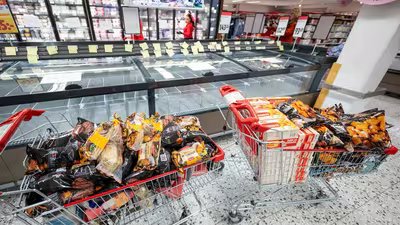
Supermarket refrigeration systems in several European countries were hit by a cyberattack overnight on Sunday, with hackers remotely altering the settings of cooling equipment and causing temperatures to rise, potentially forcing some stores to dispose of food, the Belgian news agency Belga reported on Monday.
The attack affected refrigeration and freezer units at several major supermarket chains, including Delhaize, Carrefour and Spar.
Stephan Moelans, chief executive of refrigeration company Sabcobel, told Belga that the incident began around midnight on Sunday and affected approximately 20 of the hundreds of units monitored by his company across Belgium.
The attackers remotely switched the evaporators in the refrigeration systems into defrost mode, causing temperatures inside the units to rise.
Moelans said the company mobilized technicians at 1am. They worked throughout the night and into Monday morning to disconnect the affected equipment from the network and restore normal operation. Despite the response, some stores may have suffered losses, as certain food products stored at unsuitable temperatures will probably have to be discarded, he added. The method used in the attack was similar to one reported in France in early October, when the refrigeration systems of hundreds of stores were targeted in a comparable incident.
Moelans said Sabcobel had stepped up efforts to protect the equipment in recent weeks, but addressing the security vulnerability required physical modifications as well as software updates. He said the simplest solution was to monitor refrigeration systems through secure internet connections. Most of the company’s clients had already switched to this arrangement following the attack in France.
Belgian prosecutors have launched an investigation into the incident.
By Monday afternoon, similar disruptions had also been reported in the Netherlands, Estonia, Ireland, Luxembourg, Sweden and Finland. In Luxembourg, several Delhaize stores reported problems with their refrigeration systems, while in Ireland, the equipment at 13 SuperValu outlets was affected.
Major supermarket chains in the Netherlands had not been hit, but smaller retailers and butcher shops reported disruptions. Several shops in Estonia also experienced problems.
Finland’s National Cyber Security Centre identified several successful attacks, although the damage was limited. In Sweden, refrigeration systems stopped working at several Coop stores.
Christophe Hansen, the European Commissioner for Agriculture and Food, described the latest wave of attacks targeting supermarkets as a deliberate attempt to disrupt the EU’s food supply.
He added that the attacks were also intended to undermine public confidence. While food supply security was not currently at risk, food losses and the impact on businesses were real, Hansen said.
A European Commission spokesperson said the incidents demonstrated how cyberattacks could disrupt services, damage businesses and directly affect people’s daily lives. The spokesperson stressed the need to strengthen cybersecurity across the EU.
Related articles:
At a time when public debate is increasingly polarized and superficial, Hungarian Conservative remains committed to depth, intellectual honesty, and independent conservative thought.
Producing high-quality journalism requires resources. Your contribution helps us expand our coverage, reach new audiences, and keep our content accessible.

Please consider supporting our mission.