Protests across Europe against conditions in schools, housing and the soaring cost of living are set to continue throughout the weekend, with hundreds of thousands to take to the streets in countries across the continent – including France, Belgium, Italy, Spain and the United Kingdom.
Following weeks of protests in several European countries, unions, activists and young people held simultaneous rallies on Friday, which are set to continue over the weekend.
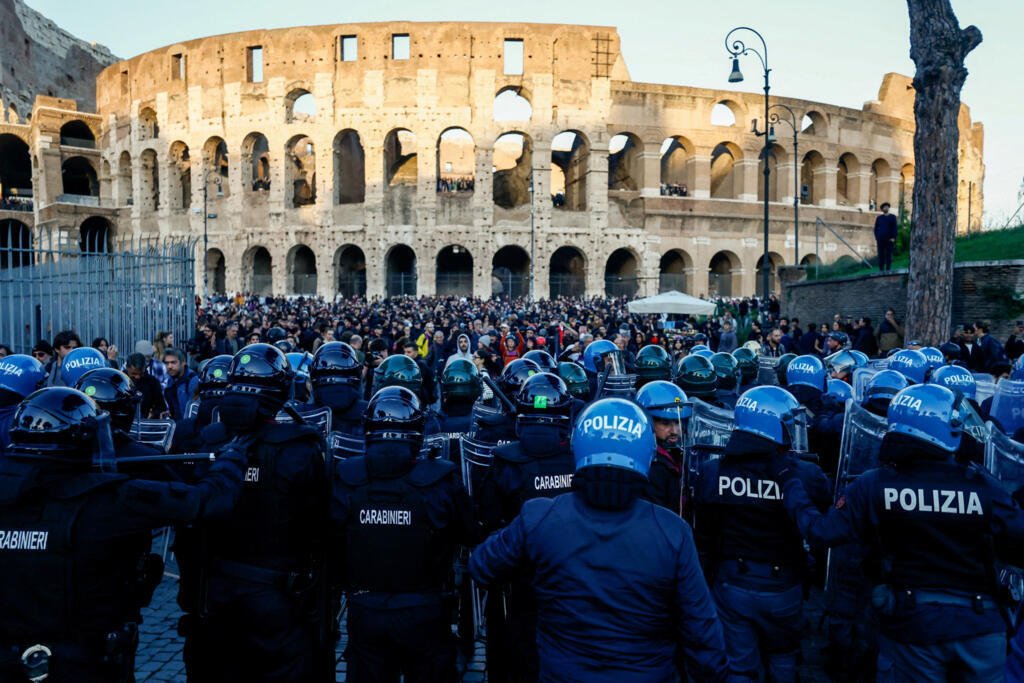
In Italy, a 24-hour strike called by the CGIL trade union brought demonstrations to more than 100 cities. Protesters denounced stagnant wages, rising living costs and what organisers described as the government’s failure to strengthen public services and worker protections. Student groups joined workers in calling for greater investment in education and policies aimed at reducing inequality.
In Croatia, students boycotted classes and staged protests in around a dozen cities, demanding greater investment in education, housing and public services rather than military spending.
Meanwhile in Austria, several hundred people gathered outside the University of Vienna for a youth-led protest calling for more spending on education and less on weapons. Police dispersed the event after reported disturbances. Officers used pepper spray and made several arrests.
While local grievances sparked the movement in individual countries, the protests are linked by concerns shared across the continent.
The demonstrations come ahead of a series of key elections in Spain, France, Italy and Greece, and as Russia’s invasion of Ukraine approaches the end of its fifth year.
Fighting for the future
A coalition of more than 50 youth and student-led groups said young people in more than 25 countries were expected to join the protests.
They urged a “radical transformation of the system we live in” and encouraged young people to protest against militarisation and social injustice.
They launched their call to action under the slogan: “Fight for our future, not their wars!”
Protesters in other European countries have been inspired by French students who began blocking their high schools in mid-September to demand better learning conditions.
The school movement fuelled a nationwide campaign against soaring prices, inadequate public services and police brutality.
Among the other organisers are France’s Yellow Vests, a movement that first rattled President Emmanuel Macron with street protests in 2018 and 2019.

‘Sense of being abandoned’
Trade unions and campaign groups from seven different European countries – France, the UK, Belgium, Spain, Italy, Portugal and Greece – have also called for coordinated protests this weekend.
One of their primary demands is the right to housing and the control of rental prices – an issue that has sparked major protests in Spain and prompted Prime Minister Pedro Sanchez to call early elections, scheduled for the end of this month.
Home prices have surged by almost 70 percent in the European Union since 2015, and rents have climbed by 25 percent – far outstripping income growth, according to the EU’s statistics office Eurostat.
Meanwhile energy costs have been driven higher by the war in Iran.
Spain’s housing crisis takes centre stage ahead of snap election
Ludovic Voet, secretary of the European Trade Union Confederation, which represents approximately 45 million workers across the continent, believes a fundamental shift is taking place in Europe.
“The cost of living, the price of gas and petrol, housing, working conditions and the state of educational facilities – all of this points to a widespread sense of being abandoned, even though we are generating more wealth than ever before,” he told RFI.
Voet called for governments to better protect workers at a time when traditional industry is declining and artificial intelligence is restructuring entire sectors.
“It is clear that, when faced with foreign competition, far too little is being done to protect the jobs we have on the continent,” he said, arguing that EU watchwords such as “competitiveness” and “deregulation” spoke little to ordinary people.
“We do not see ourselves as mere line items in a budget. This sense of injustice, combined with the feeling of being left unprotected in a rapidly changing world, fuels an anger that is present everywhere across Europe.”

‘Generational rage’ drives young Europeans to fight to be heard
Women’s rights
While organisers say that hundreds of protests and strikes are expected to take place in countries including Portugal, Croatia and Switzerland, the scale of the mobilisation remains difficult to predict.
In Italy, the demonstrations will coincide with a general strike set to affect transport, schools and hospitals, with the CGIL trade union dubbing the protests “the country’s call for change”.
In Rome, members of the collective Donne De Borgata (“Women of the Suburbs”) said they would be joining the demonstrations to draw attention to the economic and social hardship.
In Primavalle, the western suburb where the group was founded, “the main problem is rampant poverty”, said 22-year-old history student Caterina. “Personally, I would like to see a psychologist, but that has become a luxury.”
She told RFI the organisation was currently fighting to get a centre in Primavalle where women could seek help escaping violence.
“[Prime Minister] Giorgia Meloni has set our country back 10 years in terms of women’s rights. She really needs to go.”
EU chief unveils €800bn plan to ‘rearm’ Europe and support Ukraine
While the European Union seeks to rearm in the face of threats from Russia, protest organisers say funds allocated to rearmament should be spent on education, youth policies and housing.
In Germany, the collective GenZ Regelt (“Gen Z has got this”) says it expects 15,000 people to join protests in Berlin, alongside rallies in dozens of other cities. Fears of a possible reintroduction of military service have led many young people to join the protests.
“While seemingly unlimited amounts of money are being poured into the military and the infrastructure supporting the military, the welfare state is being dismantled,” Hannes Kramer, a German student protester, told French news agency AFP.
(with newswires)