Alex Gibney’s new four-hour documentary, “Musk,” is unlike any I’ve seen.
The film combines incisive and poignant interviews about the tech lord man-baby with video-game-style sequences and an uncanny Valley-esque CGI avatar of Elon Musk uttering his own words in a stilted AI voice. (Musk has often mused that we are living in a simulation run by a more advanced civilization, so that’s on point.)
There are also of course, countless clips of the real Musk, now 55, a man who, as one of his many detractors in the film puts it, “is a skilled inventor of his own value.”
“Few people promote themselves as egregiously as Musk,” says tech writer Kara Swisher, a onetime admirer and current antagonist of Musk.
I will leave it to the critics to weigh the artistic merits of Gibney’s stylistic choices — I personally did not love the sequences where a ray-gun-wielding hand bursts through the doors of many federal agencies (POV: Musk), vaporizing workers while a meter ticks up the kills. It is, however, an apt metaphor for the violence Musk’s callow Department of Government Efficiency team inflicted on thousands of civil servants in the brutal period after President Trump’s second inauguration.
Overall, I found the film fascinating, scary, infuriating and not the least bit reassuring about Musk, his ethics or our future. Will Musk eventually use the expansive files his DOGE minions improperly downloaded to train his incipient XAI venture? No one knows.
I’ve long believed that money and power infantilize. Few men embody that notion more fully than Musk, who is petty to the point of absurdity. During the 2023 Super Bowl, for example, he was irked that President Biden’s tweets about the Philadelphia Eagles got more engagement than his, so Musk flew to San Francisco and ordered his team to change the platform’s algorithm to artificially boost the visibility of his own posts.

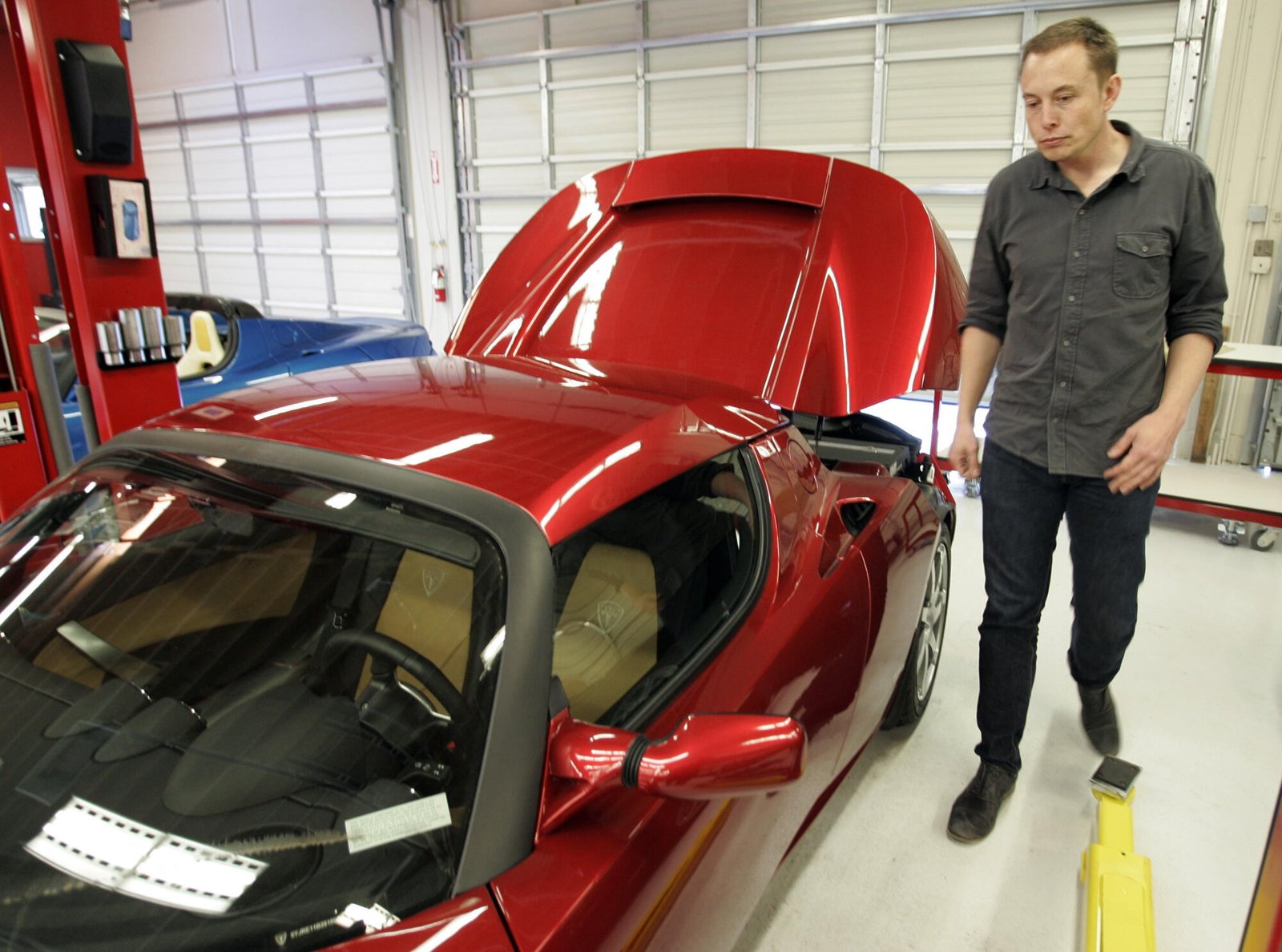
Tesla CEO Elon Musk next to a new Tesla sports car at a showroom in Menlo Park, Calif., in 2008.
(Paul Sakuma / Associated Press)
This from a man who claims to have purchased Twitter in the name of free speech.
Gibney’s film does a good job of explaining Musk’s rise: He is a good but not great engineer, a terrible manager with a genius for self-promotion and exaggeration, particularly when it comes to, say, the highly questionable “autopilot” ability of Teslas, which has been the subject of numerous lawsuits and multimillion-dollar payouts after fatal crashes. Tesla’s infamous 2016 video of its “Full-Self Driving” system was proved to have been staged.
“The promise is always illusory,” Lawrence Fossi, a former securities lawyer and Musk skeptic, tells the filmmakers.
A COVID-era political awakening — Musk was infuriated by lockdown mandates that adversely affected Tesla production — led to Musk ingratiating himself with Trump, whose reelection in 2024 effectively put an end to dozens of Biden-era federal investigations into Musk’s companies.
Musk’s explosive falling-out with Trump over the deficit-exploding One Big Beautiful Bill Act was destined to be short-lived. Trump needs Musk’s political cash, and Musk needs government cash and freedom from worrying about pesky government investigations.
Musk was born and raised in South Africa. He arrived in Silicon Valley for graduate school in 1995, an opportune moment for an entrepreneurial geek. He immediately dropped out of Stanford to create, with his brother Kimbal, Zip2, a company that basically put the Yellow Pages online. In 1999, Compaq bought it for $307 million.
With Musk’s $22-million haul, he co-founded an online financial services company that became PayPal, which was sold to EBay for $1.5 billion.
In 2002, Musk used most of his share from that sale, $175 million, to found SpaceX. The goal was to reduce space transportation costs and, ultimately, enable the colonization of Mars, a Musk obsession stemming from his belief that the human race is headed for extinction as a result of declining birth rates and existential technological threats.
“His ideas come from sci-fi,” says astrophysicist Adam Becker, who dismisses Musk’s obsession with colonizing Mars as rank fantasy. The air on Mars is toxic, Becker says, “and the dirt is made of poison.”
Former Deputy NASA Administrator Lori Garver championed the fledgling SpaceX in the face of tremendous government skepticism, but is turned off by Musk’s grandiosity. “He’s not sending people to Mars,” Garver says dryly. “He is talking about it.”

President-elect Trump and Elon Musk watch the launch of the sixth test flight of the SpaceX Starship rocket on Nov. 19, 2024, in Brownsville, Texas.
(Brandon Bell / Getty Images)
After some truly spectacular failures, SpaceX successfully pioneered the use of reusable orbital rocket boosters, and has secured at least $22 billion in government contracts. It has also become an indispensable provider of internet service around the globe, through its Starlink satellites.
In 2004, Musk became a primary investor in Tesla, the electric car company founded by Martin Eberhard and Marc Tarpenning. Eberhard says he regrets not being more wary of Musk, who did not actually “found” the company, but because of a court settlement has the right to call himself a “founder.” As Eberhard says in the film, there’s actually no strict, legal definition of “founder.”
About those declining birth rates: Musk has made it his business to populate as much of the planet as possible. He has fathered at least 14 children with several women, and possibly many more. He has connected with many potential mothers on X, which he famously purchased from Twitter in 2022, whereupon its value plummeted by 80%.
Ashley St. Clair is a onetime conservative influencer and mother of one of Musk’s children who has refused to sign an NDA limiting her ability to talk about him. She described his direct messages to potential mothers on X as “a Gatling gun of sperm.”
In an emotional interview, his first wife, Justine Musk, a mother of six, breaks down as she discusses the death of their first child from complications of SIDS in 2002.
In 2016, their eldest child, Vivian, came out as trans. During a 2024 interview with Jordan Peterson, a clinical psychologist turned right-wing culture warrior, Musk said that his child had died, “killed by the woke mind virus.”
“We went through the death of an actual child,” says Justine, plainly pained by his cruelty. After Vivian came out, Justine says, “He cut off her health insurance.”
Such heartlessness is almost unimaginable, until you remember Musk has argued that “the fundamental weakness of Western civilization is empathy.”
In “Musk,” Gibney slyly includes scenes from the 1937 movie “The Man Who Could Work Miracles.” Based on an H.G. Wells short story, three celestial beings choose one puny mortal to become omnipotent. Can a human handle all that power? Or will he destroy Earth because he’s not smart enough to anticipate what he will unleash?
You can probably guess the answer.
Bluesky: @rabcarian
Threads: @rabcarian