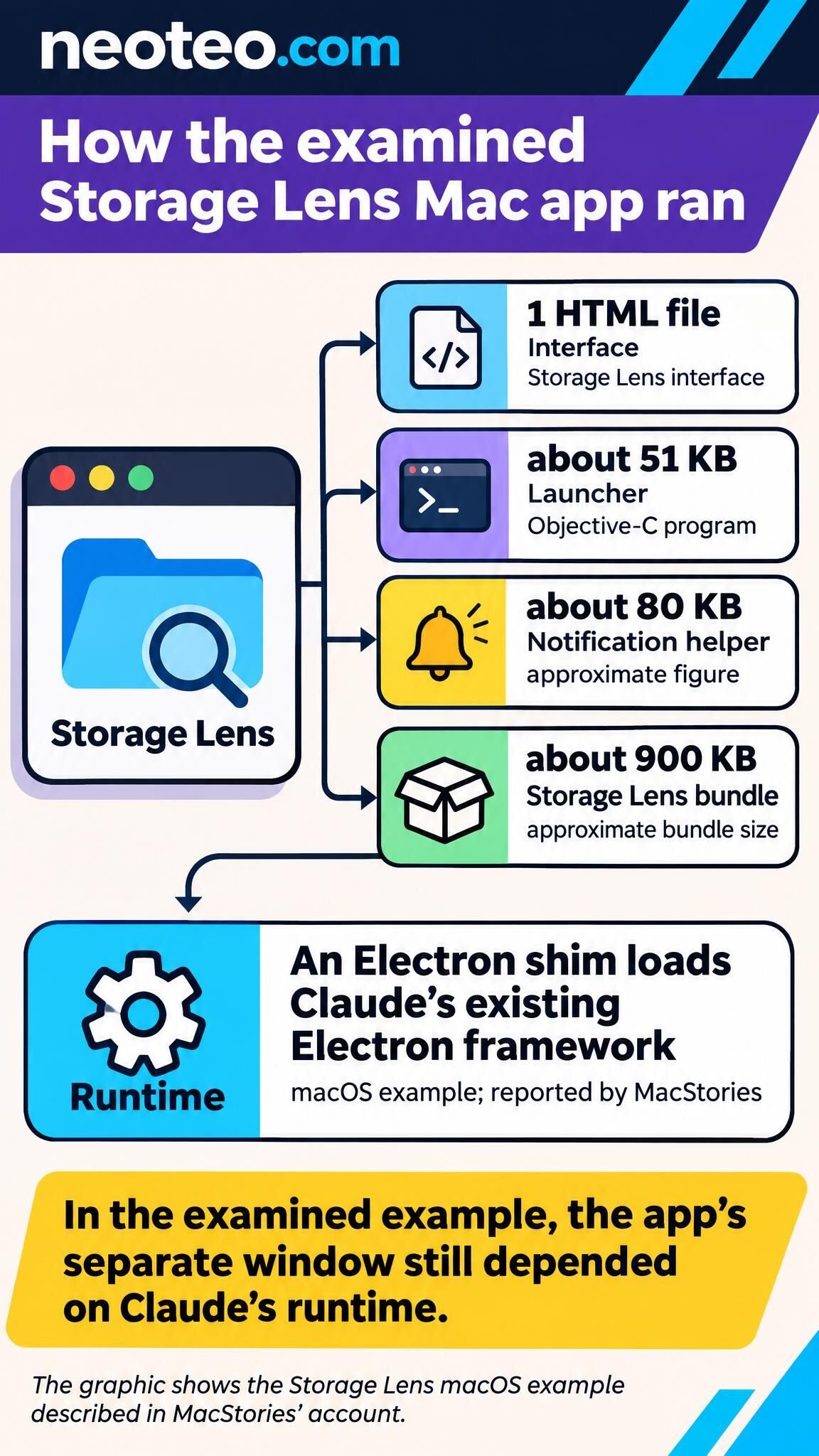
MacStories’ Federico Viticci reports that the Storage Lens Claude Artifact app he examined on macOS used an HTML interface in an Electron shim that loaded Claude’s existing Electron framework. Claude’s main process handled the app’s actions, so its separate window did not run as an independently implemented native Swift or SwiftUI app. ClaudeDevs announced desktop installation for Artifacts on Mac and Windows on November 24, 2026, in a post from its developer account.
For the feature’s installation steps and permission choices, see our earlier guide to Claude Artifact desktop apps.
A separate app window can still depend on the runtime and processes of its host app.
A separate window does not mean a separate runtime
A desktop window and icon can make an Artifact feel like a standalone app, but Viticci’s teardown describes a different arrangement for Storage Lens: a small launcher opened the interface through Claude’s existing Electron framework. The interface called window.claude.use('desktop') to reach Electron-like functions, including filesystem and shell operations.
The installation experience is demonstrated in Mark Szymanski’s English-language video showing a Snake Artifact being installed and discussing portability.
Inside the examined Mac app

MacStories reports that Storage Lens had a single HTML interface file and a bundle of about 900 KB. Claude Code’s explanation, quoted by Viticci, described an approximately 51 KB Objective-C launcher, an approximately 80 KB notification helper, and an icon. These are approximate figures for the components and bundle in that Mac example.
The launcher reportedly located Claude.app and loaded its existing Electron framework. Through window.claude.use('desktop'), Storage Lens could call functions for tasks such as reading directories or running shell commands. Viticci reports that Claude’s main process handled the app’s actions, including system access.
What the runtime dependency means
The separate window did not make Storage Lens independent of Claude Desktop: Claude’s main process remained part of its execution path. In Viticci’s test, the Artifact’s permission prompt appeared within Claude. He reported that clicking “Allow” did not itself change macOS permissions because Claude already had Full Disk Access.
MacStories also quotes Anthropic support as saying that programs started by a shared app stop after the recipient loses access—for example, if the owner stops sharing the Artifact. The quoted estimate is up to about 20 minutes; it can take longer when Claude cannot check access, such as when it is offline, signed out, or using another organization.