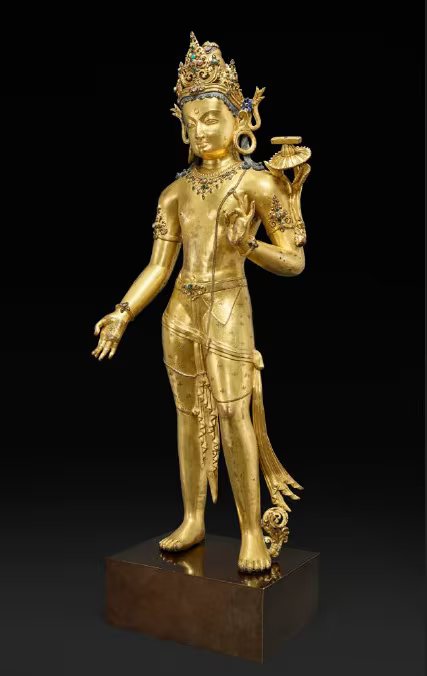
The figure stands a little under a metre tall, a jewelled crown on its head and a lotus rising at its shoulder. Manjushri is the bodhisattva of wisdom in Buddhist tradition, and this gilt-copper image of him, cast in the Himalayas some nine centuries ago, became the most expensive lot of Christie’s autumn season in Hong Kong this week. A sculpture made to be venerated outran every imperial porcelain and every scroll in the room.
It also carried the auction house past a symbolic line. Across eight live sales of Hong Kong Asian Art Week, Christie’s crossed the billion-Hong-Kong-dollar mark, its best result for the category in eight years. In its results announcement, the house says Greater China was the leading buying region, followed by Southeast Asia, and that Millennial and Gen Z collectors made up more than half of all new buyers.
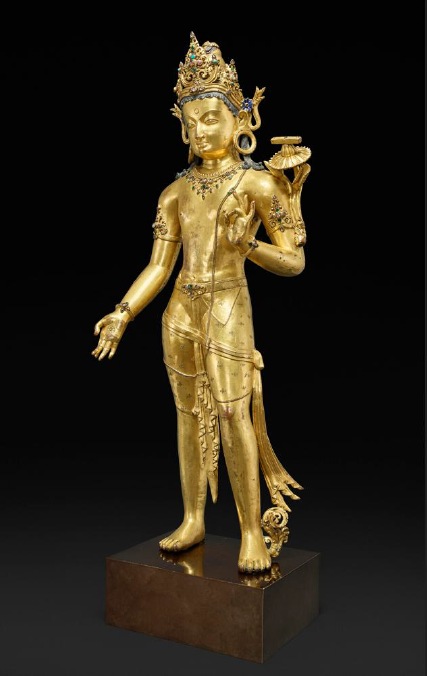
The sales totalled HK$1.02 billion (US$129.4 million), with hammer prices 111% above the low estimate. The Manjushri, offered in the standalone sale Awakening Wisdom: Masterpieces of Buddhist Art from a Private Asian Collection, fetched HK$137.35 million, more than double its low estimate and a world auction record for a Himalayan gilt-bronze sculpture. With the Indian, Himalayan and Southeast Asian Art sale, the category reached HK$283 million, which Christie’s calls the highest total ever achieved for it anywhere.
Painting supplied the season’s other story. Bada Shanren, the descendant of the Ming royal house who became a Buddhist monk after the dynasty fell and then one of China’s most singular painters, was born in 1626, so this autumn falls in his four-hundredth year. An album of twelve ink leaves of flowers and birds, dated 1699 and once held by Zhang Daqian and later by the Bada scholar Wang Fangyu, sold for HK$61.9 million, more than five times its low estimate and, by Christie’s count, the most valuable Chinese classical painting sold this season. Bada’s birds, pared down to a few strokes and a sidelong, wary eye, remain among the most recognisable images in Chinese art. In modern ink, Li Keran’s Sailing in River Li led at HK$12.8 million.
In the ceramics rooms, the third chapter of The Ai Lian Tang Collection – Gems of the Imperial Capital brought HK$214.5 million, taking the collection to HK$737.8 million over three seasons, the third most valuable single-owner collection of Chinese ceramics and works of art ever sold at auction. Its top lot was a yangcai ‘Hundred Deer’ hu-form vase with a Qianlong seal mark, at HK$35.06 million, while a carved emerald-green jadeite snuff bottle barely five centimetres high made HK$25.91 million, a world auction record according to the house. A jewelled gold ewer made for the Qianlong Emperor, sold on its own, reached HK$55.8 million.
Sales continue online until 5 November with Pavilion Online – Chinese Art. At The Henderson, Christie’s Asia Pacific headquarters, a commemorative exhibition revisiting the Royal Academy’s International Exhibition of Chinese Art of 1935–36 is on view until 6 November. That London show helped shape how the world looked at Chinese art. Ninety years on, this week’s results show where the weight has shifted: the leading buyers now come from Greater China and Southeast Asia, and more than half of the newcomers belong to a younger generation.