Beginning today (October 26), the Communist Party of China (CPC) is holding a four-day meeting of its top leaders in Beijing, known as the fifth plenum. Such meetings have previously heralded key policies — including the 1978 liberalisation of the Chinese economy.
This year, the meeting comes as the rest of the world keenly watches China’s position in sectors ranging from artificial intelligence (AI) to manufacturing. At the same time, its economy is no longer growing at the rates it did a few years ago, and corruption within the CPC has been touted as a major reason for purging senior military leaders.
What can the closed-door event reveal about the priorities of Chinese leaders? G Venkat Raman, professor at IIM Indore and fellow at the Institute of Chinese Studies (ICS), New Delhi, explains.
What are CPC Central Committee plenums?
The CPC holds a National Congress every five years to set its broad political direction and elect a Central Committee. Comprising around 200 members and 175 alternate members, this committee then elects the Politburo (around 24 members) and its Standing Committee — China’s apex political leadership of seven leaders. At the very top is the general secretary, the position Xi Jinping holds.
Between these congresses, it convenes plenary sessions, or plenums, to deliberate on major political, organisational and policy questions.
Although the State Council (similar to a Union Cabinet) and National People’s Congress (the national legislature) perform administrative and legislative functions, the CPC exercises overarching political leadership. Plenums translate the leadership’s priorities into authoritative decisions guiding ministries, provincial governments, state-owned enterprises and other institutions.
Their agendas range from economic reforms and development plans to Party discipline, ideology and senior appointments. The first plenum after a Party Congress generally establishes the new leadership; subsequent meetings set policy priorities and address institutional challenges.
Story continues below this ad
The forthcoming Fifth Plenum of the CPC’s 20th Central Committee is unusual. Whereas Fifth Plenums have generally focused on economic development planning, this meeting is expected to consider a draft decision on comprehensive and rigorous Party self-governance, signalling a distinct internal emphasis.
How have previous plenums shaped China’s political and economic direction?
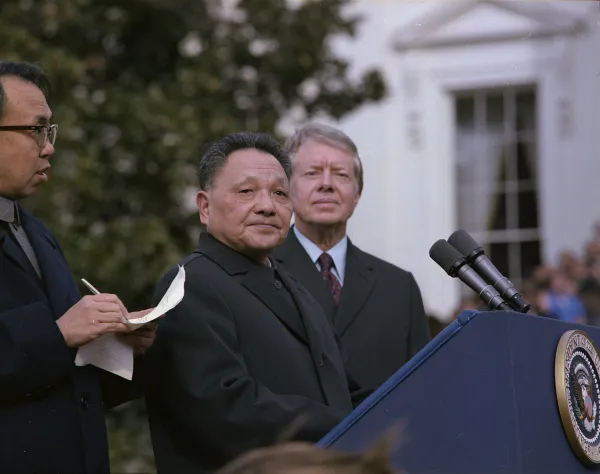
Several plenums have marked turning points in contemporary Chinese history. The Third Plenum of the 11th Central Committee in 1978 initiated the reform era associated with Deng Xiaoping.
 Deng Xiaoping and Jimmy Carter at the arrival ceremony of Deng’s visit to the US (1979). (Wikimedia Commons)
The Sixth Plenum of the 19th Central Committee in 2021 adopted the Party’s third historical resolution, consolidating Xi’s political and ideological position. The Fifth Plenum of 2015 announced the universal two-child policy.
Notably, the Fourth Plenum in October 2025 adopted recommendations for the 15th Five-Year Plan (2026–2030), departing from the usual sequence in which Fifth Plenums address development planning. Another relevant precedent is the Sixth Plenum of 2016, which adopted regulations on internal Party political life ahead of the Party Congress in 2017.
Story continues below this ad
The 2026 meeting similarly precedes a Party Congress by approximately a year, making its emphasis on discipline and organisational cohesion particularly significant.
What does this emphasis mean in practice?
Since assuming leadership in 2012, Xi has made comprehensive and rigorous Party self-governance (quan mian cong yan zhi dang) central to his political programme. It encompasses combating corruption, enforcing political discipline, supervising officials and ensuring compliance with central directives.
The underlying principle is the Party’s self-revolution (dang de zi wo ge ming): the CPC’s conviction that it must continuously correct internal weaknesses to preserve its governing authority and maintain the Party’s legitimacy and effectiveness.
The disciplinary vocabulary is revealing. The Central Commission for Discipline Inspection (CCDI) has warned against ‘duplicitous’ officials (liang mian ren) who profess loyalty while acting otherwise, and ‘nice-guyism’ (hao ren zhu yi), whereby officials avoid confronting misconduct to preserve personal relationships. Both expressions highlight concerns about superficial loyalty and weak accountability.
Story continues below this ad
On October 23, the Politburo acknowledged continuing problems in central Party and state institutions and demanded substantive rectification. The timing underscores that the forthcoming Plenum concerns not merely political loyalty but also the institutional capacity to implement central decisions effectively.
Could this also affect China’s economic growth?
China’s economic transformation historically relied on provincial experimentation, local entrepreneurship and competition among regional governments. Under Xi, however, political authority has become increasingly concentrated, narrowing the autonomy traditionally enjoyed by local officials.
This tension is acute amid weak domestic demand, local government debt and pressures for technological upgradation. Beijing needs provincial governments to attract investment, support private enterprise and implement reforms. Yet intensified anti-corruption investigations and political supervision can encourage risk aversion, with officials prioritising compliance over initiative.
Recent official discourse emphasises adapting policies to local conditions (yin di zhi yi) and encouraging officials to take responsibility and act (dan dang zuo wei). It acknowledges that effective governance requires administrative initiative alongside political discipline.
Story continues below this ad
The emerging approach resembles selective decentralisation. However, administrative delegation within centrally prescribed boundaries is not equivalent to political decentralisation. The test is whether tighter Party supervision can coexist with meaningful local discretion. China’s economic performance depends not only on central decisions but also on whether local governments have the confidence and capacity to implement them creatively.
What could the Plenum signal about Xi Jinping’s authority, and the 21st Party Congress?
Recent investigations and personnel removals make this Plenum particularly consequential. The anti-corruption campaign has reached senior Party officials and military commanders, including individuals previously considered close to Xi.
According to the Asia Society Policy Institute’s estimates, nearly a quarter of the Central Committee’s original 2022 membership may be unable to attend on account of potentially being purged. Even the highest levels of the Central Military Commission (CMC), China’s apex military leadership body, have not been spared the anti-corruption campaign, with only two of the seven members still standing, raising questions about institutional stability and military leadership.
These developments reveal a paradox: disciplinary enforcement may consolidate Xi’s personal authority while exposing weaknesses in the institutions and personnel responsible for implementing his decisions.
Story continues below this ad
The next Party Congress will determine the leadership lineup. Xi, at 73, is widely expected to seek a record-extending fourth term as Party general secretary. Leaders before him served two terms, and he broke from tradition in 2022. Any appointments, promotions or confirmed expulsions at the Plenum will attract scrutiny, although major leadership decisions may be deferred until 2027.
The larger question is whether Xi can rebuild an experienced and trusted leadership team after extensive removals. Rather than a formal succession meeting, the Plenum may indicate how he intends to manage political continuity and institutional renewal.
What are the wider implications of tighter Party governance for China?
Although the Fifth Plenum focuses on Party governance, its implications extend to China’s economic priorities and international standing.
Stronger Party supervision could improve accountability, curb corruption and ensure consistent implementation of national priorities. However, political discipline alone cannot resolve structural economic problems or stimulate domestic demand. China’s governance system will ultimately be judged by its ability to translate industrial ambitions into sustainable economic growth.
Story continues below this ad
Internationally, greater political cohesion could strengthen Beijing’s capacity to pursue long-term technological and strategic objectives amid geopolitical competition. Yet foreign investors and trading partners will assess whether tighter Party control improves regulatory predictability or further concentrates decision-making, reducing transparency and flexibility.
The wider significance of the Fifth Plenum will depend on how its decisions reshape the relationship between Party supervision, institutional accountability and policy implementation. The central question is whether tighter political control can strengthen China’s governing capacity while sustaining economic dynamism and confidence among its international partners.