For people in China, there are two holidays each year that last seven days: the National Day holiday, from 1 to 7 October, and the Spring Festival holiday. Most people choose to travel during the National Day holiday, so this week is known as “Golden Week”.
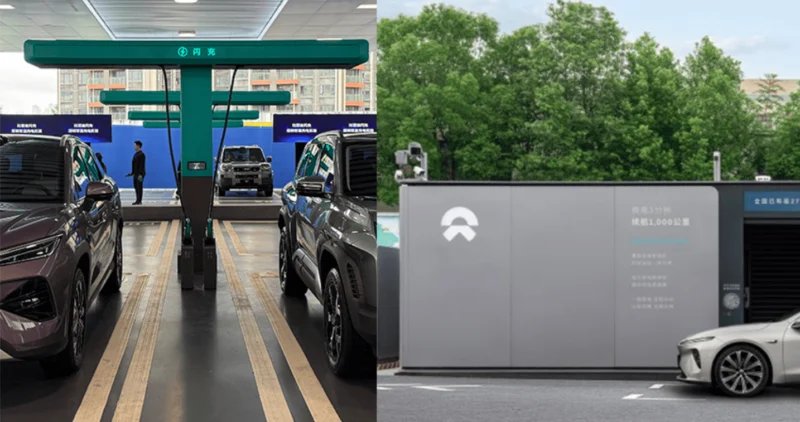
In China, which has a very large number of electric vehicles, this undoubtedly puts charging infrastructure to the test. BYD and Nio have both published figures on how their Flash-Charging and battery-swapping networks performed during Golden Week. The data show that, in terms of efficiency, Nio’s battery-swapping service is three times as efficient as BYD’s Flash Charging service.
Flash Charging vs swapping
BYD, leveraging its network of 12,165 Flash Charging stations, facilitated over 1.22 million charging sessions. The network’s peak performance saw 188,344 vehicles served in a single day. On this day, BYD completed an average of 15.5 charging sessions per flash-charging station.
On the other side, Nio continues to champion its signature battery-swapping model. With 4,168 stations nationwide, the network’s peak performance saw 188,344 vehicles served in a single day. On this day, Nio completed an average of 44 swapping sessions per flash-charging station.
By comparison, on their respective busiest days, a single Nio battery-swap station carried out approximately three times as many battery swaps as a BYD Flash Charging station completed flash charges.
Nio’s busiest station completed 211 battery swaps in a single day, while BYD’s busiest site carried out 160 charging sessions.
Performance comparison
The following table summarises the key performance metrics for both networks during the holiday period:
| Metric | BYD (flash charging) | Nio (battery swapping) |
|---|---|---|
| Total stations | 12,165 | 4,168 |
| Peak single-day services | 188,344 vehicles | 183,664 swaps |
| Peak day average service | 15.5 vehicles per station | 44 swaps per station |
| Peak station service volume | 160 charges in a day | 211 swaps in a day |
| Peak station session time | 9′ per charge | 6′ 49″ per swap |
Open networks vs proprietary networks
Chinese law does not allow “exclusive charging networks”, charging facilities established by any manufacturer must be open to vehicles from other brands. BYD’s approach is to make half of its Flash-Charging connectors available to all vehicles, and reserve the other half for BYD models.
Even so, not all BYD models support flash charging. Just as the amount of water a barrel can hold depends on its shortest stave, how long a Flash Charge user has to wait to charge their vehicle depends not only on them, but also on how long the vehicle currently charging takes to finish.
As a result, for a long time BYD’s flash-charging network could not operate at full capacity: if the owner of a BYD model capable of flash charging arrived at a charging station and found the chargers already occupied by older BYD models that don’t support Flash Charging, they had no choice but to wait until those cars had finished charging before they could use the flash-charging service.
As no other models have yet joined Nio’s battery-swapping network, its swap stations have effectively become an “exclusive battery-swapping network” for Nio electric vehicles. So far, this has made its overall energy replenishment efficiency three times that of BYD’s flash charging.


Most important news in your inbox.
Recaps
· scheduled
All you need, in one email.
Instant alerts
· real-time
Ping me when an article goes live.
of 27 topics selected