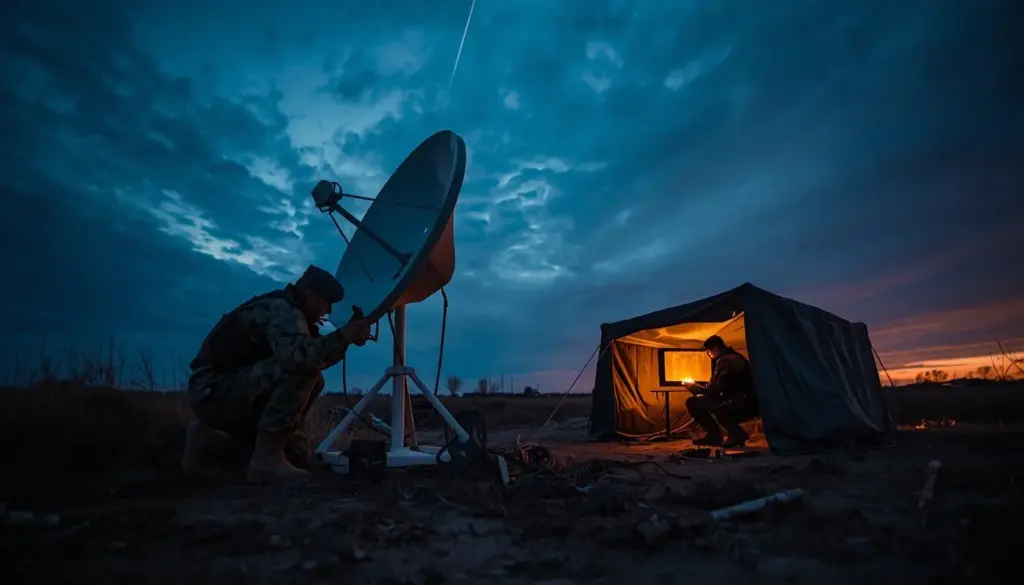
AT&T, Verizon and T-Mobile want the FCC to carve two prized mid-band slices out of a satellite-to-phone proposal, and reporting from TeslaNorth frames the fight as a race over who controls the airwaves Starlink Mobile needs to reach ordinary handsets. The carriers filed their position through CTIA, the wireless trade group. They object to the 2.5 GHz and 3.45 GHz bands, which they say carry terrestrial 5G traffic that satellites could disrupt.
The timing matters. The FCC released its draft on October 8, and it is reported as scheduled for a commission vote on October 29, four days from today. Investors have already watched this storyline move markets once, as we covered when AT&T fell 5.6% on reports that SpaceX eyed 80,000 cell sites. This time the dispute is about spectrum rules, not tower real estate.
One caution up front. Nothing has been decided. The FCC has not adopted the proposal, has not approved the listed bands for satellite use, and has not authorized Starlink Mobile to operate in them. Describing the draft as something that would “benefit” SpaceX is a characterization from the coverage, not an established outcome. This analysis lays out what the filings and reports confirm, what the dispute means for 5G network hardware and handsets, and where it likely goes next.
Don’t miss new tech stories on Google
Add Tech Insider once in the Google app and our stories appear in your news suggestions.
Add Now
What the Carriers Told the FCC
The three largest US mobile carriers rarely align this tightly in public. In this case they did, and they chose CTIA as the vehicle. According to the reporting, the joint position asks the FCC to exclude the 2.5 GHz and 3.45 GHz bands from the expanded satellite-to-phone pool. Their stated reason is possible interference with terrestrial 5G and mobile-broadband networks.
The filing goes beyond the two bands. CTIA also asked the commission to apply comparable performance requirements to satellite and terrestrial networks, and it urged a “same customer, same rules” approach. In plain terms, if a satellite service sells coverage to the same person who would otherwise use a carrier network, it should face similar obligations on reliability and quality.
A third request deals with control. CTIA asked that terrestrial carriers keep “meaningful consent” and control over how satellites use their licensed spectrum. That phrase carries the real weight of the filing, because the draft would change how satellite operators gain access in the first place.
The FCC Draft: 482 MHz and Coexistence Agreements
The framework at the center of the dispute is called Supplemental Coverage from Space, or SCS. It lets satellite operators extend coverage to ordinary phones by using spectrum that terrestrial carriers hold. The October 8 draft would add 482 MHz of spectrum to satellite-to-phone services, according to the cited reporting.
The draft also changes the mechanism. Under the current approach, a satellite operator generally has to lease spectrum from a terrestrial licensee. The draft would replace that spectrum-leasing requirement with coexistence agreements. A lease gives the carrier a commercial lever, since the satellite company must negotiate terms and pay for access. A coexistence agreement shifts the conversation toward technical compatibility, and the carriers worry it dilutes their veto.
That is why CTIA’s “meaningful consent” language appears in the filing. Carriers read the lease-to-coexistence swap as a quiet transfer of leverage. A satellite operator that no longer needs a lease can approach the commission with an interference showing instead of a carrier with a rate card.
Why 2.5 GHz and 3.45 GHz Are the Flashpoint
Carriers did not object to the whole 482 MHz. They singled out two bands, and the choice is revealing. Mid-band spectrum in this range is where modern 5G earns its keep. It balances coverage and capacity better than low bands, which travel far but carry little, and better than millimeter wave, which carries plenty but barely penetrates a wall.
Coverage from these bands powers the speeds consumers now expect from 5G. UK operators are building on the same logic, as shown when O2 pushed its 5G+ service to 219,000 people in Cumbria. Mid-band holdings are the asset carriers monetize most directly, so any new user sharing those frequencies, even from orbit, raises a flag.
Reports describing the filings say the two bands use time-division duplexing. That means uplink and downlink traffic share the same frequencies in tightly coordinated time slots. The carriers argue a satellite transmitting or receiving in those bands could upset that choreography. The objection concerns synchronization as much as raw signal strength, and it is a difficult one to settle with a simulation alone.
The 290 MHz Math
Excluding the two bands would remove 290 MHz from the proposal, according to the reporting. Simple subtraction shows what that does to the plan. The table below separates confirmed figures from arithmetic derived from them.
| Item | Figure | Basis |
|---|---|---|
| Spectrum the FCC draft would add | 482 MHz | Cited reporting |
| Bands carriers want excluded | 2.5 GHz and 3.45 GHz | CTIA filing, per reporting |
| Spectrum those two bands represent | 290 MHz | Cited reporting |
| Spectrum left if both are excluded | 192 MHz | Derived (482 minus 290) |
| Share of the proposal in dispute | About 60% | Derived (290 divided by 482) |
| Draft release date | October 8 | Cited reporting |
| Reported FCC vote date | October 29 | Cited reporting |
| 2024 AT&T downlink loss claim | 18% average | AT&T, separate 2024 proceeding |
The derived numbers tell the story. Roughly three of every five megahertz in the proposal sit in the two bands the carriers want out. If the FCC grants the request in full, the headline figure shrinks from 482 MHz to 192 MHz. A satellite operator would then work with a much smaller and probably less useful menu.
That arithmetic explains the intensity of the lobbying. Carriers are not nibbling at the edges. They are contesting the majority of the new allocation, and the contested portion happens to be the mid-band spectrum most valuable for capacity.
How Satellite-to-Phone Interference Works
Interference in a satellite-to-phone setup differs from the familiar kind between two cell towers. A satellite moves fast, covers a vast footprint and speaks to phones that were never designed with it in mind. Its signals arrive at the ground from above, and a single satellite can touch many terrestrial cells at once.
Time-Division Duplexing Raises the Stakes
In frequency-division systems, uplink and downlink live on separate frequencies, so a stray signal in one direction rarely corrupts the other. Time-division systems alternate on a single frequency, and every base station in an area must agree on the same clock. An outside transmitter that breaks that rhythm can hurt many cells at once. This is the heart of the carriers’ technical case, based on how the reports describe the filings.
What It Means for Handset and Radio Hardware
Phones carry radios built around band lists. Whether a handset can talk to a satellite depends on whether its modem and antenna support the bands in question. Choosing which bands enter the SCS pool therefore shapes which devices work on day one and which need new silicon. Spectrum policy and chip design move together here. A decision on October 29 would give modem makers and phone vendors a concrete target, though no new satellite-capable handset was identified in the research behind this story.
CTIA’s “Same Customer, Same Rules” Argument
Beyond the technical objections, CTIA made a regulatory fairness argument. If a customer cannot tell whether a call rides a tower or a satellite, the rules governing both should look alike. Carriers shoulder coverage commitments, build-out deadlines and performance obligations tied to their licenses. A satellite service reaching the same subscriber, they argue, should meet comparable benchmarks.
The argument has teeth for one reason. Regulators judge licensees by what they deliver, and a new entrant using adjacent or shared spectrum could, in the carriers’ view, collect the benefits of access without the same accountability. Whether the FCC treats satellite coverage as supplemental or as a competing service will shape how seriously it weighs the point.
There is a counterargument, and SpaceX’s allies will likely make it. Satellite coverage fills gaps where towers do not exist, so holding it to the same standards as dense urban networks could defeat its purpose. The commission has to decide how to weigh that tension.
Where SpaceX and Starlink Mobile Fit In
SpaceX is the satellite operator associated with the Starlink Mobile effort in the reporting, and reports such as Drive Tesla’s coverage of the carrier pushback describe the draft as helping its ambitions. That reading is an interpretation, and the sources do not show SpaceX winning anything yet. The reviewed reporting also does not detail SpaceX’s own filing in this round, so this article does not attribute specific arguments to the company.
What the record does show is a pattern of carriers contesting SpaceX’s spectrum requests. The Starlink network already has a hardware track record outside the US, where we reported that Starlink speeds in Ukraine were restored after throttling. That kind of operating history gives SpaceX a credible technical story, even as carriers question how its signals behave over US cities.
The carrier angle also connects to corporate strategy. A Bloomberg-based account we examined described how SpaceX eyes 80,000 US cell sites for a carrier bid. If SpaceX wants to behave like a fourth carrier, incumbents have every reason to guard the spectrum that would make that possible.
Lessons From the 2024 Interference Fight
This is not the first clash. In a separate 2024 proceeding, AT&T said a SpaceX proposal could produce an 18% average reduction in downlink throughput in an operational AT&T PCS C Block market deployment. AT&T described the proposed interference as “unacceptable harmful interference” in that filing, as quoted in reporting. Coverage at the time, including The Verge’s August 2024 report, showed the two largest rivals leaning on the FCC together.
Verizon took a procedural route in its own filing. It said SpaceX “has failed to demonstrate that its requested waiver of the aggregate out-of-band PFD limit meets the Commission’s waiver standard.” The sentence is dense, but the message is simple. Verizon argued SpaceX had not met the legal bar for an exception to emission limits.
The two filings illustrate the playbook. AT&T quantified harm with a throughput number, while Verizon attacked the legal basis for a waiver. Expect both approaches again, since the same companies are now arguing over a much larger block of spectrum. The earlier technical exchange is also outlined in DCD’s coverage of the interference fears.
Competitive Comparison: Who Wants What
The table below summarizes each party’s stated position based on the reporting and filings cited. Where the sources are silent, the table says so.
| Party | Core ask | Main concern | Tool used |
|---|---|---|---|
| AT&T | Exclude 2.5 GHz and 3.45 GHz | Interference with terrestrial 5G | CTIA filing, plus 2024 throughput claim of 18% |
| Verizon | Exclude 2.5 GHz and 3.45 GHz | Interference with terrestrial 5G | CTIA filing, plus FCC waiver-standard argument |
| T-Mobile | Exclude 2.5 GHz and 3.45 GHz | Interference with terrestrial 5G | CTIA filing |
| CTIA | Comparable requirements and “meaningful consent” | Loss of carrier control over licensed spectrum | Trade-group submission |
| SpaceX (Starlink Mobile) | Not detailed in the reporting reviewed | Not detailed in the reporting reviewed | Not detailed in the reporting reviewed |
| FCC draft | Add 482 MHz, swap leasing for coexistence agreements | Expand satellite-to-phone coverage | October 29 vote, as reported |
The gap in the SpaceX row deserves honesty. Much of the public record in this round comes from the carriers, which makes the story look lopsided. The FCC will weigh a fuller file than any news summary captures, and readers should treat single-sided coverage with some caution.
Historical Context: From Leasing to Coexistence
For years, carriers and satellite companies sat in separate regulatory lanes. Carriers bought licenses at auction and built towers. Satellite operators used their own bands and sold to ships, planes and remote sites. Phones in your pocket stayed on terrestrial networks.
The SCS framework blurred that line by letting satellites supplement carrier coverage using carrier-held spectrum. The leasing requirement kept the arrangement commercial, because a satellite company needed a carrier partner. The October draft would loosen that tie. Coexistence agreements still involve negotiation, but the carrier no longer holds the single key.
Each step in this history widened SpaceX’s path and raised carrier anxiety. The 2024 skirmishes covered individual waivers. The current draft covers the framework itself. That jump in scope is why the three carriers filed jointly through CTIA instead of arguing one by one.
Market Impact for Carriers, Investors and Device Makers
Markets care about this fight because spectrum is the scarcest input in wireless. A carrier’s mid-band holdings underpin its capacity, its fixed wireless products and its ability to defer costly new cell sites. Any rule that lets a competitor share those frequencies tests the valuation of the assets.
For SpaceX, a favorable rule lowers the cost of reaching a phone directly and could speed a consumer launch. For tower owners and carriers, an unfavorable one adds a rival that does not need to build towers. The merger angle sharpens the picture. Our analysis of the SpaceX-Tesla merger’s antitrust test at $3.5T notes how much connected hardware a combined company could control.
Device makers face a quieter exposure. A decision that adds many bands or few changes the radio roadmaps for upcoming phones. No price, launch date or product detail for Starlink Mobile is confirmed in the reporting, so any claim about consumer packaging remains speculation at this stage.
Predictions: What Happens Next
These are analytical judgments, not reported facts. Each could fail if the FCC changes course.
- The vote may slip or arrive amended. Items on an FCC open meeting agenda are sometimes edited right up to the meeting. A joint filing from all three major carriers raises the odds of at least a partial change to the band list.
- A split outcome looks likelier than a clean win. The commission could keep some of the 482 MHz while carving out one of the two contested bands, or it could keep both and attach interference conditions.
- Coexistence agreements will draw the next fight. If the leasing requirement goes away, expect carriers to push for detailed technical standards inside those agreements, along with dispute-resolution rules.
- Petitions for reconsideration are probable. Whoever loses on October 29 has a path to ask the FCC to revisit the order, which extends the uncertainty into the new year.
- Hardware roadmaps will follow the band list. Modem and handset makers will wait for the final text before committing to band support, so real-world satellite-capable phones trail the ruling by a product cycle.
What It Means for Phone Buyers and Network Engineers
Consumers will not feel anything on October 30. Rules come first, then equipment, then service. If the final order keeps the mid-band spectrum in play, the long-run benefit is wider coverage in dead zones. If the carriers prevail, the satellite pool narrows, and coverage depends more on lower, less contested bands.
Network engineers have a more immediate to-do list. Teams running time-division 5G in the two bands should document their current performance baselines now. If satellite use is approved and degradation appears, a pre-existing baseline makes interference claims far easier to prove. More hardware coverage lives in our hardware section.
FAQ
What did AT&T, Verizon and T-Mobile ask the FCC to do?
Through CTIA, they asked the commission to exclude the 2.5 GHz and 3.45 GHz bands from its Supplemental Coverage from Space expansion. They also asked for comparable performance requirements for satellite and terrestrial networks.
How much spectrum does the FCC proposal add?
The cited reporting says 482 MHz. Excluding the two contested bands would remove 290 MHz of that total, leaving 192 MHz by simple subtraction.
When does the FCC vote?
The draft was released October 8 and reporting says the vote is scheduled for October 29. Agenda items can change before a meeting, so watch for updates.
Has the FCC approved Starlink Mobile to use these bands?
No. The FCC has not adopted the proposal, approved the bands or authorized Starlink Mobile to use them. The headline claim that the draft benefits SpaceX is a characterization from coverage.
Why do carriers worry about interference?
Their objections concern possible interference with terrestrial 5G and mobile-broadband networks. Reports say the contested bands use time-division duplexing, which depends on tightly coordinated timing.
What is a coexistence agreement?
It is an arrangement between a satellite operator and a terrestrial licensee to share spectrum without harmful interference. The FCC draft would use these agreements in place of a spectrum-leasing requirement.
What does “same customer, same rules” mean?
It is CTIA’s phrase for holding satellite and terrestrial services to comparable performance requirements when they serve the same subscribers.
Does this affect my phone today?
Not directly. Any change would take time to reach devices and networks, and no new satellite-capable handset or Starlink Mobile pricing has been confirmed in the reporting reviewed.

