- GBP/USD remains depressed as Fed hike bets and geopolitical risks support the USD.
- BoE rate hike bets offer some support to the GBP and help limit losses for spot prices.
- Traders also seem hesitant amid relatively thin liquidity conditions on Black Friday.
The GBP/USD pair trades with a negative bias for the second straight day, hovering around the 1.3100 mark during the Asian session on Friday amid a modest US Dollar (USD) uptick.
Wednesday’s US macro data – the Personal Consumption Expenditures (PCE) Price Index and the Q3 GDP report – pointed to stubbornly high inflation and resilient economic growth, underpinning prospects for further policy tightening by the Federal Reserve (Fed). Moreover, traders are pricing in two more rate increases in early 2027 after the expected 25 basis points (bps) Fed hike in December. Moreover, geopolitical risks act as a tailwind for the safe-haven Greenback, which, in turn, is seen exerting some pressure on the GBP/USD pair.
In the latest development, US President Donald Trump said during annual Thanksgiving calls with US military personnel that America has victory at hand in its war on Iran, while expressing uncertainty over whether Iran would accept the opportunity for a deal. Meanwhile, Saudi Arabia and Yemen’s Iran-backed Houthis are trading increasingly intense strikes on strategic sites, including oil infrastructure and ports. This marks a sharp escalation in fighting between the two sides, which backs the case for further appreciation of the USD.
The British Pound (GBP), however, could draw support from the growing acceptance that the Bank of England (BoE) will hike interest rates in December. Moreover, Markets are pricing in a high probability of further tightening priced into 2027. This might hold back traders from placing aggressive bearish bets on the GBP/USD pair in the absence of any relevant market-moving economic releases, either from the UK or the US. Nevertheless, spot prices seem poised to register modest gains for the first time in the past four weeks.
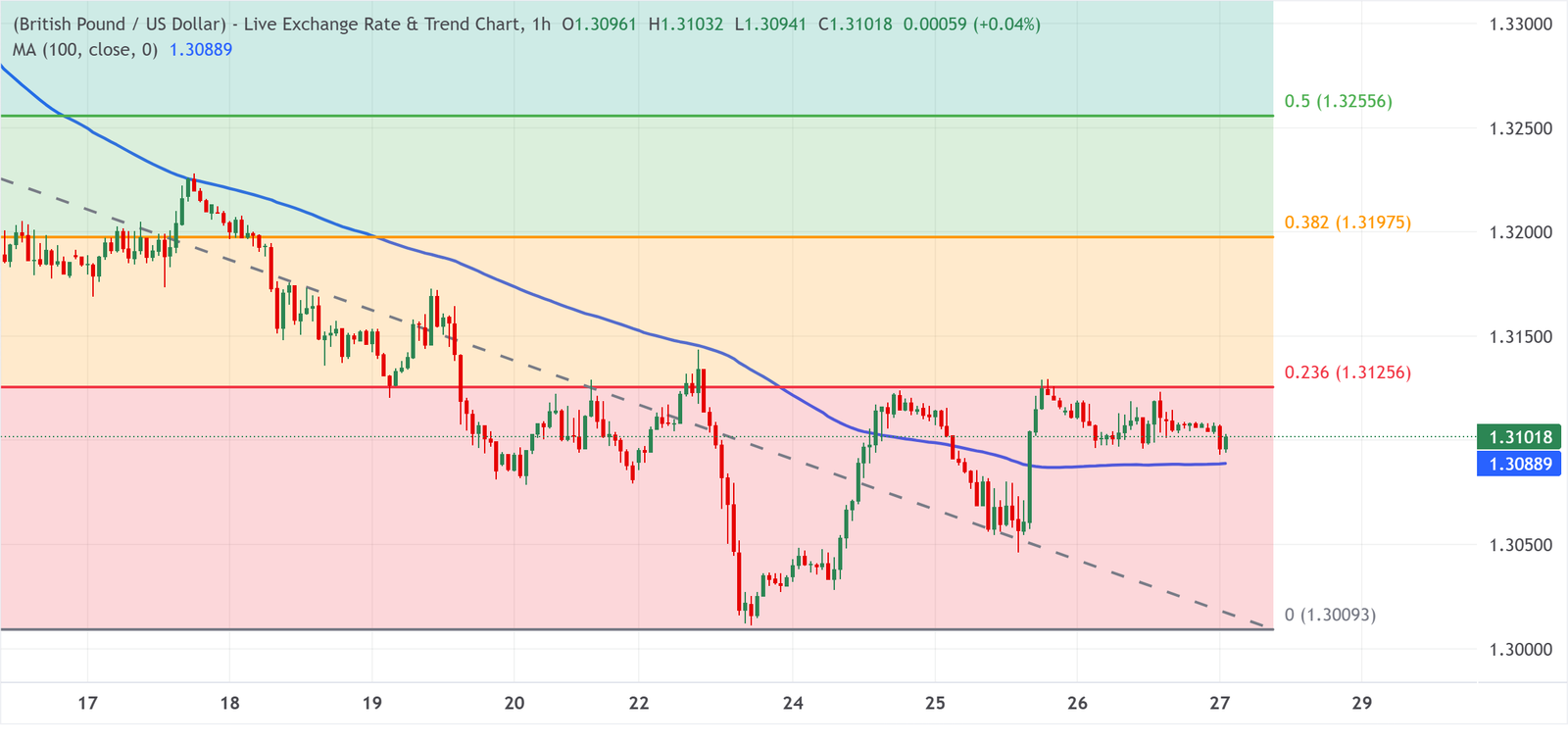
GBP/USD 1-hour chart
Technical Analysis
The GBP/USD pair holds above the 100-hour Simple Moving Average (SMA) at 1.3089, keeping a mildly bullish intraday bias. Spot prices, however, remain below the 23.6% Fibonacci retracement at 1.3126 of the 1.3009–1.3502 swing, suggesting topside attempts are being capped. This is followed by higher Fibonacci barriers at 1.3197 and 1.3256, ahead of broader levels at 1.3314 and 1.3397, with the 1.3502 swing high acting as a distant cap. On the downside, immediate support is offered by the 100-period SMA at 1.3089, while a deeper pullback would expose the structural floor at 1.3009.
(The technical analysis of this story was written with the help of an AI tool. Know more.)
Pound Sterling FAQs
The Pound Sterling (GBP) is the oldest currency in the world (886 AD) and the official currency of the United Kingdom. It is the fourth most traded unit for foreign exchange (FX) in the world, accounting for 12% of all transactions, averaging $630 billion a day, according to 2022 data.
Its key trading pairs are GBP/USD, also known as ‘Cable’, which accounts for 11% of FX, GBP/JPY, or the ‘Dragon’ as it is known by traders (3%), and EUR/GBP (2%). The Pound Sterling is issued by the Bank of England (BoE).
The single most important factor influencing the value of the Pound Sterling is monetary policy decided by the Bank of England. The BoE bases its decisions on whether it has achieved its primary goal of “price stability” – a steady inflation rate of around 2%. Its primary tool for achieving this is the adjustment of interest rates.
When inflation is too high, the BoE will try to rein it in by raising interest rates, making it more expensive for people and businesses to access credit. This is generally positive for GBP, as higher interest rates make the UK a more attractive place for global investors to park their money.
When inflation falls too low it is a sign economic growth is slowing. In this scenario, the BoE will consider lowering interest rates to cheapen credit so businesses will borrow more to invest in growth-generating projects.
Data releases gauge the health of the economy and can impact the value of the Pound Sterling. Indicators such as GDP, Manufacturing and Services PMIs, and employment can all influence the direction of the GBP.
A strong economy is good for Sterling. Not only does it attract more foreign investment but it may encourage the BoE to put up interest rates, which will directly strengthen GBP. Otherwise, if economic data is weak, the Pound Sterling is likely to fall.
Another significant data release for the Pound Sterling is the Trade Balance. This indicator measures the difference between what a country earns from its exports and what it spends on imports over a given period.
If a country produces highly sought-after exports, its currency will benefit purely from the extra demand created from foreign buyers seeking to purchase these goods. Therefore, a positive net Trade Balance strengthens a currency and vice versa for a negative balance.
Disclaimer: For information purposes only. Past performance is not indicative of future results.