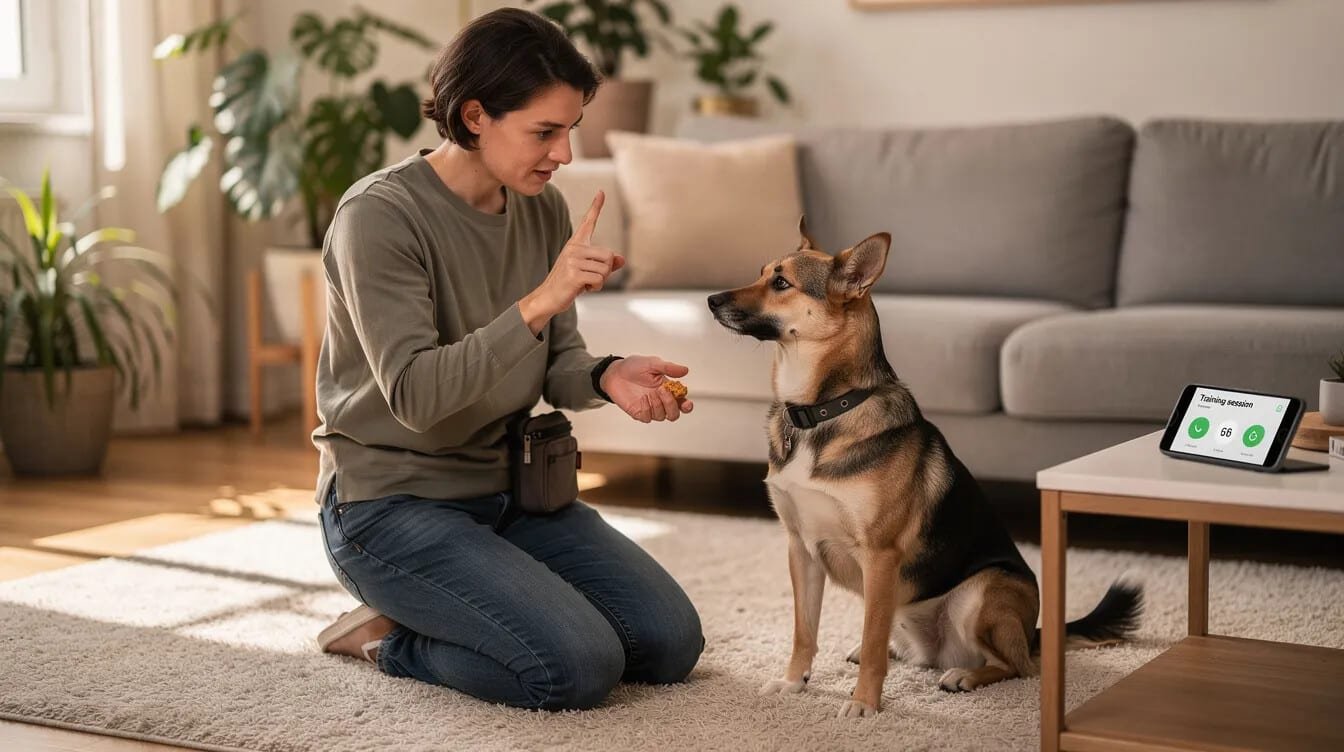
Training does not have to be a perfect 30-minute session. A few minutes on the couch, one command on a walk, one habit repeated until it sticks. That is what moves the needle with a dog, and it is what the best dog training apps are built to support.
There is now peer-reviewed evidence behind that idea. In early 2025, University of Lincoln researchers published the first study on whether structured app training changes a dog’s behavior. The finding was cautious but real: puppy owners who completed more of an app’s core modules tended to report milder problem behaviors later. Not magic. Not a cure. Just consistent practice adding up.

This is less a ranking of logos than a working shortlist: five dog training apps worth your time in 2026, what each is good at, where each falls short, and a plain way to match one to your dog. We judged them the way a trainer would: does it fit a real day, does it follow behavior science, and is it honest about what an app can and cannot do.
Do dog training apps actually work?
Short answer: yes, for what they are designed to do. Dog training apps are strong at consistency, structure, and progress tracking. They turn vague intentions into daily lessons you can finish before the kettle boils. They are not a replacement for hands-on help with serious behavior cases.
As a category, dog training apps have grown fast because they solve a real problem. Most dog owners want to train the right way but do not have time for long training sessions or a standing class. Training apps fill that gap with structured training plans, reminders, and reward based training.
What the research says
The University of Lincoln study (in the journal Animals, February 2025) surveyed a subset of 367 owners who either did no formal training or used only one puppy training app. Higher completion of the app’s first four chapters was associated with lower odds of more severe problem behaviors, including less aggression toward familiar people and reduced house soiling. It is observational, so it shows association, not proof of cause. Still, it is the first peer-reviewed signal that app-based puppy development can help prevent problems before they set in.
That matches what pet parents describe in practice, and how plenty of dog parents train day to day. Reported benefits of sticking with a training app that uses positive reinforcement cluster around a few things:
- faster response to basic cues once practice becomes a daily habit
- steadier leash walking and better recall when the app breaks skills into small steps
- more impulse control around food, doors, and guests
- quicker wins on trick training, which keeps motivation high for both of you
Good dog training apps also teach you to read your dog. Learning canine body language is half the job, and the valuable information they share about body language sticks because you use it the same day.
What dog training apps cannot do
Apps are a foundation-skills and daily-habit layer. They are not built to treat separation anxiety, resource guarding, severe aggression, or compulsive behaviors on their own. Those cases need a qualified professional who can watch your dog in real time.
If you are dealing with any of those, book one of the certified trainers in your area or a veterinary behaviorist. Use an app alongside that work, not instead of it. Setting realistic expectations up front is the difference between an app that helps and one that frustrates you.
How we chose these dog training apps
Feature lists are easy to pad, so we weighed the things that decide whether an app actually helps:
- Fits real life. Short training sessions you can do daily beat a long plan you quit by week two.
- Reward-based methodology. The training approach should sit on positive reinforcement, in line with the current professional consensus.
- Honest guidance. The app should be clear about what it covers and when to call in a pro.
- Life-stage fit. A new puppy, an adolescent, and a senior need different things.
- Progress tracking. Streaks, logs, and milestones that keep you consistent without nagging.
- Trainer credentials behind the content.
No single app wins on every one of these. The right pick is the one that fits your dog and the way you actually live day to day.
The best dog training apps in 2026
1. Woofz, best all-round training and care habit
Woofz is the pick if you want one place for training and everyday care, built around your specific dog rather than a generic curriculum. The app is a free download on iOS and Google Play, and it runs entirely on positive reinforcement, with lessons created by certified dog trainers.
The core of it is My Plan, a personalized path that adapts to your dog’s age, situation, and goals from a short onboarding quiz. Instead of guessing what to do next, you get a step-by-step queue of lessons, quizzes, and practice steps designed to build a daily habit rather than just hand you information.
Around that sits Explore, a content library for when you have a specific goal. That is where you find command practice (basic obedience through fun tricks), a Commands Bootcamp, and troubleshooting programs for common issues like chewing, barking, and pulling. Practice flows are short by design, the kind of thing you slot into daily life.
Woofz also goes past commands into routine and care: daily goals, activity and walking logs, relaxation content, and calendar-style progress tracking. You can keep multiple dog profiles, share the setup with family so everyone trains the same way, and ask the in-app AI helper a quick question when you are unsure what to do next.
- Best for: owners who want structured training plus a care routine in one app, at any life stage
- Platforms: iOS, Android
- Free vs paid: free tier covers the first level of My Plan, a set of basic commands, early quizzes, and the daily wellness routines and logging. Most commands, quizzes, programs, and the deeper analysis layer sit behind a subscription.
- Pricing: a 3-day free trial is common (some users see a 7-day offer), then an auto-renewing subscription. US prices have ranged from roughly $7.99 to $9.99 weekly, $12.99 monthly, and $29.99 to $59.99 yearly, though prices vary by country and platform and change often. Accurate at time of writing; check the live listing. Cancel anytime in Settings.
- Rating: around 4.6 stars on the App Store across tens of thousands of ratings at time of writing
- Key features: My Plan, Explore, Commands Bootcamp, wellness routines, support for multiple dogs on one account, and family sharing.
- Watch out: the app is a daily-practice tool, so results depend on you showing up. Serious behavior cases still need a pro.
2. Zigzag, best for a brand-new puppy

Zigzag is the most puppy-focused option here, and the one with published science attached. The app is built as a week-by-week puppy development program that follows your dog’s age, with a strong emphasis on welfare, positive reinforcement, and emotional development rather than drills.
This is the app behind that University of Lincoln study, which makes it a rare puppy training app with peer-reviewed research on structured puppy development. The lesson progression is clear and linear, which suits first-time puppy owners who want a path to follow from day one: potty training, crate training, socialization, and basic training in a sensible order.
The plan adapts as your puppy grows, so the lessons at eight weeks are not the ones at six months. That week-by-week structure works like personalized programs for early puppy development, which is what makes the app easy to stick with when a new puppy feels like a lot at once.
- Best for: new puppy owners who want a guided, science-informed first year of puppy development
- Platforms: iOS, Android
- Trade-off: the focus is puppies, so it has less to offer once your dog is grown. The subscription centers on the puppy program.
3. Dogo, best for feedback on your actual training

The Dogo app pairs structured programs with something most apps skip: a human looking at your work. The app’s video exams let you record your dog doing a skill, submit the clip, and get notes back from a trainer, usually within a day. The app is the nearest thing to professional oversight without booking a live session.
Beyond that, the Dogo app offers 100-plus guided lessons from potty work through obedience and tricks, each with short demo videos, quizzes, a built-in clicker, and milestone tracking.
- Key features: video exams, 100-plus daily lessons, a built-in clicker, and milestone tracking.
- Best for: owners who want a trainer glancing at their homework
- Platforms: iOS, Android
- Pricing: a 7-day free trial, then around $9.99 monthly or about $99.99 yearly at time of writing. Prices vary, so confirm before you sign up.
- Trade-off: feedback is asynchronous, not a live lesson, and depth thins out for advanced goals.
4. Pupford, best free foundation course

Pupford leads with one of the strongest free offers around: a 30-day foundation course for new owners, taught with positive reinforcement and led by well-known trainer Zak George, covering recall, leash work, house training, and impulse control. If you want to test the water before paying, it is a genuinely good app to start with.
Past the free course, Pupford Academy opens up deeper programs, detailed videos, and behavior content, with the option of longer subscriptions and, at times, lifetime access deals. Some owners find the free lessons a little general, but as a free entry point the app is hard to beat.
- Best for: new dog owners who want a strong free tier before committing
- Platforms: iOS, Android
- Trade-off: the best material sits in the paid Pupford Academy, and some technical complaints (playback, crashes) show up in reviews.
5. Puppr, best for tricks and fun

Once the foundations are solid, Puppr is where training gets fun. The app leans into trick training with 80-plus lessons from celebrity trainer Sara Carson and her Super Collies, a built-in clicker, clear step-by-step videos, and positive reinforcement throughout. There is a free version with starter lessons, so you can teach a few tricks before deciding on Premium.
Puppr Premium (around $12.99 monthly or $99.99 yearly after a 7-day trial, at time of writing) opens up the full library and live in app chat with the trainer team, so you get quick chat support between lessons. The app is less a structured puppy path and more a deep, user friendly trick library.
- Best for: owners who love teaching tricks; a great app with a big visual library
- Platforms: iOS, Android
- Trade-off: it is built for tricks, not behavior correction, so pair it with a foundation app for problem behaviors.
How to choose the best dog training app for your dog
With the five best dog training apps here, the decision comes down to your dog and your habits.
The biggest differences are not the feature lists but how much an app adapts to your dog and how much support sits behind it. An app that changes as your dog learns keeps you engaged far longer than a static checklist, so weigh that as heavily as price.
Match the app to your dog’s life stage
A new puppy needs foundation skills in the right order: socialization, potty training, crate training, and basic cues, ideally in short lessons repeated daily. Housebreaking, or toilet training, usually comes first. The critical socialization window runs from about three to fourteen weeks, so puppy owners benefit most from an app with reminders and step tracking during that stretch.
Puppy training works best in short, frequent reps. A dedicated puppy training app that follows puppy development week by week keeps you from asking a puppy for too much too soon, and it turns toilet training and socialization into small daily wins.
Adopted an older dog? Give them room to settle before you drill anything. Adult dogs often do best with impulse-control and obedience work, while senior dogs need slower, calmer sessions. The best puppy training app for a 9-week-old is rarely the best app for a 9-year-old.
Check the training approach
This one is not a matter of taste. The American Veterinary Society of Animal Behavior (AVSAB) recommends that only reward-based methods be used for all dog training, including behavior problems, because the evidence shows aversive methods carry welfare risks and no added benefit. Reward based training builds confidence and protects the bond between you and your dog.
So screen for it. Any app worth using should state that its training methodology is built on positive reinforcement methods, not punishment or dominance. All five dog training apps here qualify, which is not an accident.
Look at trainer credentials
Dog training is unregulated in the United States, which means anyone can call themselves a dog trainer. That makes trainer credentials the clearest quality signal you have.
The main one to know is CPDT-KA, from the Certification Council for Professional Dog Trainers (CCPDT), the leading US certifying body. It requires at least 300 hours of hands-on experience and a 200-question exam, with recertification every three years. For medical or serious cases, look for certified trainers who specialize there, or a veterinary behaviorist (a board-certified DACVB). When you weigh an app, check whether its lessons were written by qualified trainers with real trainer credentials, not anonymous content teams.

Weigh the level of guidance you want
Be honest about how much hand-holding you need:
- Self-guided: structured training plans you follow on your own (Woofz, Zigzag, Pupford). Lowest cost, most flexible.
- Video feedback: submit clips, get trainer notes (the Dogo app). A middle path with light professional oversight.
- Live coaching: for weekly one-on-one time with real trainers, you are into hiring a certified trainer directly, in person or online. No app fully replaces that, and for serious cases it is where pro trainers and certified trainers earn their fee.
Most owners do fine self-guided and only want more when one problem stalls them. If that happens, booking an in person trainer for a session or two on top of the app is often enough to get moving again.
Read the pricing and trial terms
Most dog training apps use auto-renewing subscriptions, and the free download is just the front door. Before you commit, check three things: what the free tier really includes, when the first week or trial ends, and how to cancel. A few apps sell lifetime access as a one-time option, which can beat a subscription if you plan to use the app for years.
Paid tiers add extra features like deeper analytics and more programs. Prices shift by region and platform, so treat any number you read as a starting point and confirm on the App Store or Google Play. Most pet owners start on the free tier and upgrade only once the habit sticks. Clear trial and renewal terms are a sign of a good app that respects your time and money.
Frequently asked questions
What is the best free dog training app?
For a truly free start, Pupford’s 30-day foundation course and Puppr’s free tier are the strongest. Woofz is also a free download with a usable free level, including its wellness routines and daily logging. If “free” means you never pay, expect limits: most training apps reserve their deeper programs and personalized content for paying users. A free version is a great way to test whether an app’s training approach clicks with you before you sign up.
How much do dog training apps cost?
Most dog training apps are a free download, then charge a subscription after a short trial. Self-guided apps typically run from a few dollars a week to roughly $30 to $100 a year, depending on the app, region, and current offer. A few sell lifetime access as a one-time payment instead of a subscription, which can work out cheaper over several years. Always confirm the price on the App Store or Google Play, because these numbers move.
What is the 3-3-3 rule for dog training?
The 3-3-3 rule is a guideline for helping a newly adopted dog settle: about 3 days to decompress, 3 weeks to learn your routines, and 3 months to feel fully at home. It is not a strict schedule, and every dog is different, but it sets realistic expectations so you do not rush training in week one.
What is the 7-7-7 rule for dogs?
The 7-7-7 rule is used two ways. Some trainers use it like the 3-3-3 rule but stretched out (roughly 7 days, 7 weeks, and 7 months of adjustment for a nervous or rescued dog). Others mean the puppy “Rule of Sevens,” a socialization checklist: before about 7 weeks or in the early weeks at home, expose your puppy to 7 different surfaces, 7 locations, 7 types of people, 7 challenges, and so on, always kept positive.
Are dog training apps worth it?
For most dog owners, yes. Dog training apps cost far less than a run of in person classes, and they turn training into short daily lessons and short sessions you can keep up. The value shows up only when you use them. If your dog has a serious issue like separation anxiety, treat training apps as a support layer, not a fix. For everyday manners, basic obedience, and daily habit building, the best dog training apps are well worth the money.
Can a dog training app replace a dog trainer?
No, and the honest apps say so. A dog training app is built for practice and consistency, not for reading your dog in real time. For puppy basics and trick training it can carry most of the load, but a live dog trainer catches timing and body language a phone cannot. For medical or serious cases, work with certified trainers or a veterinary behaviorist. Think of it as a team: the app handles daily reps, real trainers the hard parts.
The bottom line
The best dog training apps have made structured, reward-based learning cheaper and more accessible than a run of in-person classes, and there is now research suggesting it genuinely helps with puppy development. No app replaces a pro for severe cases, and none works if it sits unopened. The best dog training apps simply give pet parents a next step instead of leaving you to figure it out alone.
Pick the one that fits your dog and your day. Then open it, teach one thing, reward it, and let tomorrow build on today. Your furry friend does not need a perfect trainer. Just a consistent one.
Sources
- American Veterinary Society of Animal Behavior, Position Statement on Humane Dog Training (2021):
- Rowland, T. et al. “Educational Apps and Dog Behavioural Problem Prevention,” Animals 2025, 15(4), 520:
- University of Lincoln, “New Training App Could Reduce Problematic Behaviours in Dogs” (March 2025):
- Certification Council for Professional Dog Trainers, dog trainer certification:
- Woofz on the App Store (pricing and rating, at time of writing):