TL;DR: A surprisingly weak jobs report has flipped the RBA outlook from hikes toward rate cuts, adding an Australia-specific leg to the Aussie’s risk-driven slide. With the key 0.6755 retracement now broken, AUD/USD is on track toward 0.65, and inflation data and the December 8 RBA meeting are the next tests of the easing bias.
Why Is the Australian Dollar Falling After the Jobs Shock?
Australian Dollar extended its broad decline on Thursday after a surprisingly weak employment report reinforced expectations that RBA’s next interest rate move will be a cut rather than another hike. AUD/USD fell to around 0.6688 in Asian trading, breaking decisively below an important medium-term technical support level, while overnight index swap (OIS) pricing shifted further toward monetary easing in 2027. Although the December meeting is still expected to deliver no change, markets now price approximately 31bps of cumulative rate cuts over the next 12 months, compared with only 6bps earlier this week.
The currency’s weakness has developed against a broader backdrop of cautious global risk sentiment, with AUD underperforming every other major currency over the week. However, Thursday’s additional selling coincided with a sharp reassessment of Australia’s domestic interest rate outlook, even as Japanese and South Korean equities recovered. The combination of weaker labor market data, falling rate expectations and deteriorating technical momentum suggests that AUD/USD’s decline may have further to run.
Follow AUD/USD’s slide toward 0.65 and the RBA repricing behind it on the ActionForex Telegram channel.
Employment Shock Undermines Case for Further RBA Tightening
Australia’s unemployment rate rose from 4.7% to 4.9% in October, its highest since October 2021 and above expectations for an unchanged reading. Employment contracted by 43.5K against forecasts for a 25.2K increase, following September’s revised decline of 36.4K. The back-to-back employment losses provide evidence that labor market conditions have weakened more substantially than previously anticipated.
The deterioration extended beyond the headline employment figures. The number of unemployed people increased by 17.8K to 753.7K, while the employment-to-population ratio declined from 63.6% to 63.3%. Total hours worked also fell 0.2%, reinforcing the picture of reduced labor demand. Although ABS trend estimates indicate a more gradual weakening than the volatile monthly figures suggest, the latest report adds significantly to concerns that Australia’s labor market is losing momentum.
- Unemployment rate: 4.7% to 4.9% (highest since October 2021)
- Employment: −43.5K (forecast +25.2K); September revised to −36.4K
- Unemployed people: +17.8K to 753.7K
- Employment-to-population ratio: 63.6% to 63.3%; total hours worked: −0.2%
The employment disappointment has substantially weakened the case for further RBA tightening. With unemployment rising and employment contracting for a second consecutive month, the policy debate has shifted away from whether additional rate increases are needed and toward when the Bank might begin reversing previous tightening. That does not imply an imminent cut, particularly while inflation remains an important consideration, but the latest figures have changed the balance of risks surrounding the interest rate outlook.
RBA Pricing Shifts From Hike Expectations to Cuts in 2027
The change in OIS pricing illustrates how quickly expectations have moved. As recently as Tuesday, November 17, markets still assigned a modest premium to further tightening, with approximately 6.5bps of cumulative increases priced by February and March 2027.
By Thursday, November 19, that tightening premium had disappeared. OIS pricing at approximately 06:05 GMT showed almost no change expected at the December 8 meeting, with just 0.6bps of easing implied. February was similarly close to unchanged at 1.2bps of cuts, while March carried 4.3bps of cumulative easing.
The expected policy shift becomes considerably more pronounced from mid-2027. Markets priced 9.8bps of cumulative cuts by May, 16.0bps by June, 22.8bps by August and 28.3bps by September. By the November 2027 meeting, approximately 31.3bps of easing was implied, compared with just 6.2bps on Tuesday. That represents roughly 25bps of repricing in two days.
- December 8: about 0.6bps of easing; February: about 1.2bps; March: about 4.3bps
- May: about 9.8bps; June: about 16.0bps; August: about 22.8bps; September: about 28.3bps
- November 2027: about 31.3bps (6.2bps on Tuesday, roughly 25bps of repricing in two days)
The figures point to an emerging easing bias rather than expectations for an immediate policy reversal. With the cash rate currently at 4.85%, the market-implied path increasingly favors lower rates during the second half of 2027. The December meeting is still overwhelmingly viewed as a hold, but the prospect of another hike has largely disappeared from near-term pricing.
AUD Weakness Broadens Beyond Global Risk Aversion
Australian Dollar has been the weakest of the eight major currencies over the past week, declining against every counterpart in the weekly FX heat map. The strength of JPY and USD during the period suggests that global risk aversion has contributed to the selling pressure.
However, the currency’s performance also points to an Australian-specific component. AUD/NZD fell approximately 0.7% from Tuesday’s 1.2253 to 1.2167, despite NZD occupying a more neutral position in the weekly currency rankings.
Thursday’s Asian session provided a clearer contrast between domestic and global influences. AUD/USD was trading around 0.6688, down 0.36%, while Dollar Index gained only 0.07% to 103.887. Meanwhile, Nikkei rose 0.63% and KOSPI advanced 0.38%, indicating that the latest AUD weakness occurred without a corresponding selloff in those regional equity markets.
The divergence strengthens the case that RBA rate repricing is contributing to Thursday’s additional decline, rather than the move being driven solely by broader risk aversion. The sharp change in expected Australian interest rates also provides a fundamental explanation for the currency’s sustained underperformance.
ActionForex’s Technical View: AUD/USD, Breakdown Opens Path Toward 0.65
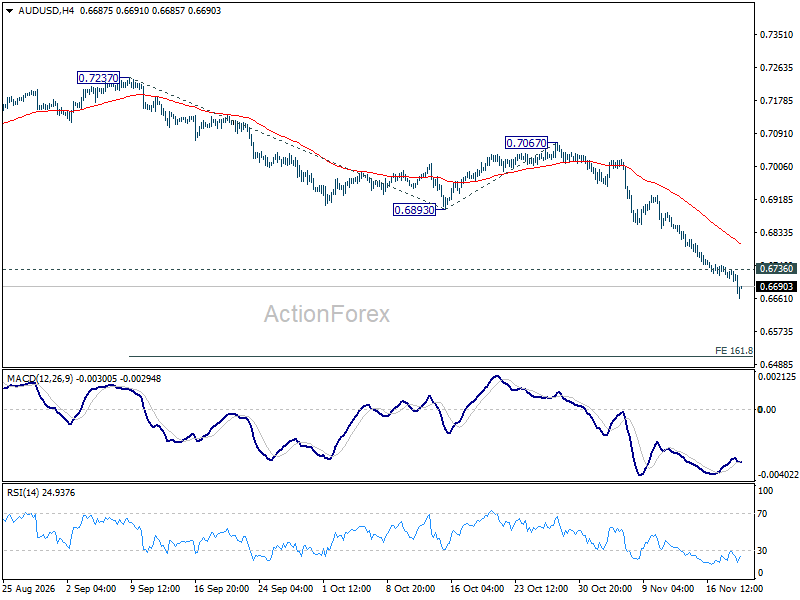
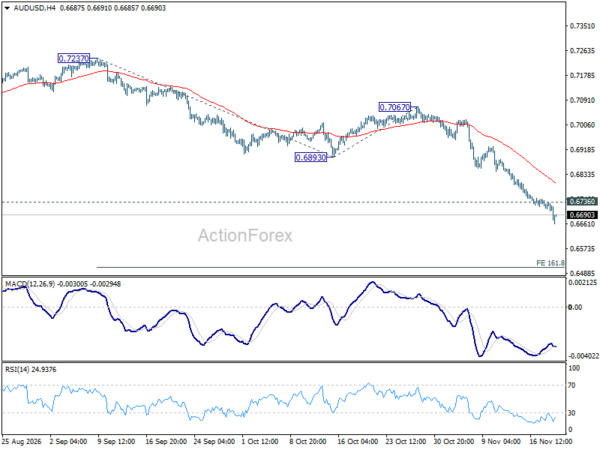
AUD/USD’s decline from 0.7277 extended further after the employment release, with bearish momentum intact despite increasingly oversold conditions. Four-hour RSI has fallen to around 24.9, but there is no convincing sign of bottoming. The pair remains on track toward the 161.8% projection of 0.7237 to 0.6893 from 0.7067, at 0.6510.
A recovery above 0.6736 would indicate short-term consolidation, particularly given the oversold momentum readings. However, the near-term outlook will stay bearish as long as 0.6893, which has turned from support into resistance, holds in the event of a rebound.
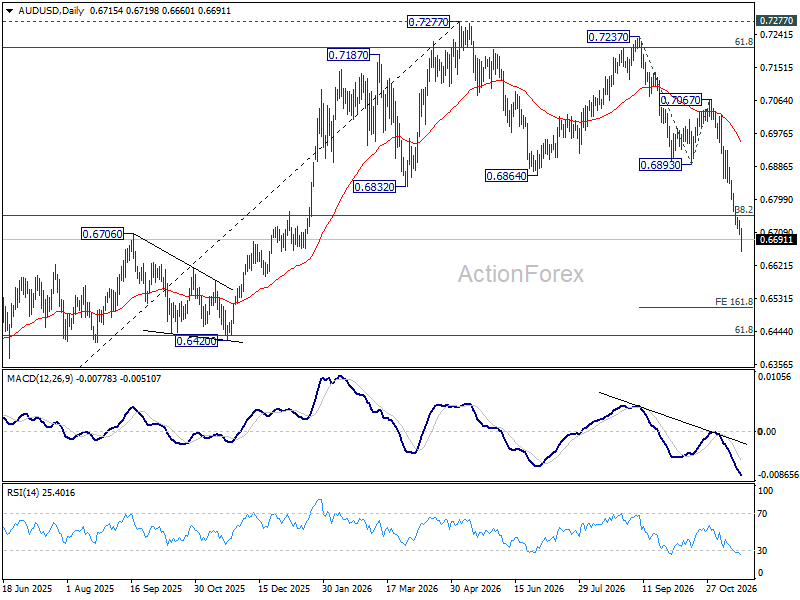
The daily chart reinforces the bearish outlook. The fall from 0.7277 has accelerated, with daily RSI near 25.4 and MACD continuing to deteriorate. More importantly, the 38.2% retracement of the advance from 0.5913 to 0.7277, at 0.6755, is now firmly broken. The break marks a significant deterioration in the medium-term technical structure and strengthens the case for an extension of the current decline.
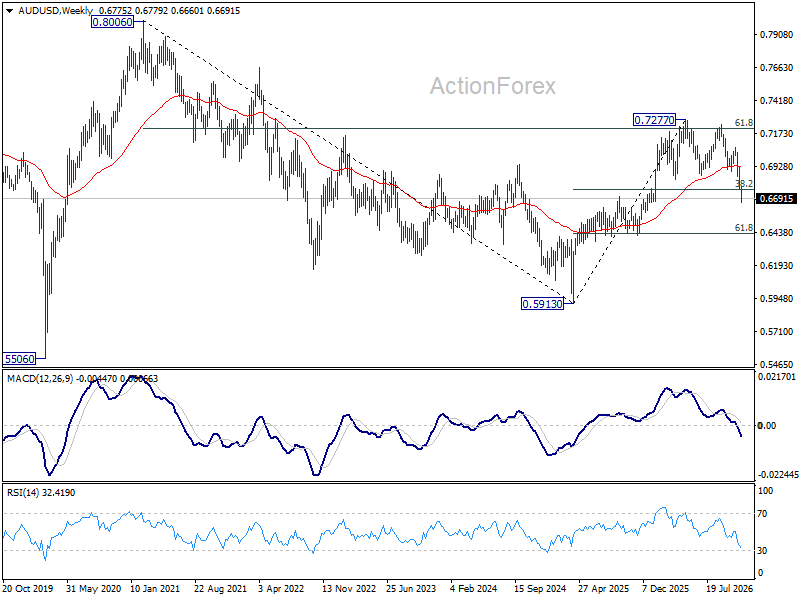
The weekly perspective suggests that the implications may extend beyond the immediate downside projection. Current momentum raises the possibility that the entire advance from the 2025 low of 0.5913 to 0.7277 is being reversed. Even if the decline ultimately proves corrective, AUD/USD should target the 61.8% retracement at 0.6434 after the nearer-term objective at 0.6510.
The December 8 RBA meeting and upcoming inflation readings will test the durability of the market’s emerging easing bias. Stronger inflation could revive some expectations for tighter policy, while an unwinding of the recently priced cuts would weaken the interest rate argument for further AUD losses. For now, the combination of deteriorating employment conditions, a decisive shift in OIS pricing and the break below 0.6755 supports maintaining a bearish outlook toward 0.6510, with 0.6434 emerging as the next major objective.
Key Takeaways
- Australian unemployment rose to 4.9% and employment fell 43.5K (forecast +25.2K), the second straight monthly decline, weakening the case for further RBA tightening.
- OIS pricing now implies about 31.3bps of cuts by November 2027, up from 6.2bps on Tuesday, while December is still expected to be a hold.
- AUD was the weakest major currency on the week, and Thursday’s drop came as the Nikkei and KOSPI rose, pointing to an Australia-specific component.
- AUD/USD broke the 0.6755 retracement and is on track toward 0.6510, with 0.6434 as the next major objective.
- Resistance sits at 0.6736 and 0.6893, and the December 8 RBA meeting and upcoming inflation readings are the next tests of the easing bias.
Stay ahead of AUD/USD’s slide toward 0.65 and the RBA signals that could extend or reverse it—join the ActionForex Telegram channel for regular market updates and analysis.