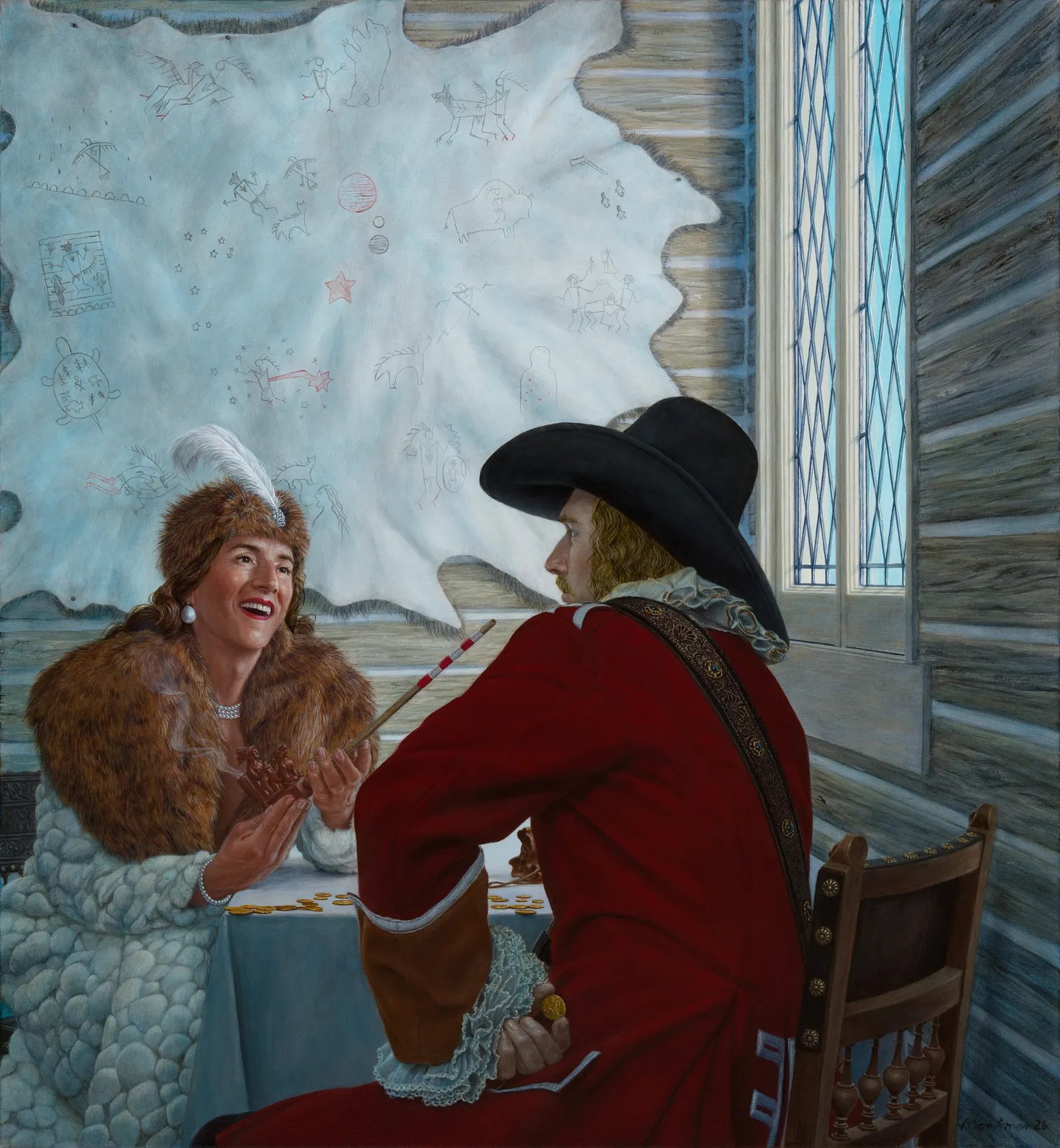
When, four years ago, the Frick Collection invited the Indigenous artist Kent Monkman to create a series of new works, Monkman turned his attention to one of the museum’s smallest—yet most cherished—holdings: Johannes Vermeer’s Officer and a Laughing Girl. The painting, from 1657, depicts a young woman in conversation with an officer wearing a wide-brimmed black beaver hat.
“Beavers used to drive the economy of North America,” says Monkman, who is Cree. “They were the first currency—you paid for things with beaver pelts.”
His wheels soon began to turn. In his practice, Monkman likes to rewrite European art and history from an Indigenous perspective. Could he give this Vermeer a Native twist, with a bit of his signature sense of humor?
The answers to that question make up “Kent Monkman: Officer and Laughing Girl,” on view in the Frick Collection’s Cabinet Gallery from now through February.

Kent Monkman, New Amsterdam, 1600s, 2026. Acrylic on canvas.Photo: Kent Monkman Studio
In his new acrylic paintings, Monkman replaces the female figure in Vermeer’s original scene with his genderfluid alter-ego, Miss Chief Eagle Testickle, a frequent presence in his work. “Miss Chief has always been in strategic relationships with colonial men,” Monkman says. “She’s always trying to improve the life of her people. She is someone that stands up, talks back, reverses the gaze, and questions authority—and she always does it in a way that is with love. She’s always trying to seduce people with love.”
Over four years, Monkman and his studio created five different versions of Officer and a Laughing Girl using his Miss Chief character. (At the Frick, they’re all set against beaver-themed toile wallpaper.) Not only do both Miss Chief and the officer’s clothes evolve from one painting to the next, but their setting shifts, too, reflecting different elements of Indigenous history. “Through these paintings, I knew I could have a conversation about colonial history, fur trade, treaty relationships, geography, and the dispossession of land,” Monkman says.