Advanced Micro Devices (AMD +5.30%) and Nvidia (NVDA +1.02%) are two of the biggest names in the artificial intelligence (AI) chip market. Their graphics processing units (GPUs) are the most popular options, and each is growing rapidly. However, from an investment standpoint, they are fundamentally different, especially when price tags are considered.
Nvidia is far cheaper than AMD, and this is something that investors can’t ignore. I think that makes Nvidia the superior buy, but is there more to this picture? Let’s take a look.
Image source: The Motley Fool.
Nvidia is defying the law of large numbers
Nvidia and AMD both make GPUs, which are general purpose computing units that can excel in just about any situation. This makes them the workhorse of the AI computing landscape, even as other custom AI alternatives grow more popular. Those custom chips are only meant to run one type of workload and will never fully replace GPUs.
NVDA Nvidia
$218.20+$2.20 (+1.02%)
NASDAQ · As of 1:13 PM ET 10/27/26
In the early days of the AI arms race, Nvidia’s products were far superior, which allowed it to capture an early lead. While AMD has improved its game, Nvidia’s early lead has been tough to overcome. However, the law of large numbers suggests that the larger a company gets, the harder it is to grow. Therefore, if AMD is smaller, then it should be able to grow faster than Nvidia. If everything else is equal, a faster-growing stock will lead to better long-term returns, which would push AMD ahead of Nvidia as an investment option. The problem is, it isn’t happening.
AMD Advanced Micro Devices
$559.43+$28.15 (+5.30%)
NASDAQ · As of 1:12 PM ET 10/27/26
Nvidia is far larger than AMD. Nvidia’s data center division (the sector most exposed to AI) saw revenue of $89 billion during the second quarter of its fiscal year (FY) 2027 (ended July 26). AMD’s Q2 (which ended on June 30) saw revenue of $6.7 billion. The company’s financial calendars are about one month apart, so this isn’t a perfect comparison, but it’s the best that investors can do. With AMD’s data center division being more than 10 times smaller than Nvidia, it should have no problem growing faster, but Nvidia’s growth in Q2 was 117% versus AMD’s 107%.
While both companies are each delivering strong results, Nvidia is clearly growing faster despite its much larger size. But there’s more to this analysis.
AMD and Nvidia also have non-data-center segments. However, Nvidia’s other businesses are far smaller, and data center revenue accounts for the majority of Nvidia’s $96.2 billion total. AMD’s Q2 revenue was $11.5 billion, so other divisions make up a far higher percentage of its revenue. The problem is that these product lines aren’t growing nearly as fast, so AMD’s overall growth rate significantly lags Nvidia’s.
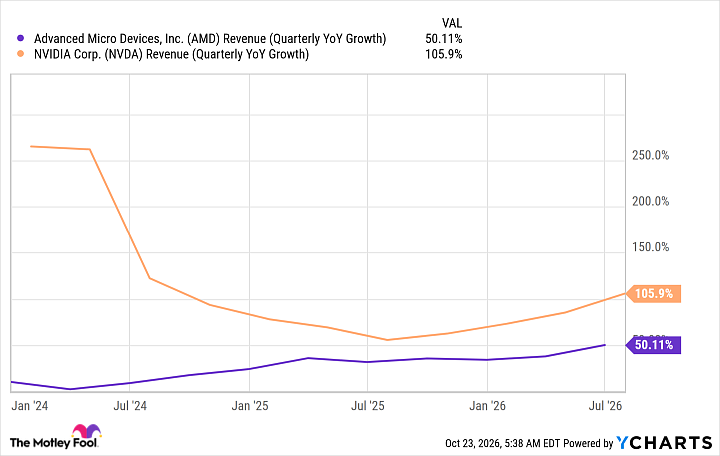
AMD Revenue (Quarterly YoY Growth) data by YCharts.
With this kind of growth disparity, you’d expect Nvidia to have a premium valuation relative to AMD, as it is growing far faster. But that’s not the case.
AMD’s stock is far more expensive than Nvidia’s
Because these two are expected to grow rapidly over the next few quarters, I think valuing them based on forward earnings makes a lot of sense. From this perspective, AMD is basically three times more expensive than Nvidia.
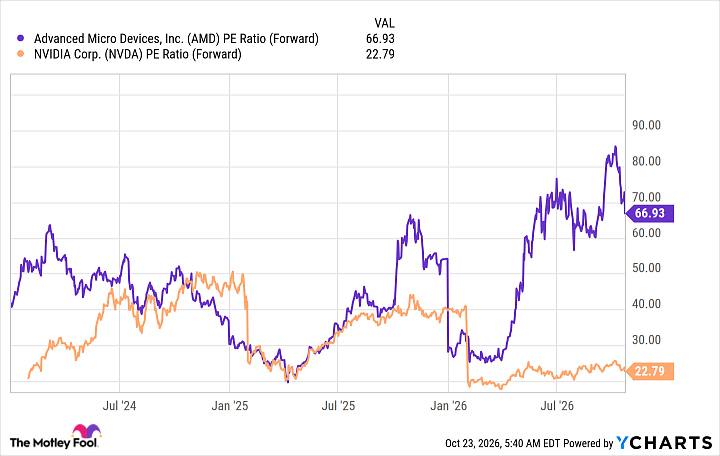
AMD PE Ratio (Forward) data by YCharts.
That’s a huge gap that doesn’t seem logical, but that’s how the market is pricing these two stocks. I think this is a huge mistake, and eventually it will correct itself so that these two stocks trade at roughly the same valuation. Whether that’s caused by an AMD sell-off or an Nvidia rise is uncertain, but I’m confident that Nvidia will be the far better stock to own over the next few years. Its broad exposure to the AI arms race will boost the stock over the next few years, leading it to outperform AMD over the long term.