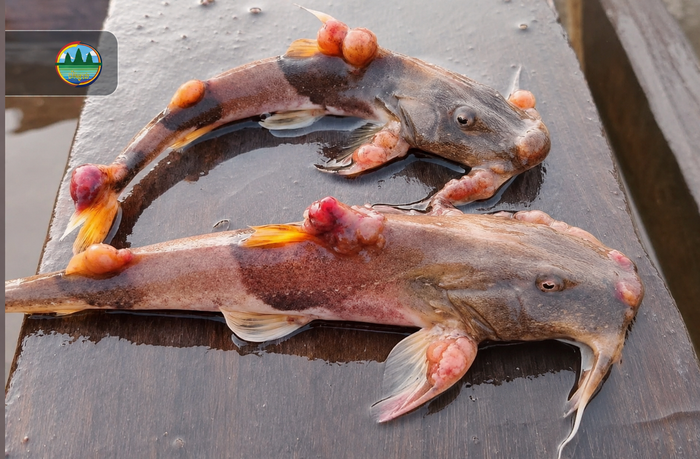
Disgusting appearance with blisters and lumps all over the body
Suspicion of heavy metal contamination due to mining development
Detection of heavy metals such as arsenic in the Mekong River
Authorities urge China and Myanmar to block pollution

A series of bizarre-looking so-called “zombie fish” have been discovered in Thailand’s Mekong River, raising concerns among local residents.
According to Hong Kong’s South China Morning Post (SCMP) on the 16th (local time), a series of catfish fish “Pla Khae” with blisters and bumps on the body or changed fin color have been discovered in the Mekong River in northeastern Thailand. Local residents are calling the fish a ‘zombie fish’ in the bizarre appearance.
As the cause of abnormal symptoms, the possibility of heavy metal contamination due to the development of mines in the upper Mekong River is raised. Aombun Tipsuna, who has been involved in environmental protection activities in the Mekong River basin, claimed heavy metals from mines in Myanmar, Laos, and China were polluting the river. “If these fish continue to remain in the Mekong, their condition will worsen,” he warned, raising the possibility that this may have weakened the fish’s immunity and made them vulnerable to disease.
In fact, the concentration of heavy metals is rapidly increasing in the Mekong River area. According to a survey of water quality at 10 Mekong River locations in August this year by the Thai Pollution Control Office, arsenic concentrations exceeded surface water standards in Luizhu, Nongkai, and Bungkhan provinces bordering Laos. A September survey also found that arsenic concentrations in most regions exceeded the standard. Earlier this month, 0.3 milligrams of arsenic per liter was detected in the Saigang River in Chiang Rai, northern Thailand, 30 times the standard. The Saigang River is a river that flows into the Mekong River.

The problem is that the contamination of the river can threaten the residents’ tables. According to the Mekong River Commission (MRC), about 69 million people lived in the Mekong River basin as of 2020. Many of them rely on rivers for their livelihoods, such as agriculture and fishing. Water drawn from about 2500 pumping facilities installed along the river is used for drinking water and agricultural water, and agricultural products grown with this water are also sold in major Thai wholesale markets.
In particular, plaques with abnormal symptoms are widely consumed for food, raising the possibility of heavy metals accumulating in the human body through the food chain. Long-term consumption of fish with accumulated harmful heavy metals such as arsenic, mercury, lead, and cadmium can lead to health problems such as organ damage or nervous system abnormalities, according to a researcher at Naresuan University in Thailand.
As concerns over pollution in the Mekong River grew, the Thai government also came up with a solution. First of all, consultations with neighboring countries are being promoted to respond to the mine development in Shan State, Myanmar, which is suspected to be a source of pollution. It also urged Chinese and Myanmar authorities to set up blocking facilities to prevent mine wastewater from flowing into rivers.
Thai Prime Minister Anutin Chanwiragwan also raised the issue with China on the 13th, and it is known that the ASEAN summit will continue related discussions.