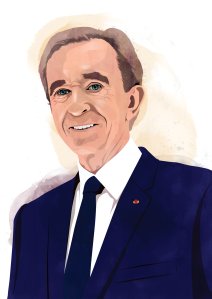
One of the chief architects of the modern fashion and luxury industries, and as chairman and chief executive officer of one of France’s most successful and valuable companies — LVMH Moët Hennessy Louis Vuitton — Bernard Arnault is known widely in Paris circles by his initials alone, B.A.
What is perhaps less known about him is his distaste for the word luxury — he prefers the term “high-quality products” — and his rather unorthodox view on profits, seeing them as the natural consequence of an intense focus on innovation, product excellence, craftsmanship and brand desirability.
He practices what he preaches, famously spending his Saturdays doing a round of store visits, typically stopping at the Dior flagship on Avenue Montaigne, the multilevel Louis Vuitton store within Galeries Lafayette, and perhaps a swing by Le Bon Marché, the Left Bank department store that is also part of the LVMH group, home to more than 75 brands across fashion and leather goods, perfumes and cosmetics, watches and jewelry, wines and spirits, selective retailing and a smattering of hospitality and media brands.
One of the most successful French entrepreneurs of the modern age, widely admired for his steely determination, long-range vision and passion for strong creativity, Arnault is the 2026 recipient of the John B. Fairchild Honor, which recognizes a career of influence and distinction in the fashion industry.
Named after WWD’s legendary and feared publisher and chosen by its current editors, the honor was introduced in 2016 as part of WWD’s annual celebration of creative vision, performance and leadership in the fashion industry. Past winners include Ralph Lauren, Karl Lagerfeld, Leonard Lauder, Giorgio Armani, Miuccia Prada, Tommy Hilfiger, Maria Grazia Chiuri, Brunello Cucinelli and Valentino Garavani and Giancarlo Giammetti.
To be sure, Arnault has so propelled the cultural status of fashion, leather goods, perfumes, fine liquors and hotels that he is practically a rock star among business leaders, solicited for selfies at LVMH shareholder meetings, and mobbed by media and admirers when he attends events like the Viva Tech fair in Paris, of which LVMH is a founding partner.
Whether in the boardroom, on the tennis courts or — as he’s sometimes found himself over the years — in the law courts, Arnault’s competitiveness is legendary. Rare setbacks have included foiled attempts to take over rivals Gucci and Hermès, and investments in Donna Karan New York, Marc Jacobs and the Phillips auction house, both of which he eventually divested.
While still perceived by some in France as a fearsome corporate raider thanks to the 1988 hostile takeover of Louis Vuitton, Arnault is more often portrayed as an unofficial ambassador for French culture in the world, and its defender at home, donating 200 million euros for the restoration of the Notre Dame cathedral following the catastrophic 2019 fire, and more recently 50 million euros to fund the creation of a new institute for mathematics and fundamental sciences at École Polytechnique, France’s top engineering school, from which he graduated in 1971.
In recent years, he’s also shared the bright spotlight on LVMH with his five children, all of whom have accrued increasing responsibilities within the family-controlled group.
At the company’s annual general meeting last April, Alexandre Arnault, deputy CEO of Moët Hennessy, LVMH’s wines and spirits division; Frédéric Arnault, CEO of Loro Piana; Antoine Arnault, head of communication, image and environment at LVMH; Delphine Arnault, chairman and CEO of Christian Dior Couture; and Jean Arnault, 25, watch director at Louis Vuitton, all took the mic to share highlights of their respective businesses.

Alvaro Tapia Hidalgo/WWD
Sources close to Arnault say that grooming them for success is one of his biggest passion projects as he also dotes on his vast stable of brands.
In 2024, he told shareholders that being family-run helps LVMH stand apart. “We’re trying to create a spirit that is different from purely anonymous companies,” he said at the time. “The role of the family is first and foremost to foster this spirit and it also allows us to have a long-term vision.
“What we care about is making sure that in 10 years’ time, our brands are still as desirable, if not more, as they are now,” he added.
Indeed, the luxury magnate is famously known for looking far beyond quarterly results and near-term volatility, remaining confident about the midterm outlook.
Speaking to shareholders at its annual general meeting last April, as the conflict in Iran was unfolding, he allowed that it could foretell a crisis for the sector.
“It won’t be the first, and chances are we will continue to gain market share, as we did in 2025,” he said at the time.
“What excites, motivates and entertains me is what the group will look like, and how will it be positioned, in five years’ time,” he continued. “I think we’re very well placed to remain by far the leader in the luxury sector.”
Last year, LVMH shareholders approved by more than 99 percent a resolution allowing Arnault to remain as chairman and chief executive officer until the age of 85.
“What I like most is the idea of transforming creativity into profitability,” Arnault told WWD in a 1999 interview. “I see new ideas and the way we are going to make them real products that will work on a worldwide scale. If I have a talent — and that must still be demonstrated — it is that one.”
For creativity, he turned to such fulgurant fashion talents as John Galliano, Lee Alexander McQueen and Marc Jacobs, later recruiting Hedi Slimane, Nicolas Ghesquière, Maria Grazia Chiuri and Jonathan Anderson, contributing to the phenomenon of “star designers.”
Arnault also esteems architects, including Peter Marino, who conceives Dior, Vuitton and Tiffany stores worldwide; Christian de Portzamparc, who designed the prismic LVMH Tower in New York City, and the late Frank Gehry, who created the cloud-like design for the Fondation Louis Vuitton, a vast art foundation in the Bois de Boulogne in Paris.
“Creativity is not coming from marketing executives — they can sell well, they can help with the ad campaigns — it comes from real designers or innovators,” Arnault said in the 1999 interview.
The next year, he released a softcover book titled “Passion for Creativity” that elaborated on his admiration for creative people — and his strong opinions about retail.
“When I walk into one of our stores, I believe I see immediately what is right and what is wrong,” he said in the book. “When it’s good, I say so. And when it’s not, I say so, too.”
The 200-page tome also shed light on how adroitly he can see the big picture in the face of developments like the internet, whose potential for retail was just being explored.
“What is happening with the internet is more than a technological evolution. It’s a fundamental change in the life of the consumer, in everyday life and in business,” he said in the book. “It is of the same nature as the appearance of electricity, the radio, the steam engine and even the printing press. It’s a true rupture. It’s more revolutionary than what has happened with computers over the last 30 years, which have continued to evolve and improve. This [the internet] is not essential technology. It is a totally different means to communicate, to buy, to work between businesses and individuals. It is a new media that is changing the life of business. We are only at the start. There will be a shake-up in consumer behavior as well as relations between businesses.”
Born on March 5, 1949, Arnault has never been a typical French businessman. The son of a builder from industrial northern France, he had studied piano seriously, but abandoned it when he realized he would never play among the world’s greats.
Arnault attended the elite French military and engineering institute, École Polytechnique, but unlike most of his classmates, who immediately began careers at the biggest French companies or in government, Arnault returned to Roubaix to take over the family construction business. Nervous, as were many French capitalists, about the election of Socialist François Mitterrand as president, Arnault went to the U.S. in 1981 to try to expand his family’s business there.
In 1984, he returned to France and used $15 million of his family’s money to invest in Boussac Saint-Frères, a bankrupt textile group which sheltered a crown jewel, Christian Dior.
He beat out better-financed and more-established suitors by courting the bankrupt sellers directly, rather than negotiating with the government bureaucracy charged with the sale. He also impressed Lazard Frères kingmaker Antoine Bernheim, who added credibility and $65 million in financing to the bid.
He became head and majority shareholder of LVMH in 1989, marking the beginning of what has become the world’s biggest luxury group, owner of more than 75 brands including Givenchy, Loewe, Moët & Chandon, Fred, Tag Heuer and Sephora.
At Dior, he cultivated a reputation as a maverick, first by bringing in an Italian designer, Gianfranco Ferré, to succeed longtime designer Marc Bohan and eventually transforming the French ready-to-wear and couture house — one of the country’s most cherished cultural institutions — into a marketing machine to drive sales of accessories and other products.
Next he brought in John Galliano, whose theatrical and sometimes controversial shows further catapulted Dior into fashion’s big leagues.
“What I like is to feel the emotion…I understand his way of thinking, which is, ‘I’m not going to make a presentation to show the products that you can find in the showroom.’ So really, you are shocked by what you see and I like it, I must say,” Arnault said in 1999. “And I agree even more when I see the sales results.”
In a similar vein, Arnault famously attempted to build a couture house from the ground up for designer Christian Lacroix in 1987, but eventually offloaded the business in 2005.
Still, Arnault made clear it was not a charity project, confessing in the 1999 interview that: “I think Lacroix himself understands, maybe better now than at the beginning, that for a designer to be successful and meaningful in today’s world, it’s in the shop and in the street, not in the museum. The designer who counts in the world today has to be successful at selling his products. It’s not only creativity, but creativity that the customer likes.”
Fast-forward to 2026 and Arnault was crowing to shareholders about early consumer response to Anderson’s initial designs for Dior — “It’s off to a flying start, so much so that we’re having trouble delivering products because demand is so high” — and his ambitions to make Tiffany & Co. the number-one jewelry brand in the world in five years.
“This is why I’m very confident about the prospects for our group over the next five years, and why, when the share price is falling, as it has been recently, I buy them back,” Arnault said. “In business, you must always be patient.”
Over the years, Arnault’s accomplishments, and patience, have been recognized with various accolades, including a Yale Legend in Leadership Award from the university in 2025.
Last January, he was inducted into the Academy of Moral and Political Sciences in Paris during a solemn ceremony at the Institut de France. Lifetime members of the prestigious institution are known in France as Immortals, a symbolic title. It was established in 1795 to promote the advancement of knowledge and intellectual excellence in France.
In his acceptance speech, Arnault shared how a 1969 visit the U.S. sparked his entrepreneurial mindset.
“For young people of our generation from the French provinces, the United States came as a breathtaking revelation — a land of scale and freedom. Accustomed as we were to walls and ceilings, hedgerows, narrow streets and winding roads, our eyes were suddenly opened,” he said. “On the flight home, we understood that everything — truly everything — was within reach, as long as we were willing to summon the energy, enthusiasm, optimism and determination we had seen so vividly on the other side of the Atlantic.”
In 2023, Arnault was awarded the Grand Cross of the Legion of Honor, France’s highest civilian decoration. He also holds the status of Commander in the Order of Arts and Letters, established in 1957 to recognize artists and writers, as well as others who have contributed significantly to the arts in France.