The 1980s was a difficult era for video gaming, especially because the arcade industry was really finding its feet and, as such, technological limitations created unexpected difficulty spikes. The 1990s created even more complex titles, with developers like Capcom deliberately doubling down on the difficulty of their games, to create the kind of challenges that would ensure players were determined to keep coming back for more.
The 1990s crafted some truly competitive titles that had players constantly trying to beat their prior score and their friends. These games are still considered to be extremely difficult today. Completing even one of these titles is a truly impressive feat, which is all the more reason to give them a go in the first place. The spirit of the 1990s and what was being achieved in arcade gaming has bled into the modern day.
Primal Rage Required Perfection

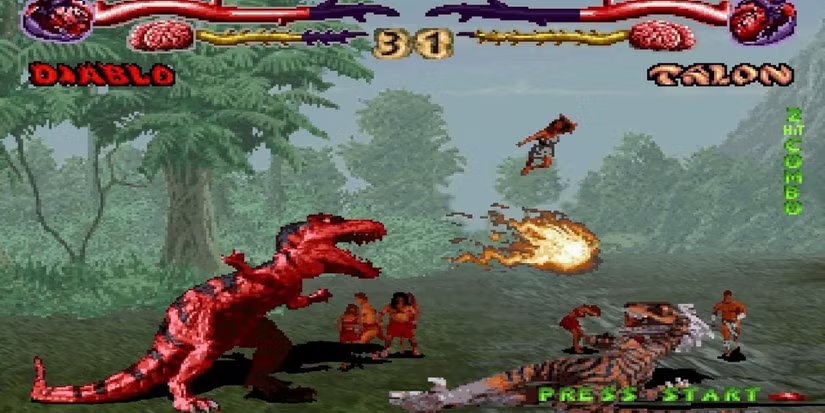
In 1994, Primal Rage was introduced to the world. This was a combat game that pitted dinosaurs and beasts against one another in gripping competition. It came from the mind of Atari Games, who had a hit on their hands. However, the problem was how brutal it really was, with players barely surviving.
For starters, the CPU was absolutely unforgiving and pushed players far past their limits. But beyond that, the lack of precision of some of the controls, layered with the perfection that was required in the player’s decision-making, meant that this was always an uphill battle. That’s nothing compared to the port versions though, which were even more challenging.
Mortal Kombat II Is A Classic For A Reason

Mortal Kombat from NetherRealm is a part of arcade history and those early titles cannot be taken for granted. Just because they have formed the fabric of the gaming landscape, though, that doesn’t mean they are without their faults. Notably, Mortal Kombat II is very difficult and requires an aggressive play style that not everyone can muster.
The 1993 game might be revisited often, but some still haven’t mastered the combos and learned how to avoid those truly killer moves. What set the game apart was the design of the enemy combat system, which was instant in its response to players. Trying to avoid those attacks and counter when needed was part of the fun though.
Captain Commando Needed Talent

In 1991, Capcom continued to utilize its incredible talents in the arcade industry by showcasing Captain Commando, an action title that played to the studio’s strengths, albeit with a couple of familiar ideas. But this brawler, with its futuristic overlay and energetic sound system, did something that other Capcom games failed to do. It challenged players beyond their desires.
Some players love a game that scales continuously and that’s what they get with Captain Commando, which often moves at a faster pace than the player was prepared for. Some enemies had a reach advantage. Some had heavy weaponry capable of tearing the competitor to shreds. Regardless of the reason, this title ends up being a real onslaught.
Sunset Riders Has Aa One-Shot Death

The 1991 run and gun game from Konami is one of those oddities from the archives. Not many people actually remember the title, which, by all accounts, was vibrant, energetic and intense in its mechanics. This was a game of momentum, but if one could not keep up with that speed and power, then one would certainly be left behind.
The one-hit deaths were especially brutal and when that happened it felt as though there was no point trying again. This was so much more than simple trial and error, because players had to overcome the speed of the enemy and the chaos of each, while trying to protect their weapons’ power ups. There were layers to every segment and at a certain point, it all became too much.
Weaponlord Required Too Much Concentration

Visual Concepts created the 1995 fighting game Weaponlord, and it was primarily intended for consoles. Yet, Weaponlord ended up on arcade all the same as part of a playtest and players found out how much concentration they needed to survive. Parrying and counter-attacks aren’t often a part of fighting games like this.
But for Weaponlord, timing was everything. To get it wrong was to court an immediate downfall. The weapon-based fighting game utilized parrying a little too much, and with complex AI and evolving controls, it seemed as if most only scratched the surface of what the game was capable of. It was better on console where more time could be spent with it.
NBA JAM Leveled Too Much

NBA Jam was a fun game, and it definitely helped to form the foundations of the sporting industry, at least when it came to arcade games and their successors. But one of the problems with the 1993 release was that the game was developed to always force the player to get better. Midway had essentially made a bit of an error.
When players started to improve, the computer system would level up accordingly, producing impossible shots and essentially ensuring that the competitor would catch up on points. With almost 100% accuracy, it becomes very difficult for a game to stay balanced. The result was a farce and players grew dissatisfied.
X-Men Versus Street Fighter Was Too Much

X-Men Versus Street Fighter has taken on many forms and has been ported or renewed for consoles like the PlayStation 2. It’s the arcade version from 1996 that should get the attention here, primarily because of how busy every sequence seemed to be. Sometimes, too much is going on, and that’s what happened here.
Funnily enough, players found themselves getting trapped in sequences repeatedly, seemingly with no way out, thanks to technological limitations. Boss AIs were sometimes impossible to overcome, while combos could stop a player from moving altogether. It’s that relentless pace, coupled with the fact that often one couldn’t see what’s happening on screen, that led players wanting no more of the title in that format.
Total Carnage Lived Up To The Name

Midway’s 1992 classic is one of those games that really represents the era. It totally brings together popular pop culture of the period, while also giving the sort of action-packed experience that the mainstream was looking for in its arcade titles. Somehow, it was not a financial success though, and there’s a glaring reason for that.
It was just too difficult. Total Carnage lived up to the name, providing players with a chaotic time. Extreme enemy density meant that players felt as though they could barely move from sequence to sequence. Equally, the bosses were punished in their design, forcing players to repeat sections continuously without success. Frustration led to many simply giving up.
Time Killers Required Precision Timing

Incredible Technologies and Strata created Time Killers, a 1992 title that didn’t have much of a lifespan outside of this initial release. It was an arcade classic by all definitions, inventive, fast-paced and providing the sort of play that competitors couldn’t quite harness. It was also endlessly difficult and relentless in its pursuit of the player.
The unusual limb control system ensured that those who did give the game a try had a tough learning curve to overcome. That’s without taking into account the instant-death mechanics, which meant that players faced a game over screen before they could blink. Extreme difficulty spikes left the game unbalanced in the end.
Alien 3: The Gun Is A Frantic Title

There are so many titles like Alien 3: The Gun that have come and gone, inspired by a previous IP and failing to quite understand the medium in which it is entering. On no level is that true for Alien 3 though, which was developed by SEGA. The title was released in 1993 and acted as a rail shooter, with plenty of horror mechanics.
And this really was a terrifying experience, a title that had jump scares galore and enough instant kill moments to frustrate any player. It was the atmospheric tone of the game, combined with its relentless hunting, that made it so difficult to survive. In truth, it almost felt as though it was an inevitable fact, that every game session would end in that gruesome demise.