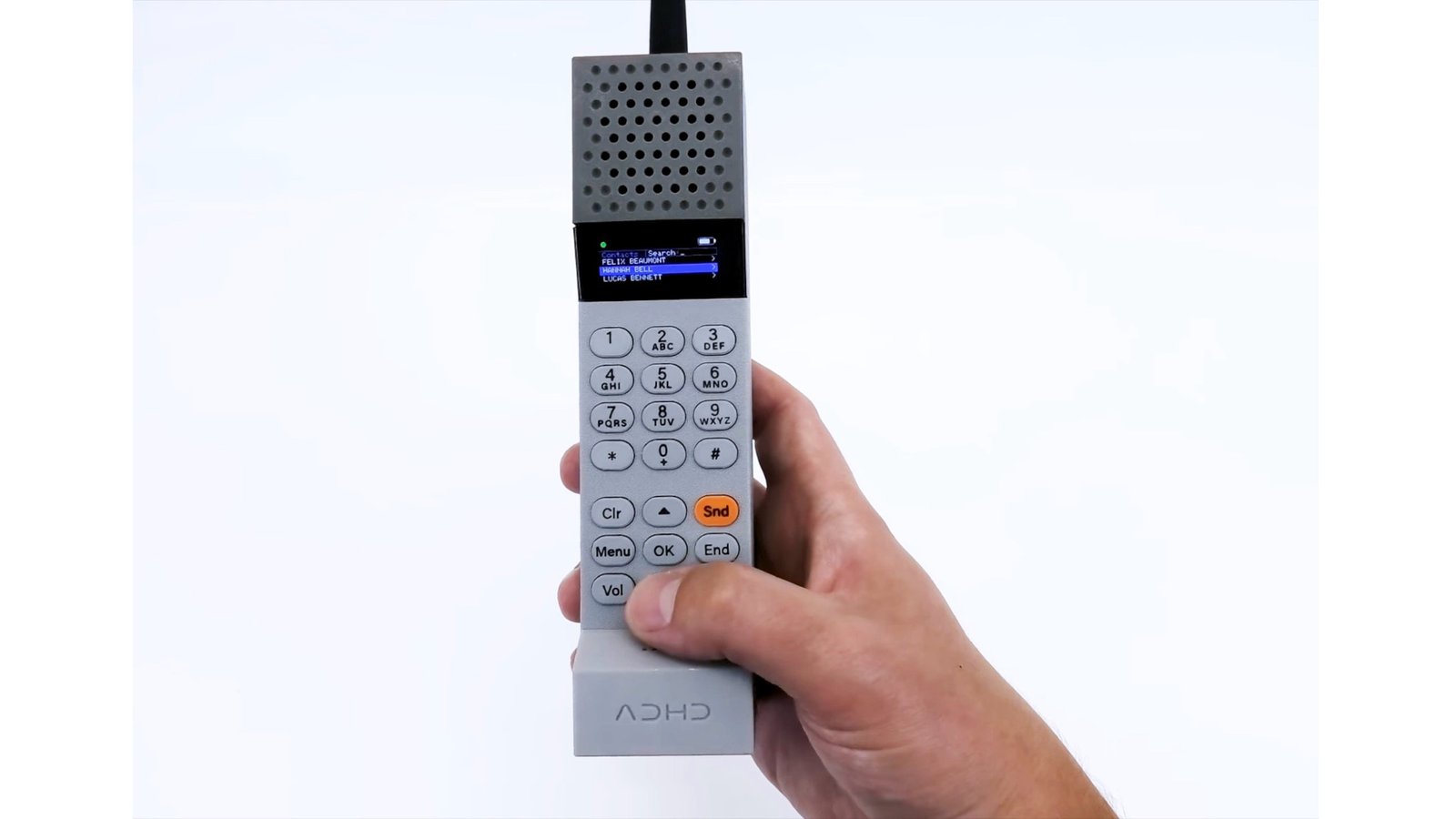
I’m all for finding ways to spend less time staring at a screen, but I’m not entirely convinced that building an entirely new phone is the answer. That’s the idea behind ADHD ONE, a gloriously chunky handset from Cologne-based designer Kevin Noki that looks like it’s escaped from the 1980s.
The name stands for Anti Distraction Handset Device, and its purpose is pretty straightforward. Rather than replacing your smartphone, it connects to an iPhone over Bluetooth, allowing you to make and receive calls while leaving your actual phone tucked away in a drawer or another room.
It has a physical 19-key keypad, a small OLED display, a microphone and a speaker, but none of the apps, social media feeds or notifications that make modern phones so difficult to put down. You can also use your iPhone’s Do Not Disturb settings to decide which contacts are allowed to get through.
There is, of course, a catch. ADHD ONE has no independent mobile connection, so your iPhone still needs to be nearby and within Bluetooth range. It’s less a replacement for your phone than a way to make calls without having the usual distractions within reach.

(Image credit: Kevin Noki)
3D-print your own retro handset
The ADHD ONE s that is not just a retro-looking shell around a modern phone. Noki has designed the handset from scratch, using Autodesk Fusion to create the enclosure before 3D-printing its components.
Inside, a Raspberry Pi Pico handles the device’s functions, while a Bluetooth module takes care of call audio. There’s also a rechargeable battery, charging controller and custom circuit board, all packed into that wonderfully oversized housing.
The design comes with a few customisation options, too. You can choose between three speaker grille styles and three antenna designs, including the sort of oversized aerial that makes the whole thing look like a prop from an old action film. There’s even an alternative housing without an antenna, although that feels like missing half the fun.
If you fancy making one yourself, Noki sells the digital build files for €29.99 (around £26). The package includes the 3D-printable STL files, firmware, circuit board manufacturing files, a parts list and a quick-start guide. You’ll need to source the electronic components and do the assembly yourself, though, and the files are licensed for personal use.
So, is this a clever way to cut down on smartphone distractions or an elaborate solution to a problem that could be solved by putting your phone in another room? Honestly, probably a bit of both.