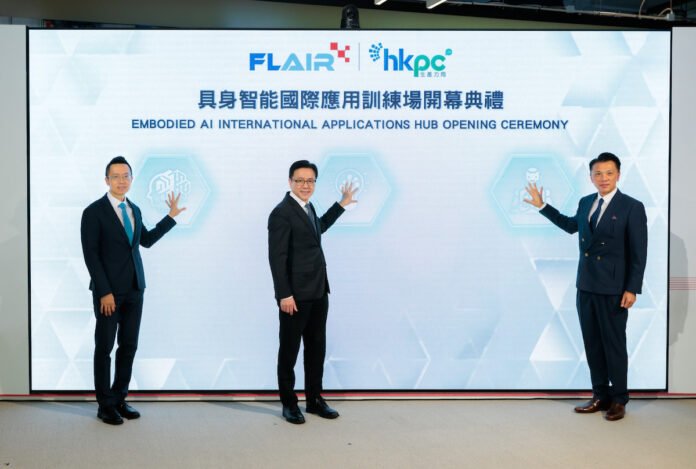

The Hong Kong Industrial Artificial Intelligence and Robotics Centre (FLAIR), under the Hong Kong Productivity Council (HKPC), has launched the Embodied AI International Applications Hub, the special administrative region’s first platform dedicated to the training, validation and real-world deployment of embodied AI and humanoid robotics technologies.
As a key platform for embodied AI research, development and scenario validation in Hong Kong, the Hub also serves as an integrated innovation infrastructure for technology development, model adaption and training, system validation and scenario testing.
Through the Hub, FLAIR will establish a continuous optimisation mechanism for embodied AI technologies, enabling humanoid robotics and embodied AI solutions to progress from laboratory research to large-scale industrial deployment.
This will support the development of new productive forces in Hong Kong and reinforce the city’s position as an international innovation and technology centre and a regional AI R&D hub.
In its initial phase, the Hub brings together seven technology partners and eight international scenario partners to jointly advance the research, testing and innovative application of embodied AI technologies across manufacturing, smart logistics, retail services, inspection and maintenance, as well as public services.
”Humanoid robotics and embodied AI are key frontiers of the next wave of technological innovation, with tremendous potential to transform industrial operations and foster new quality productive forces,” said Sun Dong, Secretary for Innovation, Technology and Industry of the HKSAR Government.
“The HKSAR Government will continue to support AI development through investments in research, funding and infrastructure, and work jointly with research institutions, tech companies, and industries to promote the large-scale development of technology, while ensuring safety and compliance,” said Sun.
Sunny Tan, chairman of HKPC, said the key to the development of embodied AI lies in whether robots can continuously learn and train to truly adapt to different scenarios and create tangible value.
“Over the years, FLAIR has continued to invest in AI and robotics R&D, building strong technical foundations in intelligent perception, autonomous decision-making, motion control and industrial applications,” said Tan.
As the technical lead of the Hub, FLAIR will establish a data-driven technology validation and optimisation framework through a closed-loop R&D process encompassing scenario definition, model adaptation and training, solution testing, performance evaluation, data feedback, technology iteration and revalidation. This framework will help enterprises continuously enhance the capability and reliability of embodied AI systems.
FLAIR said that unlike conventional technology showcase platforms, the core value of the Hub lies in its ability to leverage real-world scenario data and continuous operational testing to enable robots and embodied AI systems to learn operating patterns across different environments.
This process continuously improves autonomous execution capabilities, task success rates, generalisation capabilities, safety and environmental adaptability. Such a continuous training and validation model is critical for advancing embodied AI technologies from proof-of-concept to commercial deployment.
Combining its AI and robotics R&D expertise, FLAIR will develop testing frameworks and evaluation standards tailored to the needs of different industries.
Technologies will be assessed against multiple indicators, including operational accuracy, execution efficiency, system reliability, autonomous task completion rate, safety performance and environmental adaptability.
FLAIR said these objective benchmarks will establish clear measures of technology maturity, helping industries reduce deployment risks and accelerate the adoption of innovative solutions.
In logistics applications, embodied AI systems must handle a wide range of parcel specifications, warehouse environments and operational workflows.
In smart manufacturing, robots are required to adapt to diverse production processes, safety requirements and equipment standards across different markets.
In industrial inspection and public facility management scenarios, humanoid and quadruped robots must also demonstrate advanced full-body control and autonomous operation capabilities in complex environments.
By integrating real-world operational scenarios from different countries and regions, the Hub enables technology solutions to undergo comprehensive training and validation before deployment.
As an international city, Hong Kong combines access to the Chinese Mainland market with alignment to international standards, providing an ideal cross-regional proving ground for emerging technologies, helping enterprises to refine and validate their solutions in diverse application environments, and accelerating commercialisation and market expansion across both Chinese Mainland and overseas markets.