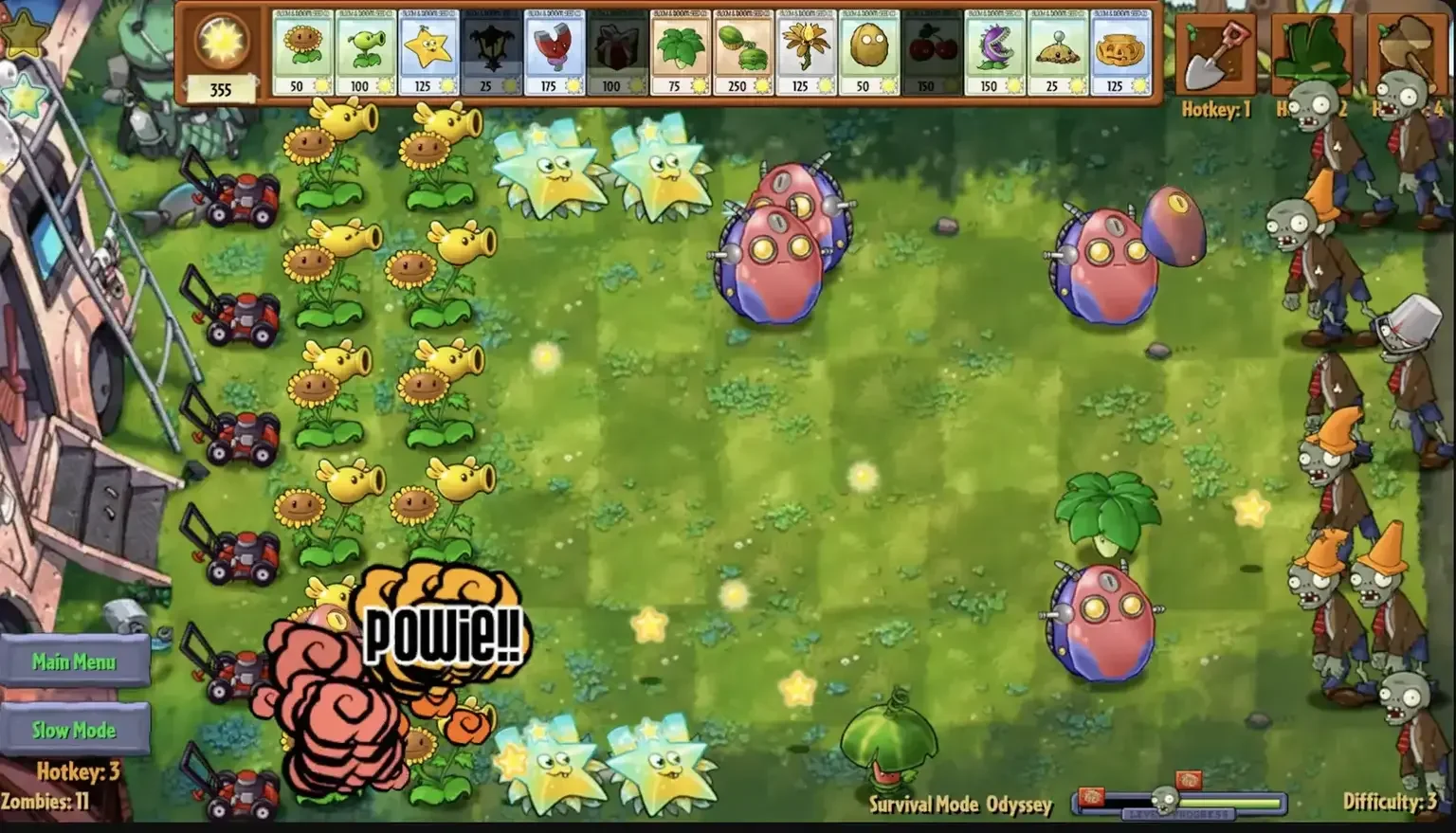

Plants vs. Zombies has always succeeded by making strategy easy to understand. Plants defend fixed lanes, zombies advance from the other side, and every unit has a clear role. The rules take only a few minutes to learn, but choosing the right plants and managing sunlight can keep players experimenting for hours.
That simple foundation has also made the series an inviting space for fan creativity. PVZ Fusion is one of the clearest examples. Rather than replacing the familiar lane-defence formula, the fan-made project expands it by allowing compatible plants to combine into new defenders. The result feels recognisable at first, but the number of possible interactions soon creates a different kind of strategy game.
A Fan Project Built Around One Strong Idea
PVZ Fusion is often described as a mod, although it is more accurately understood as a standalone fan-made game inspired by Plants vs. Zombies. It runs as its own Unity-based game on Windows and Android instead of modifying an existing Plants vs. Zombies installation. It is not an official EA or PopCap release.
For players trying to compare platforms, versions, and community release sources, this independent PVZ Fusion guide organises the current PC and Android information in one place. Checking those details before installing or updating is useful, particularly when an older save or translation may not be compatible with a newer base release.
Its defining mechanic is fusion. Familiar plants are no longer limited to performing one job for an entire level. Compatible units can be combined to create defenders with new attacks, defensive properties, or resource-generating abilities.
This changes the value of a plant from the moment it is placed. A Peashooter is still useful as an early source of damage, for example, but it can also become an ingredient in a more specialised defender later in the match. The player is not only building a defence for the current wave; they are preparing possible upgrade paths for whatever comes next.
Fusion Adds Another Layer To Familiar Strategy
The original Plants vs. Zombies asks players to balance several straightforward priorities. They need enough sun production to grow their defence, enough damage to stop stronger zombies, and enough protection to keep key plants alive. PVZ Fusion keeps those pressures but connects them through its combination system.
Some recipes blend the identities of two well-known plants. Sunshooter, created by combining Peashooter and Sunflower, brings resource production and ranged offence together. Spike-nut combines Spikeweed and Wall-nut, turning a defensive barrier into something that can also punish enemies moving across its lane. Other combinations create explosive defenders, elemental attacks, or more advanced upgrade paths.
The important part is not simply that fused plants are stronger. Their mixed roles can change how a player uses limited lawn space. A hybrid that handles two jobs may free a tile for another attacker, but creating it can also require resources that would have been safer to spend elsewhere. A powerful recipe is only useful if the defence survives long enough to complete it.
This gives each match a satisfying sense of escalation. Early waves are about stabilising the lawn and preparing ingredients. Later waves test whether those choices can handle armoured zombies, unusual movement patterns, bosses, and other threats that punish a one-dimensional formation.
More Ways To Test A Build
A deeper plant system needs situations that make its choices meaningful. PVZ Fusion supports that through several modes and challenge types rather than relying on one campaign structure.
Adventure introduces the main mechanics and gives players room to learn common recipes. Survival places more pressure on rebuilding and adapting between waves. Challenge stages can restrict the available tools or demand a particular solution, while advanced modes introduce tougher enemies and modifiers for players who already understand the basic fusion paths.
These modes help prevent the combination system from becoming a checklist. A favourite fusion may dominate one map and struggle on another. Resource-heavy builds can be difficult to establish under early pressure, while a defensive formation may lack the damage needed for a boss. Players are encouraged to understand why a recipe works instead of simply repeating the same setup.
Like many fan projects, PVZ Fusion has grown through community discussion, translations, strategy sharing, and version updates. That community layer is especially important because the newest base release and the newest translated build may not always be the same version.
Players may encounter different releases for Windows and Android, while English-language support can depend on a separate community translation. Version numbers, language compatibility, file names, and release sources therefore matter more than they would for a game distributed through one conventional storefront.
The same community also extends the strategy outside the game itself. Players document recipes, compare builds, explain difficult levels, and report changes between versions. Discovering a fusion during play can be rewarding, but seeing how another player uses the same combination in a completely different formation is often what reveals the system’s real depth.
Why Fan-Made Games Keep Classic Ideas Alive
PVZ Fusion illustrates why enduring game mechanics often continue to grow beyond their original releases. The basic language of Plants vs. Zombies remains immediately readable: defend the lawn, manage resources, and choose the right plant for each threat. A fan project can build on that shared understanding without spending hours explaining the fundamentals again.
At the same time, fusion changes enough of the decision-making to create a distinct identity. Plants become ingredients as well as units. Lawn space becomes part of long-term planning. A simple early-game choice can determine which upgrades are available several waves later.
That balance between familiarity and experimentation is difficult to achieve. Change too little and a fan project feels like a collection of extra levels. Change too much and it can lose the clarity that made the original game appealing. PVZ Fusion works from a mechanic that is easy to describe but broad enough to support new recipes, enemies, modes, and strategies.
A Familiar Lawn With New Possibilities
The lasting appeal of Plants vs. Zombies comes from the way it turns a small grid and a handful of clear rules into a flexible strategy game. PVZ Fusion respects that foundation while asking players to think about every plant in a new way.
A Sunflower can be more than an economy unit. A Wall-nut can become more than a barrier. Even a familiar opening can branch into several possible builds depending on which plants are combined and when the player commits to an upgrade.
For longtime fans, that is the attraction. The lawn still looks familiar, and the incoming zombies still create the same immediate pressure, but the path from the first planted Sunflower to the final defence is far less predictable.