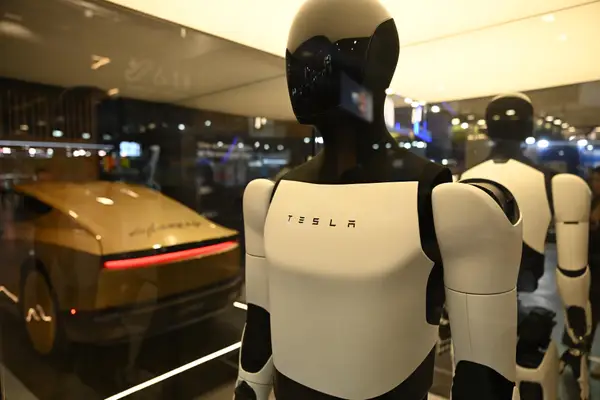
Tesla is sending its Optimus humanoid robot back to school.
Speaking on the company’s earnings call on Wednesday, CEO Elon Musk compared training the EV maker’s humanoid robot to raising a toddler.
Musk said that while Tesla’s autonomous driving models can learn from data collected by its massive fleet of vehicles, its Optimus robot has to learn by watching people do tasks and practicing them itself, a process similar to how humans learn.
“You can see this when you have a toddler, and they initially are sort of wobbly, and they don’t know how to do things, and eventually, they learn to wipe their own ass, which is a big milestone,” Musk told investors.
“They learn to read and do all sorts of things, and they learn this by playing. And we actually need Optimus to play at scale in order to have it be really good at tasks in the real world,” Musk said.
Bloomberg/Getty Images
The Tesla CEO added that the company was building out an “Optimus Academy” where prototypes can practice a wide range of tasks and generate training data to teach future versions of Optimus.
“For Optimus to get the training data we need, we actually need to make a lot of Optimi. So we need to make, I think, on the order of 10,000 or 20,000 bots and then have them do self-play,” said Musk.
Tesla said on Wednesday that it had begun production of Optimus at its Fremont factory, with Musk saying the company expects to begin delivering Optimus to customers by the end of next year.
The near-trillionaire cautioned that production would be “somewhat bumpy” and that development of the humanoid robot still has some way to go.
He listed the challenges of designing durable yet responsive robotic hands, as well as AI capable of handling open-ended tasks, among the main hurdles Tesla faces.
Tesla is not alone in setting up robot academies to provide training data for humanoid robots.
Unlike large language models like ChatGPT, which were trained on the vast corpus of text data available on the internet, robotics faces a shortage of real-world training data to teach humanoids to navigate the physical world.
Other startups, such as Texas-based Apptronik, have also set up “data factories” where robots load conveyor belts and sort objects to generate training data to combat the data shortage.