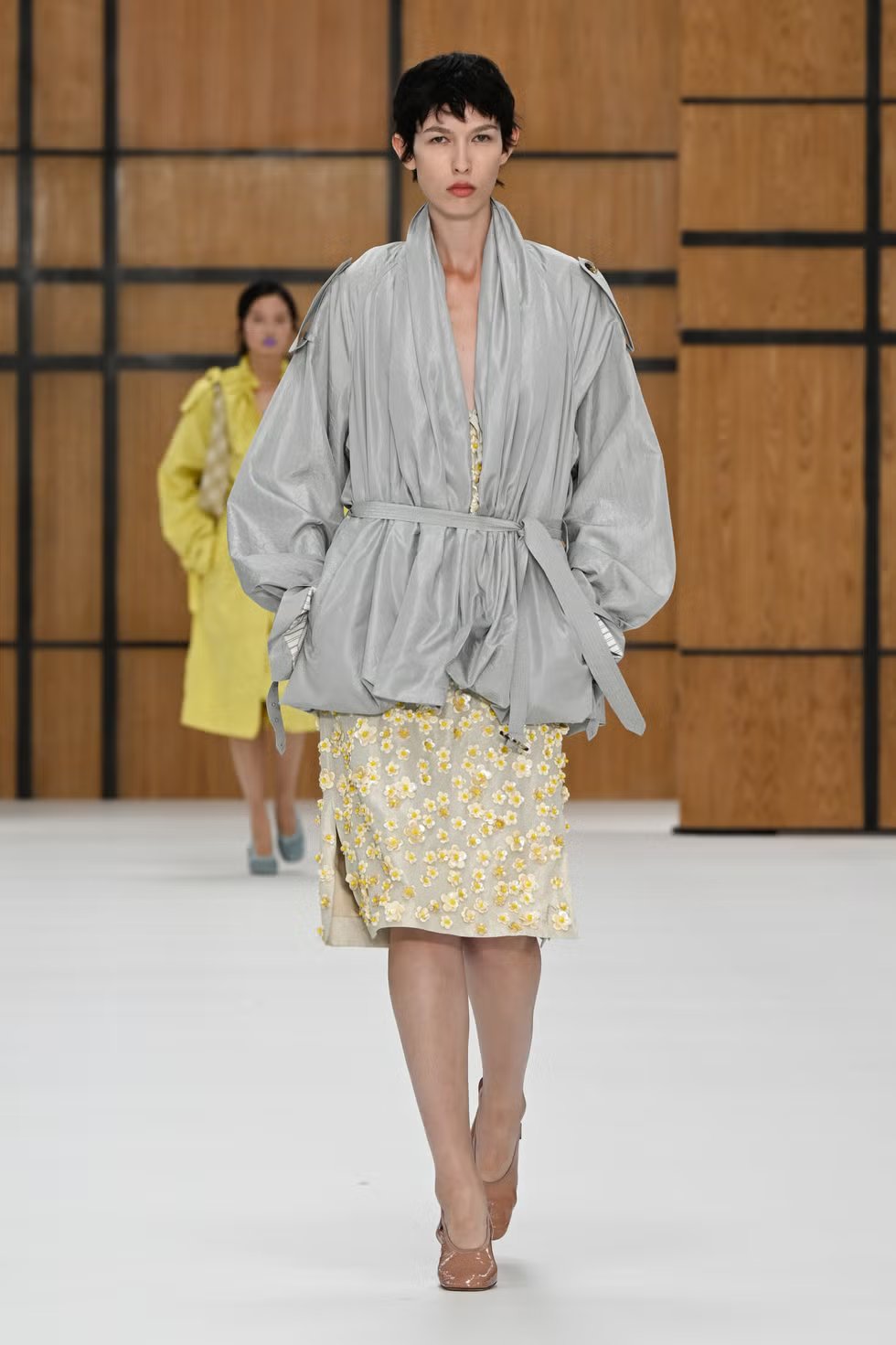
Last February, Maison Margiela skipped its usual place on the Paris Fashion Week calendar for a series of events in China, including a Shanghai runway show and exhibitions across the country that explored the various ‘principles’ of the avant-garde house – from ‘anonymity’ (a nod to founder Martin Margiela’s elusive nature, marked with an exhibition of masks in Beijing) to ‘artisanal’ (a display featuring 48 pieces from the house’s Artisanal line, its equivalent to haute couture, dating from 1989 to 2025).
The project fell under ‘MaisonMargiela/folders’, which also saw the house open up its company Dropbox as an open-to-all digital archive, spanning research for upcoming projects, internal imagery and archival material dating back to the house’s founding in 1988, some of it available to view for the very first time. Creative director Glenn Martens, who earlier this year left his concurrent role at Diesel to focus on Maison Margiela full time, said that this marked ‘a fresh way to experience the work of the maison’.
The new chapter of ‘MaisonMargiela/folders’ explores Martin Margiela’s pioneering Tokyo store

The original electrical products factory which Maison Margiela took over in 2000 to create its 2-8-13 Ebisu Minami store
(Image credit: Maison Margiela)
Today (21 October 2026), the house has revealed the latest chapter of ‘MaisonMargiela/folders’, which is a celebration of the house’s first store concept, Maison Margiela Tokyo. Opened in 2000, 12 years after Martin Margiela launched his eponymous brand (then called Maison Martin Margiela), the choice of location was typical of the designer’s unconventional approach: one might have expected the first store to be in Paris (where it was based), or in Antwerp or Brussels, Belgium (the country where Martin Margiela hailed from), but instead he chose a former residential home in the leafy suburb of Ebisu, Tokyo.
The opening forged a link between the Parisian house and the Tokyo neighbourhood that remains today: when the original store had to be relocated, Martin Margiela chose to stay in Ebisu, taking over 2-8-13 Ebisu Minami, a former factory that produced electrical goods. Its sparse, industrial interiors – featuring a glass ceiling and glass-block wall – provided the perfect canvas for Martin Margiela’s collections, with its surfaces painted in the house’s signature white. ‘White means the strength of fragility and the fragility of the passage of time… an expression of unity, purity and honesty,’ he once said of the hue, which featured across the house’s then-HQ on Rue Saint-Maur, a former convent where the walls and furnishings were also a uniform white (staff were required to wear white lab coats, an expression of collectivism and unity).

An image from the store’s opening event in 2000, featuring white balloons – a nod to house founder Martin Margiela’s signature hue
(Image credit: Maison Margiela)
‘This store is of huge significance to us,’ said Maison Margiela in statement today (it is a tradition that the house communicates in the collective ‘we’ over a singular named spokesperson). ‘It retains the memory of how we first appeared to the world. The location of Ebisu itself, the community surrounding the store, and unconventional but intentional decisions to repurpose existing features speak to the most formative elements of our identity.’
2-8-13, as the store is now called, was opened in 2007, with the coming year marking its 20th anniversary. The occasion will be marked not only with the new chapter of ‘MaisonMargiela/folders’ – the various new folders in the Dropbox chart the history of the address, as well as the events which have taken place within it – but a special-edition zine, launching 5 November 2026 (it will also be uploaded into the Dropbox). Distributed across Ebisu and in-store, the limited-edition publication will comprise memories from those who have worked in the store, as well as documenting collectors of the house’s ‘Tabi’ shoe – perhaps Maison Margiela’s most enduring link with Japan, inspired by the country’s traditional split-toe socks and shoes, which date back to the 15th century.
‘MaisonMargiela/folders’ can be accessed here. The zine will launch on 5 November 2026 exclusively in Ebisu and at 2-8-13, while an accompanying exhibition runs until 15 November 2026.

The store featured in an issue of ‘Casa Brutus’ magazine
(Image credit: Maison Margiela)