IRVING PENN’S FASHION PHOTOGRAPHY AT THE MEP
The Maison Européenne de la Photographie (MEP) in Paris presents PENN & FASHION, a retrospective of American photographer Irving Penn, tracing six decades of his work for Vogue from September 30th, 2026, to January 17th, 2027. Bringing together photographs from the MEP, the Nicola Erni Collection, and The Irving Penn Foundation, the exhibition examines how Penn moved beyond the demands of fashion publishing to develop a distinct photographic language, in which he reduced his compositions to their essentials, allowing garments and the people wearing them to become the focus.
Penn’s approach took shape at a moment when fashion photography was helping shape the visual culture of the postwar period. After joining Vogue in 1943 at the invitation of art director Alexander Liberman, he initially produced still lifes and cover concepts before establishing himself as one of the leading photographers of the magazine. His training in graphic design under Alexey Brodovitch informed his precise handling of space, while his interest in modernist painting and European Surrealism contributed to images that balanced restraint with unexpected visual tension.
a studio stripped back to its essentials
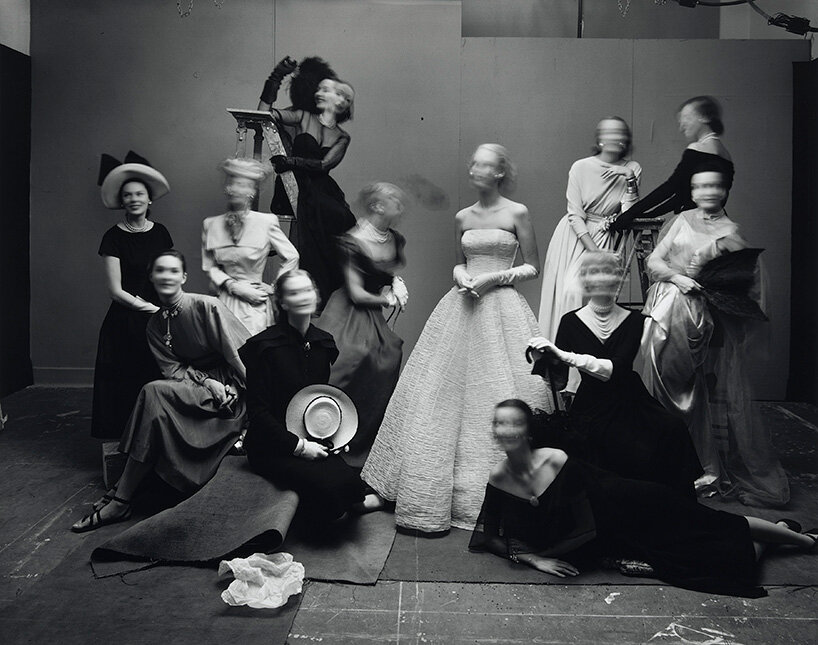
The exhibition at MEP follows Penn’s career chronologically, opening with two photographs from 1947: Theatre Accident, a still life, and 12 Models Moving Their Heads, a group portrait commissioned by Vogue. In 1950, Penn traveled to Paris to photograph the latest haute couture collections. There, he established a naturally lit studio on Rue de Vaugirard and photographed designs by Cristóbal Balenciaga, Lafaurie, and Rochas against an old theater curtain. With Lisa Fonssagrives as his principal model, he concentrated on the relationship between the clothes and the body. The images he created changed how couture was presented in fashion magazines. The absence of distracting props or narrative settings made the construction of a garment more legible, drawing attention to its silhouette and texture. Penn’s photographs of Balenciaga, whose sculptural designs he regarded as the work of a master architect of clothing, demonstrate how fashion photography can communicate the logic of a design as much as its appearance. The exhibition also includes facsimiles of Vogue, showing how Penn’s photographs appeared in the magazine and how his artistic vision shaped its fashion imagery.
from haute couture to everyday life
Alongside his Paris assignments, Irving Penn developed Small Trades, a series portraying workers and tradespeople in their professional clothing. Photographed in the studio with the same attention given to celebrated models, these sitters occupied a similarly controlled visual environment. The juxtaposition reveals a consistent interest in how clothing communicates identity. Whether photographing a couture gown or the work clothes of a street vendor, Penn approached garments as objects shaped by use, construction, and social context.
Penn’s restrained compositions created a visual continuity between subjects who occupied very different positions within the hierarchy of the fashion industry. He extended this approach to portraits of artists, designers, and cultural figures, including Christian Dior, Pablo Picasso, Jean Cocteau, and Elsa Schiaparelli. Using simple screens, a worn carpet, and carefully controlled lighting, the photographer stripped the studio back to its essentials, placing emphasis on the posture, expression, and presence of each subject. The exhibition also includes facsimiles of Vogue, showing how his photographs appeared in the magazine and how they shaped its visual language.
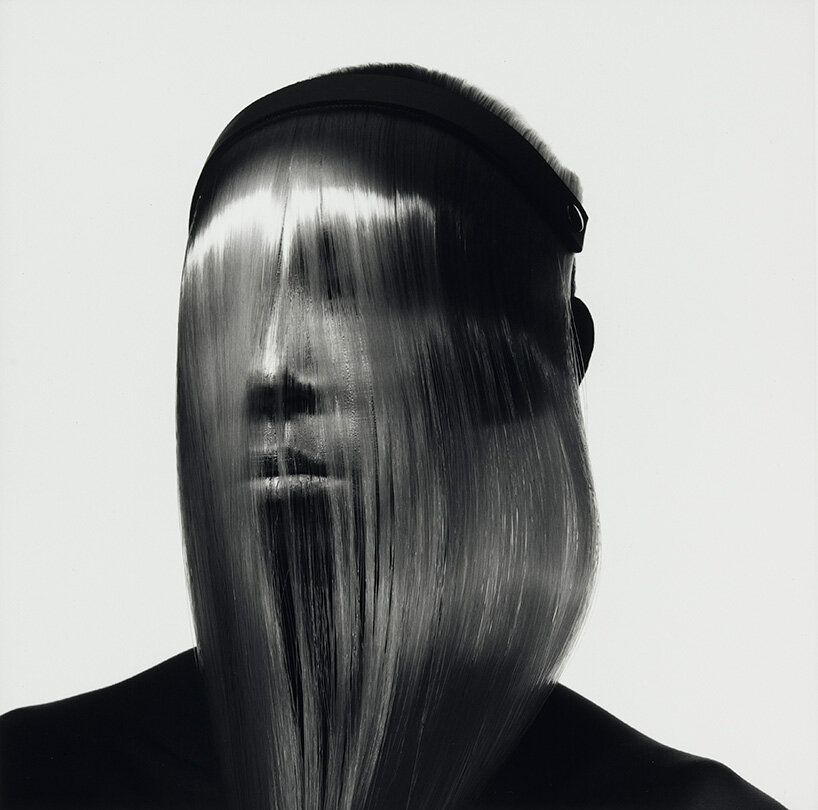
the dialogue between the photographer and issey miyake
Another section of the exhibition examines Penn’s collaboration with Japanese designer Issey Miyake, which lasted from 1986 to 1999. Their working relationship developed without Penn attending Miyake’s fashion shows. Instead, the designer sent garments to New York, where Penn photographed them in his studio before returning the transparencies to Tokyo. The distance between the two artists did not prevent a close exchange of ideas. Miyake’s sculptural garments, often defined by their manipulation of fabric and volume, aligned with Penn’s interest in reducing an image to its essential forms.
Between 1987 and 1992, graphic designer Ikko Tanaka created more than 60 posters for Issey Miyake using Penn’s color images. Twelve of these posters are included in MEP’s presentation through loans from The Miyake Issey Foundation, showing how the photographs circulated beyond the pages of Vogue and became part of the designer’s broader identity.
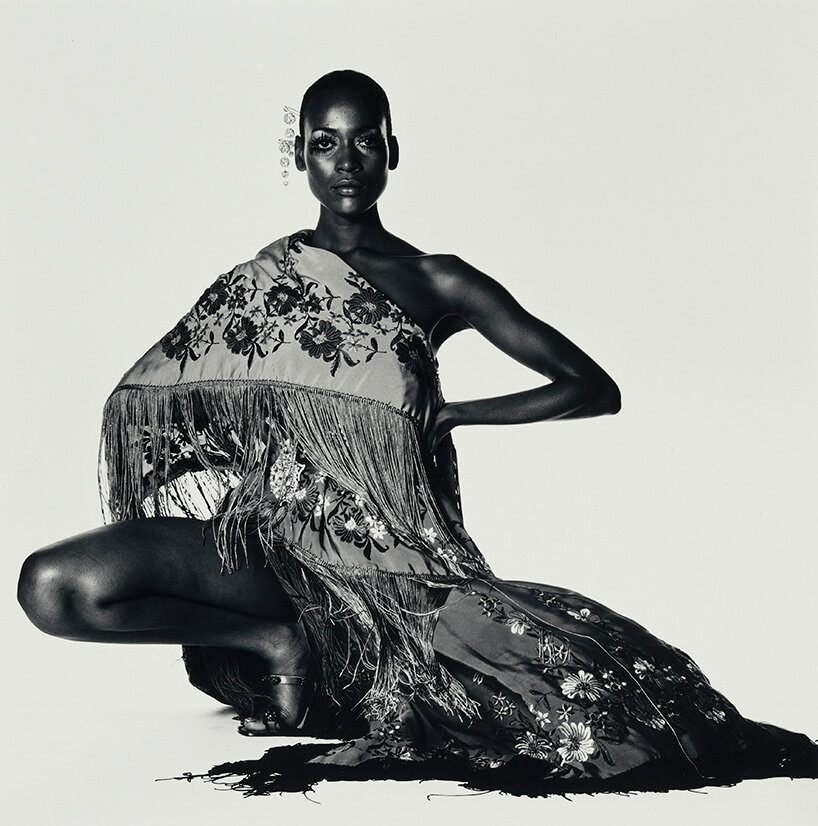
beauty, artifice, and the photographic print
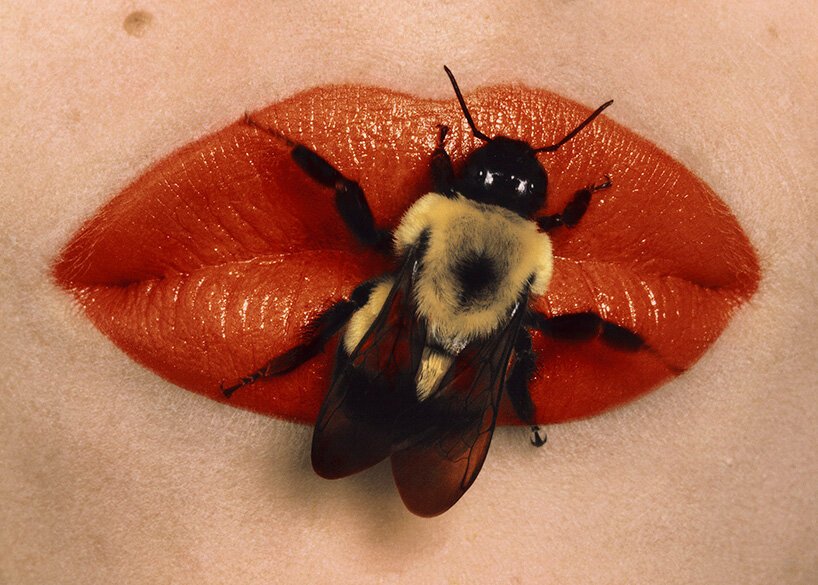
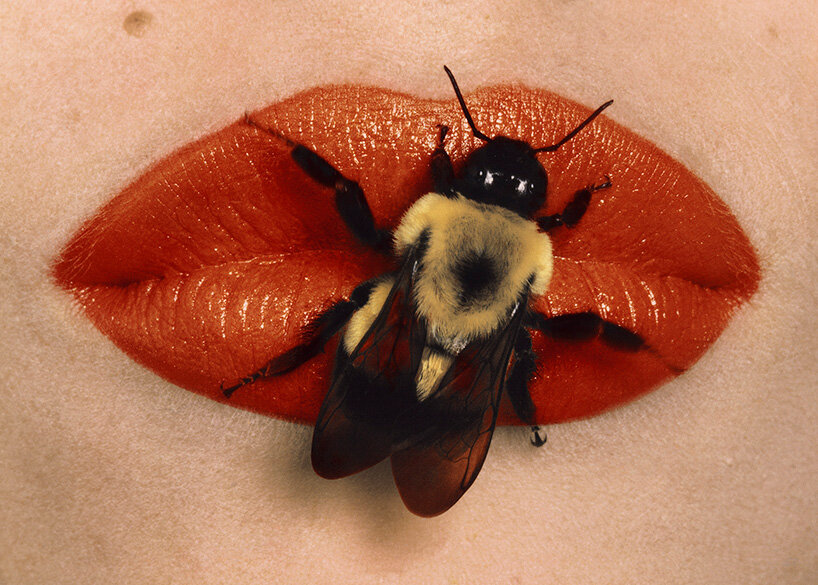
Penn continued to explore the relationship between clothing, the body, and the way fashion is presented. His photographs of designs by Yves Saint Laurent, Karl Lagerfeld, Christian Lacroix, and John Galliano kept the focus on shape and texture, even as fashion became more theatrical. His beauty photographs for Vogue gave him another way to experiment. Made with fashion editor Phyllis Posnick, these images used humor, Surrealist ideas, and unusual treatments of the face. In works such as Red-Lacquered Lid (1994) and Bee on Lips (1995), the face becomes a surface for experimentation, moving away from the usual rules of beauty photography. The American photographer also paid close attention to how his images were printed. He later made platinum-palladium printing an important part of his practice, valuing the depth of tone and the physical quality of the finished image. For Penn, making a photograph did not end when he pressed the shutter; the printing process was just as important.
Tracing Penn’s career from his early assignments for Vogue to his later fashion and beauty photographs, PENN & FASHION explores how he balanced commercial work with his own artistic ideas. His photographs show how assignments for a fashion magazine could become opportunities to experiment, looking beyond the clothes to the people wearing them and the way they appear in front of the camera.