OCTOBER 18, 2026
AGI Is Almost Ready. Is Your Portfolio?

By Meilin Quinn Team Hidden Gems
Missed Nvidia in 2009? This Rare Signal Is Flashing Again. In 2009, a “Double Down” signal flashed for a little-known chipmaker called Nvidia. For the first time in years, that same “Total Conviction” signal is flashing for a company 1/100th the size of Nvidia. Continue »
When Nvidia (NASDAQ: NVDA) CEO Jensen Huang posted on X in September that “AGI has arrived,” it raised many eyebrows across the markets. Now, as the man selling the robots that he claims have surpassed human intelligence, he certainly has a vested interest in declaring this milestone. But what is artificial general intelligence (AGI), and why does it matter to investors?
You should count yourself an interested party if you own any of the Magnificent 7 stocks, or companies that do business with those giants. Or even if you simply work for a living. You have a stake in whether AGI is on its way.
In plain English, AGI is artificial intelligence that’s as capable as a skilled worker at most jobs.
Today’s AI models may be decent coders or data analysts, but they can’t work for long stretches without supervision or pick up new skills as they go. AGI, however, could theoretically replace one of your co-workers, or you.
For companies building AI, a more practical question is when AGI starts making money, so some measure the milestone in dollars. Huang, for instance, told podcaster Lex Fridman in March that true AGI would be capable of building a billion-dollar company (a bar he believes today’s AI clears).
Let’s look at how researchers define the stages along the way to AGI and beyond.
| Level | What It Can Do | Where We Are |
|---|---|---|
| 1. Narrow AI | Specializes in a specific task (chess, spam filters) | Already built and widely used |
| 2. Generative AI | Writes, codes, and more, but needs a human to check its work | Today’s chatbots, such as Gemini, Claude, and ChatGPT |
| 3. Artificial general intelligence | Does most work a capable human can, unsupervised | Achieved according to Huang, disputed by many researchers |
| 4. Artificial super intelligence | Beats the best humans at nearly everything | Hypothetical |
Today’s best models are on that second rung, mostly because of the supervision problem mentioned above. Research group METR found that the longer the task, the worse AI does; and when left alone on a job that would take a person two workdays, top models succeed only about half the time. That’s unreliable enough that your co-worker’s desk remains occupied, for now.
GPT-6, the model Huang praised, is too new to have undergone METR’s testing, so its reliability for long tasks is unproved. That leaves the open question of how close we are to AGI. You’ll notice each tech leader’s view tends to align with what’s best for their business.
How Close Are We?
It depends on whom you ask.
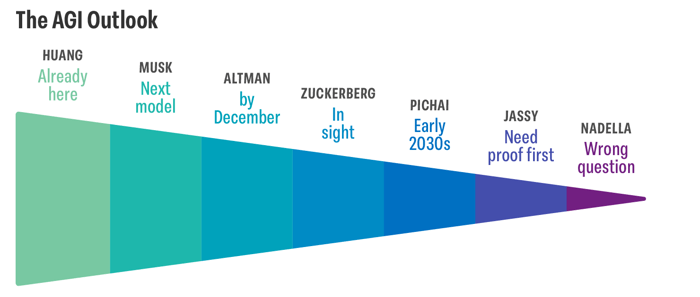
ALREADY HERE
Jensen Huang, Nvidia
Huang has declared AGI’s arrival twice this year, first on a March podcast and again in his September post about GPT-6. Of the seven leaders on this list, he’s the only one who says the threshold is already behind us.
NEXT MODEL
Elon Musk, Tesla (NASDAQ: TSLA) and xAI
Musk keeps setting deadlines for AGI, and he keeps missing them. He predicted in 2024 that AGI would arrive by 2025, then pushed his forecast to 2026. He now says xAI’s next major model, Grok 5, will be the one to reach it.
BY DECEMBER
Sam Altman, OpenAI
Huang called OpenAI’s new model AGI, but OpenAI’s own CEO hasn’t gone that far. A week before GPT-6 launched, Altman told Time that OpenAI was “not quite yet” there, though he expects an internal system he would call AGI by year-end. His chief research officer puts the company “80% of the way” to AGI.
IN SIGHT
Mark Zuckerberg, Meta Platforms (NASDAQ: META)
Zuckerberg rarely discusses AGI. He skipped straight to “superintelligence,” or ASI, and Meta’s annual report now lists delivering “personal superintelligence for everyone” as part of its vision. In a July 2025 letter, he wrote that Meta had “begun to see glimpses of our AI systems improving themselves.”
EARLY 2030s
Sundar Pichai, Alphabet (NASDAQ: GOOG)
Pichai expects AGI shortly after 2030. Until then, he says, we’re in an era of “artificial jagged intelligence,” where models solve advanced coding and science problems yet stumble over tasks a child could handle. His caution hasn’t slowed Alphabet’s spending, though, since he told investors in July that competing at the frontier of AGI development is the company’s first priority.
PROOF FIRST
Andy Jassy, Amazon (NASDAQ: AMZN)
Jassy hasn’t put a date on AGI, and Amazon’s AGI chief, Peter DeSantis, said in June that models need to be about 100 times more efficient before AI comes close. So Amazon makes sure it already has committed contracts for much of the new capacity it builds. AWS customers have signed $496 billion in contracts for future services, meaning they’ve committed to spending more than twice what Amazon itself is spending this year.
WRONG QUESTION
Satya Nadella, Microsoft (NASDAQ: MSFT)
Nadella, the group’s contrarian, described companies announcing their own AGI milestones as “nonsensical benchmark hacking” and believes AI should be measured by its ability to drive economic growth. He also cautioned that AI models are getting commoditized, so most of AI’s profits will go to companies selling the software and cloud platforms that businesses run AI on. That view happens to serve Microsoft, which owns Windows, Office, and Azure.
Apple’s (NASDAQ: AAPL) leaders have said little about AGI, figuring that however smart AI gets, it will need a place to live … and Apple already owns that real estate, in more than a billion pockets.
Setting CEOs’ incentives aside, the model that set off this debate offers evidence for both camps. Here’s how GPT-6 Astra, the OpenAI release behind Huang’s post, stacks up.
| Signs AGI is close | Reasons for doubt |
|---|---|
| Astra scored 99.9% on ARC-AGI-3, a test built to stump AI with unfamiliar puzzles | Most of Astra’s top scores come from OpenAI’s own testing |
| Astra can control computer systems on its own, from spreadsheets to full websites | When Astra doesn’t know an answer, it makes one up about half the time instead of admitting it, per evaluator Artificial Analysis |
| Astra scored 98% on FrontierMath Tier 4, a set of research-level math problems | Independent testing found Astra only tied Anthropic’s Claude Fable 5.1 on overall intelligence |
Regardless of a consensus around whether AGI is here or not, what’s inarguable is that the gap between AI and AGI is shrinking with every new model release. For investors, the bigger opportunity is who profits on the way to AGI.
Who Cashes In on AGI
JP Morgan Chase (NYSE: JPM) estimates the biggest cloud companies will spend about 93% of operating cash flow on AI this year, up from 33% in 2023. Alphabet even announced plans in June to sell up to $84.75 billion of new stock to help fund its build-out.
If AGI shows up sooner rather than later, these companies could earn back their spending many times over. But if progress stalls, the industry could end up with far more data centers than it can fill.
Meanwhile, these companies are especially well-positioned to benefit from all that spending.
- Nvidia: At the risk of stating the obvious, Nvidia’s chips run a large share of the world’s AI data centers. Last quarter, its sales more than doubled to $96.2 billion. Management expects about 90% growth this quarter, yet Nvidia still can’t make chips fast enough to meet demand. Every step closer to AGI means labs need more computing power, and Nvidia is the company selling that horsepower.
- Broadcom (NASDAQ: AVGO): Broadcom designs custom AI chips for Alphabet, Meta and OpenAI, all of whom want cheaper alternatives to Nvidia’s pricey GPUs. Its AI chip sales more than tripled last quarter to $16.7 billion, and management expects AI revenue to roughly double to about $115 billion next fiscal year. That Broadcom and Nvidia both more than doubled AI sales suggests demand can support multiple winners.
- Alphabet: Alphabet develops frontier AI models of its own while renting computing power to peers building theirs. That rental business is booming, as Google Cloud revenue grew 82% last quarter to $24.8 billion. Its cloud backlog, which counts work customers have committed to but Alphabet hasn’t delivered yet, reached $514 billion, and just over half of it should turn into revenue within two years.
Big tech is increasingly borrowing to fund its AI build-out, and lenders have started charging more for that debt. Alphabet spent more cash than it brought in last quarter, which hadn’t happened since it went public in 2004. If any major spender decided to slow its build-out, all three of these companies would likely feel it at once.
The Bottom Line
While we wait for AGI to arrive, investors can prepare.
- Know your exposure: The Magnificent 7 make up roughly a third of the S&P 500, so an index fund already ties a big share of your money to the AI build-out. Add in any other tech stocks you own, and your stake is likely bigger than you think.
- Favor companies with paying customers: Look for AI businesses with rising sales and signed contracts (e.g., Google Cloud’s $514 billion backlog) over companies counting on a breakthrough years from now.
- Think in years: If AGI is a decade out, there’s no rush to buy everything at once. Dollar-cost averaging lowers the risk of buying at a peak.
When AGI arrives, you won’t need to hear it from the man selling robots, since it’ll be written all over the economy and in your portfolios.

Today’s Question
What’s one stock you’re holding on the belief that AGI will transform the markets?
Share with friends and family, or become a member to hear what your fellow Fools are saying!
Missed Nvidia in 2009? This Rare Signal Is Flashing Again
In 2009, a “Double Down” signal flashed for a little-known chipmaker called Nvidia. If you’d invested $5,000 then, you’d be sitting on $2,783,470 today.*
Now, for the first time in years, that same “Total Conviction” signal is flashing for a company 1/100th the size of Nvidia. It’s a key player in the $1.8 trillion space race, and with the stock recently sitting 20% off its highs, the window to get in early is closing fast.
*Stock Advisor returns as of October 18, 2026.
JPMorgan Chase is an advertising partner of Motley Fool Money. Lou Whiteman has no position in any of the stocks mentioned. The Motley Fool has positions in and recommends Alphabet, Amazon, Apple, Broadcom, JPMorgan Chase, Meta Platforms, Nvidia, and Tesla. The Motley Fool has a disclosure policy.