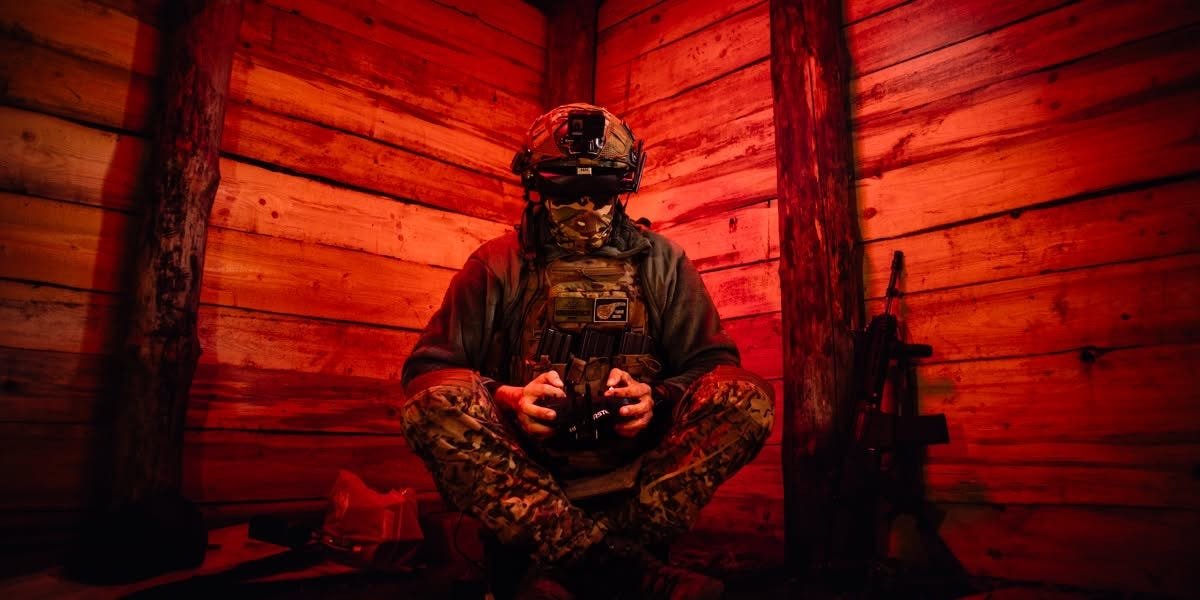
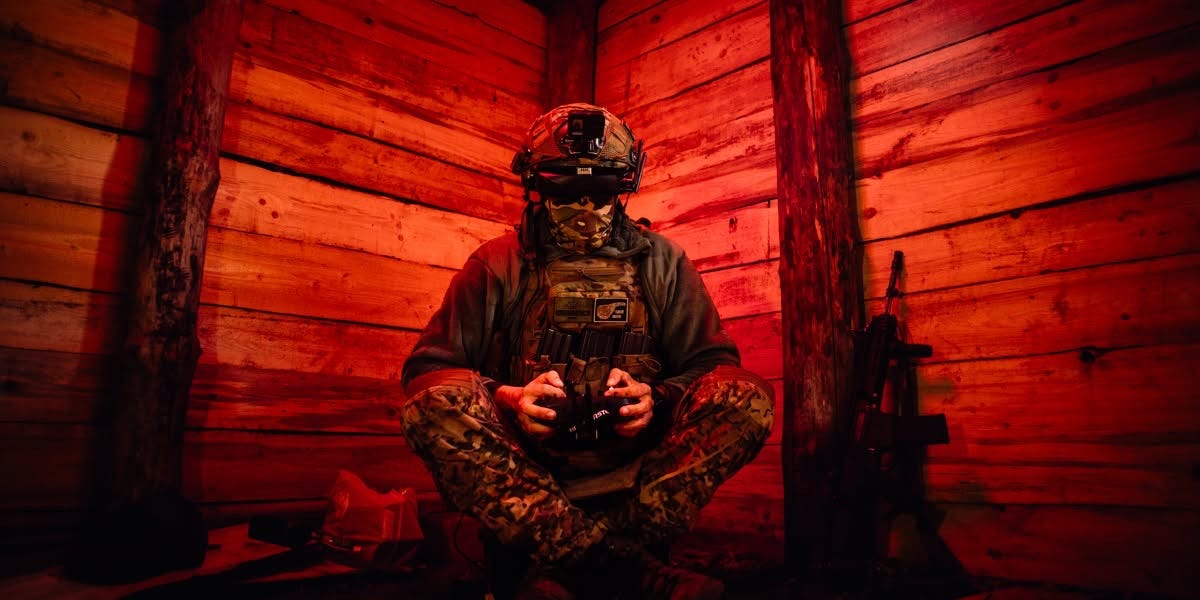
It was a very tough week for Ukraine and the good people of Ukraine.
Multiple decisions made in Washington DC by President Trump have changed the character of Russia’s war against Ukraine, given heart to Putin and has reduced the strategic momentum that Ukraine has built in 2026. These decisions have also had an impact on the reputation of the United States around the globe.
On 9 October Donald Trump announced a deal with Russian president Putin to buy Russian diesel, and consequently the US Treasury suspended sanctions on Russian diesel sales until April 2027. On 11 October, Trump announced an energy ceasefire that Ukraine accepted (initially), but which Moscow rejected and has not observed. On 14 October the military version of Starlink was capped at 161 kilometres an hour in Ukraine, and Reuters reported that the order came from inside the White House, which Trump has denied.
On 16 October, Trump then signed an executive order waiving the sanctions and tariffs in the new Graham Act that were due to take effect on 18 October. In between, Trump restated his long-held view that it was time for Ukraine to get a new president, and he called Volodymyr Zelenskyy not a good guy for us to deal with.
Russia answered Trump’s ceasefire announcement with ballistic missile attacks on all three of Kyiv’s heating plants. This has gone unremarked by Trump, Vance and others in the current US administration who clearly despise democratic Ukraine and prefer to deal with a dictator in Moscow.
This week I have reversed the usual order and placed the Pacific first. In most weeks the war in Ukraine produces the events and the Pacific absorbs the consequences, so Ukraine leads. This week the decisions that mattered most were made in Washington, and their audience resided as much in Tokyo, Taipei, Canberra and Beijing as in Kyiv and Brussels.
A diesel waiver, a ceasefire announcement and a speed limit on a satellite network each carry messages about how the United States treats a partner under attack when fuel prices and domestic politics put it under pressure. Governments and commentators across the Indo-Pacific monitor Trump’s dictates and then apply them to their situation. Beijing also watches closely, and it has just sent an aircraft carrier through the Ryukyu chain ahead of an exercise that will place American anti-ship missiles on Yonaguni Island.
The Pacific section opens by asking what America’s partners in Asia make of these decisions. The Ukraine section that follows then supplies detail including the sanctions waiver, the Russian power grid strikes, the race to intercept faster Shahed drones and the data centre strikes, each of which has important lessons for nations in the Pacific.
Welcome to my weekly update on war and strategic competition.
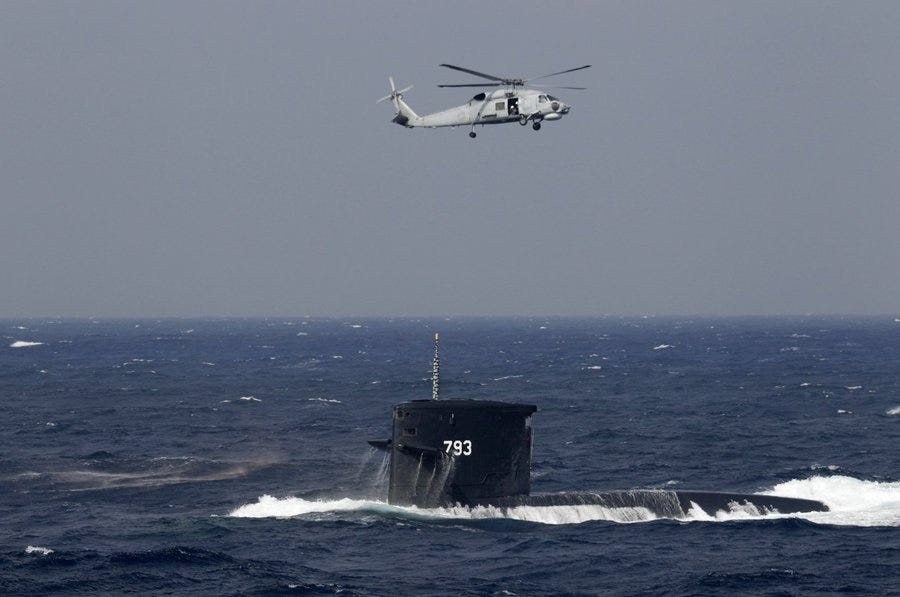
Diesel Diplomacy. The volumes in the US-Russia diesel deal are small. The Council on Foreign Relations notes the 300,000 tonnes due this month would cover about one day of US consumption. But it is the signal this deal sends that matters far more than the number of barrels of diesel being shipped to America.
Imran Khalid, writing in The Jakarta Post, points out that G7 leaders agreed on 2 October to release 100 million barrels through the International Energy Agency, and that a week later Trump announced Russian supply after a call with Putin. His conclusion for the region is blunt: “Regional fuel security cannot depend on collective frameworks that their most powerful architect treats as optional.” Nations across the Pacific will be listening to such critiques, because the oil, fertiliser and helium imported across the region transit the Strait of Hormuz, which the Iran war has disrupted.
In Seoul the argument is focused on alliance management. Edward Howell, writing in The Spectator notes that 70 per cent of South Korea’s crude imports come from the Middle East and concludes that “cheap fuel is no substitute for security”. John Lee of Korea Pro takes a commercial view, and the article’s standfirst reads “Damaged Russian refineries and tight Asian fuel supplies may keep Korean export margins high despite Trump’s pledge.”
The Australian government stated its position plainly. Energy Minister Chris Bowen told Bloomberg that “We don’t need or want Russian fuel in Australia” and added that “What the United States does is a matter for them, but we won’t be changing our approach”. An allied minister declining in public to follow a US policy is unusual. That said, as the Australian Federation of Ukrainian Organisations has been tracking for some time, Australia does import Russian oil products, but it does so through third parties. Bowen’s comments must therefore be read against this context.
Starlink and Military Dependence. On 14 October SpaceX throttled the speed of Starshield terminals in Ukraine without any warning to the Ukrainian government. The Kyiv Independent reported that mid-range strike drones and interceptor drones were disrupted and that a drone unit in the Huliaipole sector cancelled missions. Presidential adviser Serhii Beskrestnov warned that the timing “cannot be a coincidence”.
Elon Musk wrote on X that “Any limits on speed or usage are decided by the US military and ultimately [President of the United States].” Reuters then reported that the order originated inside the White House, and Trump denied it. On 17 October Zelenskyy said the 161 kilometre per hour cap remained according to the Kyiv Post. This is hurting strike operations as well as the interception of Russian drones attacking Ukrainian cities.
As such, Musk and Trump have given Putin a very significant gift. Writing this on 18 October, the throttling of Starlink / Starshield to 161 kilometres per hour appears to still be in effect.
Commentators across the Indo-Pacific region noticed the Starlink issue quickly, but the full implications are not yet spelled out. In an article for the Times of India, Yashasvi Vasistha notes that “European Union leaders are grappling with how to reduce dependence on Elon Musk’s Starlink satellite communications”, although there is little analysis of the implications for India.
Phar Kim Beng and Vic Li Yu Wai wrote in the Malay Mail, arguing that “digital sovereignty is becoming inseparable from strategic sovereignty” and warned that “Control over digital infrastructure can become an instrument of geopolitical coercion.”
Taiwan appears to have much to think about in the wake of the throttling of this important satellite service. In July the Taipei Times reported that lawmakers from the DPP, KMT and TPP were amending telecommunications law to let Starlink operate, with KMT legislator Huang Chien-hao warning that Taiwan “would have virtually no means of communicating with the outside world” if undersea cables were cut. The same report recorded public wariness after Musk admitted blocking a Ukrainian attack on Russian warships by turning off internet access and quoted the Digital Affairs Minister saying Starlink’s interest in Taiwan was “not particularly high”.
This week’s cap adds a further risk: a provider may be willing to serve a customer, and a third government may still decide what the service does in a crisis. The Atlantic Council’s Joshua VerGow puts the military side well: once a force depends on a commercial technology, “the continued availability of that technology becomes a basic assumption underlying how it plans and fights.”
Reading Trump’s Ukraine Decisions in the Pacific. The Taipei Times printed Hal Brands’ 16 October Bloomberg column, which says the diesel deal “rewards an aggressor that is terrorizing Ukrainian cities with drones and missiles, while punishing the victim for fighting back.” Anthony King, in a piece Asia Times republished from The Conversation, concludes that “This winter always looked as if it will be hard for Ukraine. It just got harder.”
But overall, in surveying many of the daily newspapers across the Pacific, critique of the Trump decisions has been more limited than it has been in Europe or in America. This is because, despite their unease with Trump’s decisions and what they indicate about his lack of loyalty to allies and security partners, America’s allies in the Pacific need the balancing effect of US military and economic forces much more than Europe does.
The reality is that Trump this week showed a willingness to ease pressure on an authoritarian aggressor to serve a limited, short-term domestic goal. At the same time, a commercial network that is owned by an individual who spent hundreds of millions of dollars helping Trump get elected – and on buttressing Republican seats in the coming midterm elections – demonstrated that a government could change its military support without notice.
Allies in the Pacific are likely to respond by hedging, through greater fuel reserves, redundant communications, drone production at home and closer links among themselves, and by doing everything possible to keep Trump on side – and keeping US military forces in the Pacific.
Vivaldi’s Fourth Season. Ukraine’s Third Army Corps announced on 14 October that the fourth stage of Operation Vivaldi retook 101 square kilometres in the Lyman sector, including the villages of Zelena Dolyna, Lypove and Kolodiazi, and cost Russia about 3,000 soldiers, according to the Kyiv Independent. The corps now claims to have liberated 16 settlements and 277 square kilometres during the execution of Operation Vivaldi.
Brigadier General Andrii Biletskyi said that “The enemy was unable to cut the key logistics artery of our group in the Donbas” and closed with “Four seasons of ‘Vivaldi’ are over, but the music continues.”
ISW reports that Russia has seized about 100 square kilometres since 1 January and has lost net territory since 1 September, and its 15 October assessment says Vivaldi “collapsed the Russian salient north of Lyman”. Russia Mattersshows a Russian net gain of 16 square miles in the four weeks to 13 October, down from 57 in the previous four weeks.
Putin’s goal of seizing the Donbas appears further away than ever. No wonder he is investing so much in getting Trump on side.
But, ever the loyal vassal, Russian General Gerasimov sought to cheer up his president this week with entirely fanciful figures about captured territory. Gerasimov claimed that Russian forces seized over 1,800 square kilometres and 92 settlements since 1 September 2026. The Ukrainian military officially rejected the Russian Chief of the General Staff’s exaggerated battlefield claims. Ukrainian General Staff spokesperson Major Andriy Kovalev stated on 17 October that, “With no significant successes on the battlefield, the Russian military leadership continues to create an illusion of major victories for its political leadership and domestic audience.”
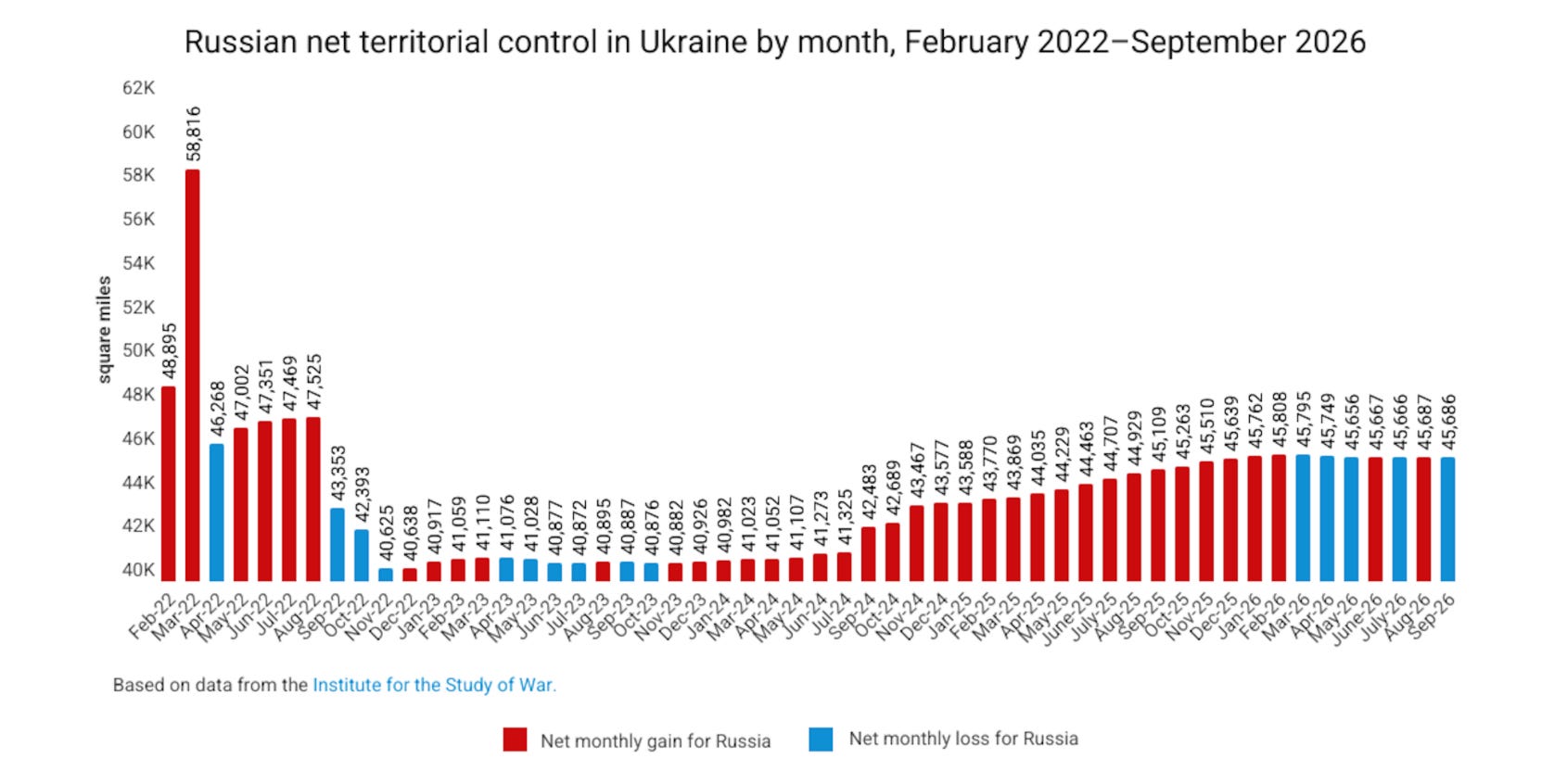
The graph above shows what is more likely to be the truth about Russian gains and losses recently. It shows that the Russians are having their second-worst period of the war for territorial losses.
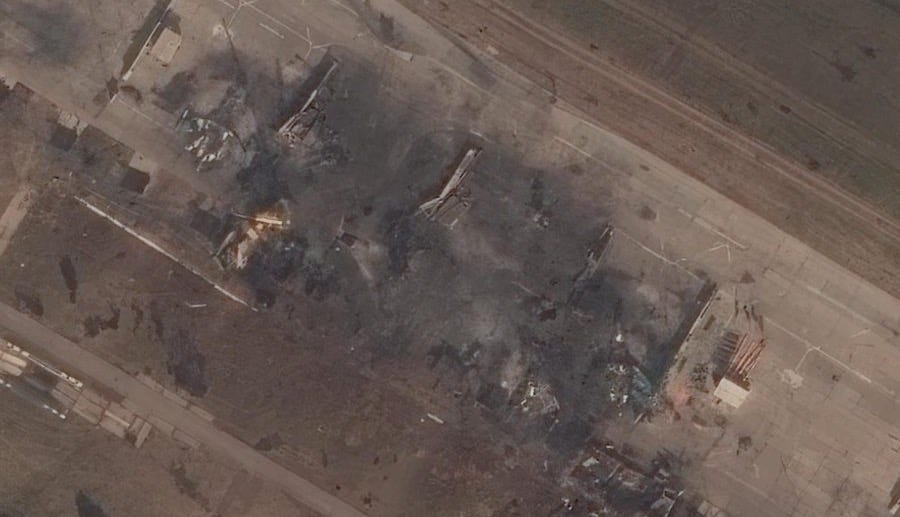
In other good news, Ukraine this week appears to have destroyed six Russian fighter bombers in a single strike.
One Season of Diesel Treachery. On 9 October Trump announced after a call with Putin that Russia would supply diesel to US and global markets. The Council on Foreign Relations explainer lists the promised volumes as more than 300,000 tonnes immediately, a further 500,000 tonnes in November and larger amounts later, and notes that the Treasury issued a temporary licence suspending sanctions on Russian diesel until April 2027.
Trump’s comments about President Zelenskyy hardened as the week progressed. On 10 October he said “it’s time for Ukraine to get a new president” and, of the refinery strikes, “He better damn well stop.” On 16 October, in an interview reported by RBC-Ukraine, he said, “Zelenskyy is not a good guy for us to deal with” and “I think I find Zelenskyy to be more difficult to deal with than Putin.”
On 16 October Trump signed an executive order waiving the Graham Act sanctions and tariffs, which he had signed into law on 18 September. The waived measures include a 500 per cent tariff on Russian imports and 100 per cent duties on the largest buyers of Russian energy.
The Energy Ceasefire That Never Was. Trump announced the energy ceasefire on Sunday 11 October. Zelenskyy wrote that “Today alone, the Russians have attacked 6 energy facilities in Ukraine. 33 people were wounded across the country.” Foreign Minister Sergey Lavrov said of Zelenskyy that “I do not think he deserves a respite.” The ISW assessment of 15 October records Kremlin insistence that no ceasefire existed, and numerous reports that Russia kept striking Ukrainian energy infrastructure from 11 to 14 October while Ukraine refrained from doing the same.
Trump told reporters he would “have to look at it” because “there’s been violations on both sides”, but he has essentially washed his hands of Russian atrocities. Throughout the past week, Russia has continued to hammer Ukraine with jet powered drones and ballistic missiles. On the night of 13 to 14 October Russia fired 39 ballistic missiles and more than 120 drones.
The Kyiv Independent reported that all three of Kyiv’s combined heat and power plants were attacked, that 600,000 people lost power and that five people died, among them residents of a nine-storey building. Zelenskyy called the strike “entirely deliberate and demonstrative in its scale.” Interestingly, Ukraine’s Air Force said of the 13 October strikes that it received no warning from partners about the first wave of missiles.
Russia’s Accelerating Campaign Against Civilians. The civilian toll rises with the energy strikes. The UN Human Rights Monitoring Mission recorded at least 328 civilians killed and 2,105 injured in September, a combined total 85 per cent above September 2025. Russia’s accelerated air campaign aims to terrorise civilians and make Ukraine unliveable.
Things are unlikely to get better any time soon without a significant step up in support from Europe (or America) to intercept ballistic missiles and jet-powered drones. President Zelenskyy has warned that Russia has stockpiled as many as 700 ballistic missiles for its winter strike campaign. CNN has reported this week that Ukraine has now exhausted its stocks of Patriot missile interceptors. Unfortunately, there are few places in the world (besides the US) where there are stocks of available interceptors. Europe has already provided a large proportion of its stocks, and the Middle East is busy using theirs.
The main sources now for Ukraine might be as follows:
-
Japan. Japan has probably the largest Patriot missile inventory in Asia, operating over 16 PAC-3 batteries. Japan has procured hundreds of PAC-2 / PAC-3 missiles. In late 2023–2024, Washington approved a transfer/repurchase of up to 400 PAC-3/MSE interceptors from Japan back to US stockpiles to backfill global needs. Japan also produces approximately 30 PAC-3 interceptors annually via Mitsubishi Heavy Industries.
-
Korea. South Korea has upgraded its legacy air defences into a layered Patriot network. Foreign Military Sales approvals include a primary 2015 package for 136 PAC-3 CRI missiles followed by a 2018 package for 64 PAC-3 MSE missiles, putting total official US export procurements at more than 200 interceptors (supplemented by upgraded PAC-2 stock).
-
Taiwan. Taiwan operates nine Patriot batteries with an estimated inventory of 330 to 400 interceptors, reinforced by approval in 2020 for 100 PAC-3 MSE interceptors and associated field equipment.
The War Zone reports that the US Army is seeking a Patriot interceptor costing no more than US$1 million, against about US$4 million for the PAC-3 MSE, and Defense One reports that one American maker says, “we need to build them like artillery rounds”, and that the company aims for 5,000 interceptors a month by November.
Jet-Powered Shaheds Continue to Outrun Interceptors. The challenge of intercepting jet-powered Gerans (a Russian derivative of the Shahed) continues. These drones can reach speeds up to 600 kilometres an hour, now make up around 40 per cent of Russian launches and may soon reach 80 per cent. Ukrainian military intelligence has reported that Russia has stopped building the Geran-3 and expanded Geran-4 and Geran-5 production, and a Ukrainian engineer says that “The Geran-5 flies 150 km/h faster than the Geran-4”. These new drones rely on Chinese turbojet engines.

Ukraine fielded its first jet interceptor, the Alexa Spatium, on 21 August. As the United24 story that covers this achievement notes:
The interceptor is primarily designed to engage Russian strike drones, including the Geran-3, Geran-4, Geran-5, and Shahed-131. It can also be used against reconnaissance drones, helicopters, and other individual targets. The interceptor is powered by a turbojet engine and is designed to operate across low- and medium-altitude flight levels.
Other companies are flight-testing different approaches to combat the jet-powered drone threat. Stefan Korshak reports that Zelenskyy said fighters shoot down about 60 per cent of jet drones, and interceptor drones intercept about 30 per cent. Using fighters is an expensive solution and is not a long-term fix for this challenge.
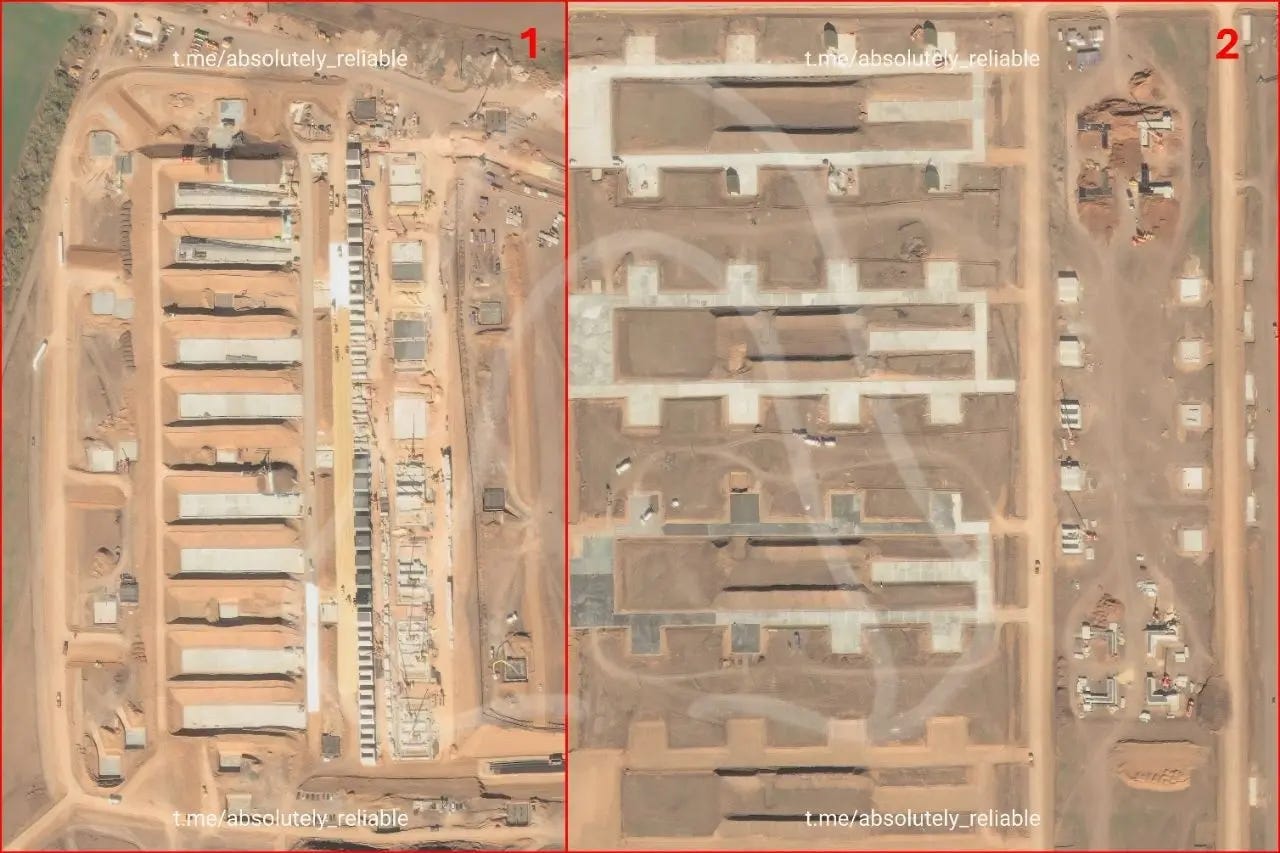
There is an added imperative for these new interceptors as stories emerged this week of a large, new Russian drone launch facility being constructed near the Millerovo military airbase in Rostov Oblast. As reported by the Kyiv Independent, the base was built in just six weeks and will be able to launch eight drones at a time.
Data Centres Join the Target List. At the start of Russia’s full-scale invasion, Russia targeted Ukrainian data centres. Ukraine passed new laws that then allowed it to export its data to centres outside Ukraine’s borders to protect it.
But Russia, over the past decade, has taken a different route. It decided upon the development of an entirely sovereign internet for Russia with all of the necessary infrastructure being located on Russian soil. Ukraine, in the past few weeks, has demonstrated how vulnerable Russia now is because of that strategy. After Russia attacked Ukrainian data centres in September, Ukraine’s response was strikes against Russian centres starting on 8 October.
The first site, at Sasovo, reportedly housed two of the three supercomputers Yandex uses to build AI models, and the outage affected Russian Railways, MegaFon and T-Bank. A Kommersant source told the Moscow Times that replacing the damaged equipment could take as long as six months, and Russia’s digital minister Maksut Shadayev said the scale of the attacks “was unprecedented”. Ukraine has now targeted data centres belonging to the Russian internet giant Yandex in three different regions of Russia, as well as another belonging to the state-owned bank Sberbank.
The lessons of this data centre strike campaign extend well beyond this war. Iran struck two Amazon facilities in the United Arab Emirates in March, and Amazon said on 15 September that it had been unable to restore access to resources and data hosted in those regions. The UAE is reportedly revising a five-gigawatt data centre project to disperse its sites.
Four initial insights might be taken from these strikes, although much more careful analysis is needed. First, governments must map where critical government and military workloads sit, and second, better disperse the work done by data centres – at a mix of sovereign and foreign sites. Third, data centres may need to be better defended, not just against cyberattacks but against drones and other kinetic attacks as well. Finally, governments will need to consider in advance what response an attack on a commercial data centre will trigger.
Given data centres provide a critical node in the global information network that now holds governments, businesses and societies together, understanding the vulnerabilities of these locations and better protecting them is crucial.
The week’s events points to two major conclusions.
First, on the ground, Ukraine is doing what a well-led army does when it learns and adapts. Operation Vivaldi has now retaken 277 square kilometres across four phases, Russia’s net gains have shrunk to 16 square miles in four weeks, and Gerasimov’s claim of 1,800 square kilometres since 1 September stands totally without evidence. Putin’s goal of taking the Donbas appears a forlorn hope.
Second, in the air and in Washington, a different situation pertains. Russia has settled on an accelerated campaign against Ukraine’s energy system and its civilians and has structured its production to support this. Russia continued that campaign through the days of the energy ceasefire announced by Trump. At the same time, Putin’s campaign to woo Trump continues to pay dividends for Russia and its war to exterminate Ukraine. The Trump administration has eased the sanctions that were meant to raise the price of Russia’s war and coerce it into meaningful peace negotiations.
To make things worse, a commercial entity that Ukrainian interceptor drones depend on now operates under a speed cap, and Reuters reported during the week that the order for this came from inside the White House. Whether Ukraine can develop solutions to this before the coldest months of winter depends on Europe supplying air defence, money and alternative, reliable communications at pace.
Nations across the Pacific are watching events in Ukraine and Washington DC and will be drawing their own conclusions. A diesel waiver, a ceasefire announcement and a speed limit on a satellite network each provide signals to allies and security partners what they might expect from the United States when fuel prices and domestic politics intrude. Regional commentary however was cautious. Pacific governments need the American presence, and there appears this week to have been little appetite for public criticism. The response from nations across the Pacific is likely to be along more practical lines. This might incorporate larger fuel reserves, redundant and sovereign communications services, increased drone and missile production at home, and closer links among regional nations.
Ukraine is gaining on the battlefield while losing ground in the diplomatic arena. The frustration and anger felt by many in Europe and America about Trump’s impulsive decisions to aid Russia this week is palpable but counts for little among Ukrainians who are being subjected to an even more brutal terror bombardment from Putin and his fellow barbarians in Moscow.
Perhaps Trump’s decisions will be seen in the future as a turning point in the trajectory of this war, in Putin’s confidence to engage in aggression against other European nations and in America’s relationships with its allies in Europe and the Pacific. But that is a judgement for future historians. For now, what remains to be done is to mitigate the profound damage done by Trump this week, to find reliable alternatives to commercial entities seeking to influence the outcome of the war in favour of Russia, to help Ukraine shatter Russian efforts to advance on the ground, and to decrease the impact of Russian missiles and drones targeting civilians and infrastructure.