Quick overview
- Nike’s stock is trading at $37.67, up 1.43%, but remains 47% below its 52-week high of $70.44.
- The recent rally was driven by a shift from tech stocks to consumer names, despite Nike’s weak revenue and guidance.
- Nike’s restructuring plan aims to save $2.5 billion by fiscal 2031, but concerns about dividend sustainability persist.
- Analysts are cautious, with a consensus rating of ‘Reduce’ and an average price target of $41.07.
Nike, Inc. (NYSE: NKE) is trading near $37.67 in pre-market action today, up 1.43% after Thursday’s 5.21% rally to $37.14. The stock bounced back from its previous close of $35.30 but is still some 47% shy of a 52-week high of $70.44 and about 18% higher than a 52-week low of $31.97. As of this writing, Nike’s market cap is about $55.2 billion.
Rotation Into Beaten-Down Consumer Names Lifts Nike
Thursday’s rally came without any major company-specific news. Instead, Nike benefited as investors pulled back from highly valued tech stocks, which came under pressure due to interest-rate and financing concerns with AI, and toward consumer stocks that were down. Lululemon’s stock price jumped 5.1%, Deckers had a 3.9% gain and the Nasdaq tumbled 0.5% at the midday mark.
Nike was between $35.94 and $37.73 in the middle of the day with a volume of almost 46 million shares. This was around 87% more than the stock’s average transaction volume of 24.8 million shares per day.
Q1 Beat Was Overshadowed by Weak Guidance
Nike’s recent decline began after the company reported results on October 1. But revenue of $11.21 billion was below the $11.3 billion estimate, and down 4.3% year-over-year, while EPS came in at $0.48, beating estimates of about $0.43 to $0.44.
Nike Direct was down 8%, Jordan Brand down in the mid-teens and Converse sales down 28%, while Greater China revenue fell 26% on a currency neutral basis. The worries included the outlook for fiscal 2027, when Nike is predicting a high-single-digit revenue decline and adjusted EPS of $1.15 to $1.35, below analysts’ expectations of $1.61. Shares fell as much as 9.6% in pre-market trading the next day, reaching $31.79. CFO Dave Denton admitted the downside, stating that results were “below both our expectations and our potential.”
Cost-Cutting Plan and Dividend Questions
Nike’s “Pace” restructuring plan will seek to save approximately $2.5 billion cumulatively by fiscal 2031, with layoffs anticipated to start in 2027.
The company also distributes $0.41 per quarter in dividends, or $1.64 on an annual basis, which equates to an approximate yield of 4.4%. However, a trailing payout ratio near 79% has raised questions about how sustainable the dividend will be if earnings continue to decline. Insiders have also sold some 14,974 shares valued at approximately $600,000 in the last three months.
Analysts Remain Cautious
Wall Street is split on Nike, yet it is deciding to be cautious. MarketBeat’s tally shows 1 Strong Buy, 7 Buy, 21 Hold and 10 Sell ratings, resulting in a “Reduce” consensus and an average price target of $41.07.
After the earnings report, UBS reduced its target to $34 from $42, but kept its rating on it at the Neutral level. Stifel lowered its price target from $40 to $36, and maintained a Hold rating, while Williams Trading downgraded the stock to a Hold rating. Bernstein, however, was more bullish, maintaining its Outperform rating while cutting its price target to $45 from $68.
What to Watch Next
Nike is testing resistance near its 50-day moving average at $37.66. The next significant level to watch is the 200-day moving average at $41.75 and the psychological resistance level of $40.
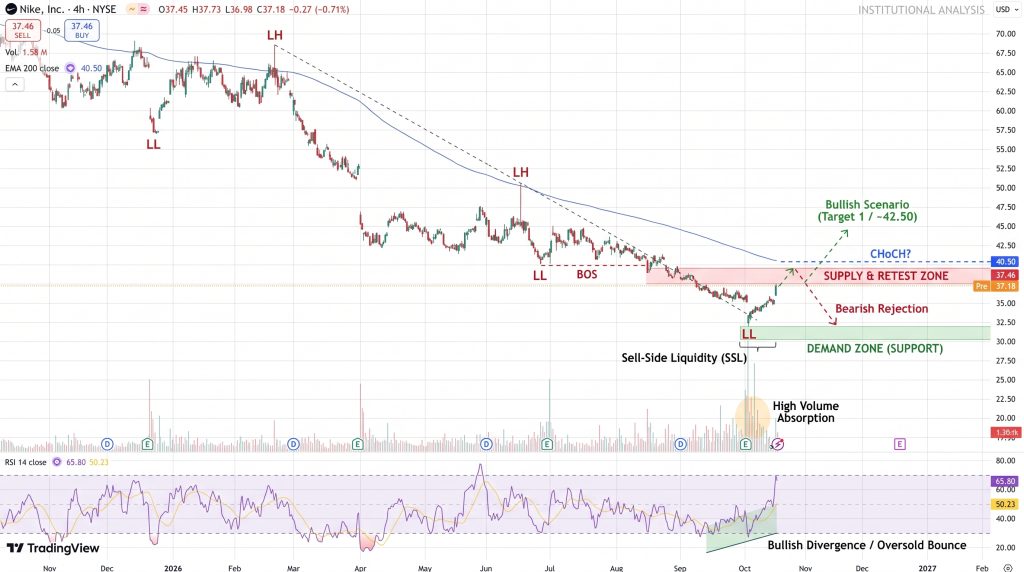
The negative side is support is near the Wednesday close of $35.30, with the post-earnings low around $32. If the price closes above $38, it may indicate that selling has slowed. But a decline below $35 would make the 52-week low more significant.
The next big driver will be Nike’s fiscal second quarter earnings report, which is expected in December. Investors will be paying attention for any indication of sales improvement, especially in China, as well as any shift in corporate outlook.
FAQs
1. Why is Nike stock falling?
Nike shares have struggled due to weak sales, declining China revenue and a disappointing fiscal 2027 outlook.
2. What are the key price levels for Nike stock?
Support sits near $35 and $32, while resistance is around $38, followed by $40 to $42.
Bottom Line
Nike’s recent rebound offers some relief, but weak guidance and declining sales remain concerns. Investors will watch upcoming earnings for signs of a recovery.

Arslan Ali Butt
Lead Markets Analyst – Multi-Asset (FX, Commodities, Crypto)
Arslan Ali Butt serves as the Lead Commodities and Indices Analyst, bringing a wealth of expertise to the field. With an MBA in Behavioral Finance and active progress towards a Ph.D., Arslan possesses a deep understanding of market dynamics.
His professional journey includes a significant role as a senior analyst at a leading brokerage firm, complementing his extensive experience as a market analyst and day trader. Adept in educating others, Arslan has a commendable track record as an instructor and public speaker.
His incisive analyses, particularly within the realms of cryptocurrency and forex markets, are showcased across esteemed financial publications such as ForexCrunch, InsideBitcoins, and EconomyWatch, solidifying his reputation in the financial community.