As the Council of Europe debates a controversial Additional Protocol on involuntary psychiatric treatment, two of its supporters face an uncomfortable question: why do countries with some of Europe’s highest rates of compulsory psychiatric admission believe that the problem lies primarily elsewhere?
Germany and Switzerland are among the countries supporting a revised draft Additional Protocol to the Council of Europe’s Oviedo Convention, intended to establish binding safeguards governing involuntary placement and treatment in psychiatric services.
The justification sounds reasonable. Some European countries have inadequate legal protections against psychiatric coercion, and a common European instrument could help prevent abuses.
Indeed, the Council of Europe’s own explanation states that the proposal was developed after identifying legal gaps in certain member states. It distinguishes countries already considered to have adequate legal safeguards from others still lacking such protections.
But this reasoning raises an important question that has received remarkably little attention.
If the problem is inadequate protection against involuntary psychiatric treatment, the first question is who should lead this work, and if it is Germany and Switzerland how does their practice compare to the rest of Europe.
The available figures suggest that both countries should first examine what is happening within their own borders.
Neither country’s record makes it an obvious model for Europe.
A protocol intended to protect human rights
The Council of Europe’s Committee of Ministers is continuing its examination of the draft Additional Protocol to the Oviedo Convention. Its Rapporteur Group on Human Rights (GR-H) discussed the proposal again on 8 October.
The draft’s stated objective is to protect the dignity, identity, autonomy and other rights and fundamental freedoms of people subjected to involuntary placement or treatment within mental healthcare services.
Article 5 provides that involuntary measures must comply with national legislation and the safeguards established by the Protocol. The revised text also presents these measures as a last resort, subject to strict requirements of legality, necessity and proportionality.
The proposal has, however, encountered growing opposition among the Council of Europe’s 46 member states, as well as from disability organisations, human rights bodies and the United Nations.
The difference between the two approaches is fundamental. While the proposed European instrument seeks to regulate involuntary measures through safeguards, the UN Committee calls for ending coercion in mental healthcare on the basis of disability, including measures described as a last resort.
Yet, beyond this legal disagreement, another question deserves attention: would the Additional Protocol actually reduce the use of involuntary psychiatric measures? By introducing safeguards and preventing abusive use that would be an expected result.
The evidence available from European countries gives serious reason for doubt.
What the European figures reveal
In 2019, a research team led by Luke Sheridan Rains at University College London published an international comparative study in The Lancet Psychiatry.
The researchers examined involuntary psychiatric hospitalisation rates between 2008 and 2017, where data were available, in 22 countries across Europe, Australia and New Zealand.
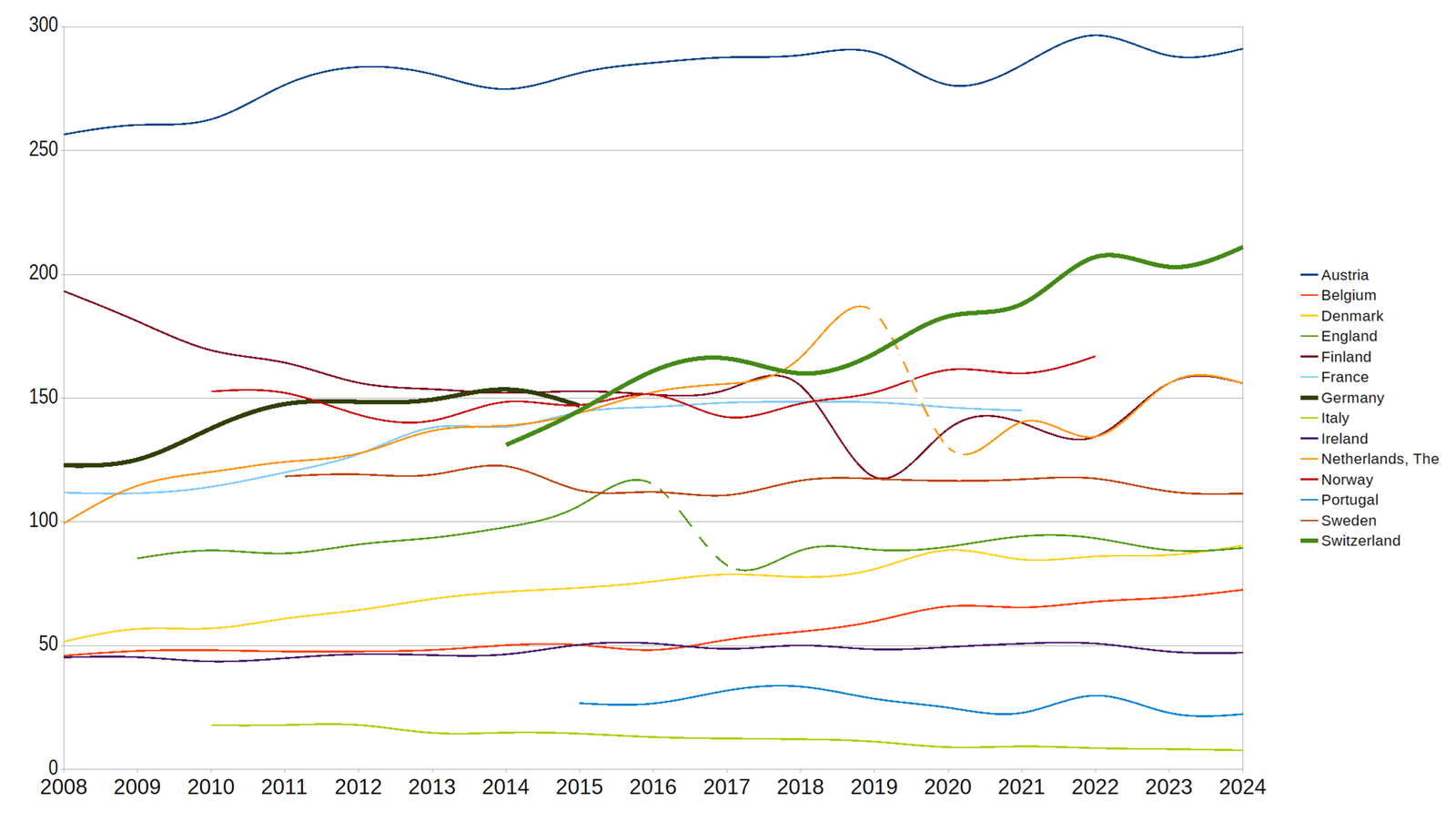
The differences were striking. Austria recorded a rate of 282 involuntary hospitalisations per 100,000 inhabitants, compared with just 14.5 in Italy, a difference of nearly twentyfold.
More surprisingly, the study found no relationship between annual involuntary hospitalisation rates and the characteristics of national legal frameworks.
Countries with extensive legislation and sophisticated healthcare systems did not necessarily make less use of compulsory psychiatric admission.
Quite in contradiction to this belief, the researchers found some associations between the increasing use of involuntary admissions and higher national income, greater healthcare expenditure and more psychiatric beds, though these relationships were generally weak and did not fully explain the differences.
Their conclusion pointed towards a crucial distinction: having legal safeguards is not the same as applying them in a way that effectively limits coercion.

The European Times examined additional national statistical sources and long-term trends in 14 European countries up to and including 2024. In ten of them, the available records indicated increasing use of involuntary admissions. Italy, Portugal, Sweden and Finland were the only countries showing decreasing trends, with Italy and Portugal already having the lowest rates in Europe.
These comparisons require some caution. Only countries which have records for 10 years or longer were included. Some countries do not systematically record involuntary admissions, while others have changed their statistical definitions in the period observed. England and the Netherlands introduced changes that complicate long-term comparisons. In the graphic above featuring involuntary admissions in 14 European countries the year when the change of statistical definition was introduced is indicated with a dotted line.
Nevertheless, one pattern stands out: Austria, Germany and Switzerland are the countries recording particularly high levels of involuntary psychiatric placement. Higher than any other country that has records available.
These are not countries generally regarded as lacking resources, advanced healthcare systems or established legal protections.
And that is precisely what makes their situation so relevant to the debate.
Switzerland: legal safeguards, but increasing compulsory admissions
Switzerland provides an especially revealing example.
Under Articles 426 to 439 of the Swiss Civil Code, a person assessed with a mental disorder, an intellectual disability or severe neglect may be placed in an appropriate institution against their will when the necessary treatment or care cannot be provided by other means.
The legal framework therefore already establishes conditions governing compulsory admission.
Yet the figures indicate that the practice is not becoming less frequent.

Source: The Swiss Health Observatory (Obsan)
According to the Swiss Health Observatory (Obsan), Switzerland recorded 19,314 involuntary psychiatric hospital admissions in 2024.
These represented 22.8% of psychiatric hospitalisations covered by the indicator.
The age- and sex-standardised rate rose from approximately 1.6 per 1,000 inhabitants in 2018 to 2.1 per 1,000 in 2024 — an increase of roughly 31%.
The figures are particularly significant when compared with Italy, where the Ministry of Health’s 2024 report recorded 4,586 compulsory psychiatric treatments in public psychiatric hospital departments, corresponding to approximately eight per 100,000 inhabitants.
Switzerland’s standardised rate was approximately 210 per 100,000 in the same year.
The two systems use different definitions and reporting methods, so their figures cannot be treated as perfectly equivalent. Nevertheless, the scale of the difference is striking and warrants investigation.
It raises an unavoidable question: why does a wealthy country with established legal safeguards rely so extensively on involuntary psychiatric admission when other European countries record substantially lower rates?
Switzerland’s figures also reveal important internal differences.

Source: The Swiss Health Observatory (Obsan)
Rates vary considerably between cantons, with particularly high levels in parts of western Switzerland and the German-speaking regions around Zurich.
Differences within a single country are especially interesting because the same federal legal framework operates across cantons. This suggests that local practices and implementation may play an important role.
Another striking finding concerns age.
People aged 80 and over have the highest rate of involuntary psychiatric admission in Switzerland, followed by the 19–34 age group. In 2024, the rate among those aged 80 or above exceeded four admissions per 1,000 inhabitants.
Psychiatric diagnoses classified as organic disorders, including dementia, account for an important proportion of involuntary placements, around 15–17% in the figures examined. However, this proportion has remained relatively stable and does not, by itself, explain the broader increase.
Nor has the expansion of psychiatric hospital services produced a corresponding reduction in involuntary admissions.

Between 2002 and 2024, the broader number of people hospitalised for psychiatric conditions rose from 51,297 to 75,144, while the number of hospitalisation episodes increased from 70,618 to 112,304.
More psychiatric care has not meant less compulsory care.
The available evidence certainly challenges any assumption that Switzerland has already solved the problem through its existing legal safeguards.
Germany: high rates, incomplete data
Germany faces a similar contradiction.
The available national statistical series indicate that involuntary psychiatric placements increased substantially during the years covered by comparable data, reaching levels well above those of most of all other European countries.
Germany presents an additional difficulty, however: the absence of a single, consistent and up-to-date national statistical series that can reliably track involuntary psychiatric admissions across all federal states.
Different German statistics count judicial proceedings, placement orders, hospital cases or persons admitted, making comparisons difficult.
Research conducted for the Federal Ministry of Health, including the ZIPHER project, has sought to address these limitations. Nevertheless, the available sources do not provide a straightforward, continuous national series covering the entire period from 2008 to 2025.
This lack of comparable information is itself significant.
How can the effectiveness of safeguards be properly assessed without reliable and consistent data on how often compulsory psychiatric measures are used?
Can another legal instrument solve what existing safeguards have failed to prevent?
The central problem is not whether involuntary psychiatric treatment can lead to abuse. It can, and abuses have been documented across Europe.
Nor is it unreasonable to insist that people subjected to coercive measures should have strong legal protections.
The question is whether creating another legal framework that regulates such measures will actually reduce them.
The research led by Sheridan Rains suggests that differences in national legislation do not explain the enormous variations in involuntary hospitalisation rates.
Switzerland illustrates the problem particularly clearly. It has legal safeguards, substantial healthcare resources and a developed system of judicial and administrative oversight. Yet compulsory psychiatric admission has continued to increase.
Germany, too, has an extensive legal and institutional framework, while continuing to face serious criticism from the UN Committee regarding coercive psychiatric practices.
Both countries have been asked to move towards a different approach — one based on autonomy, free and informed consent, and the development of non-coercive services.
The proposed Additional Protocol moves in another direction: it seeks to define the conditions under which involuntary measures may continue.
Its supporters argue that stronger safeguards are necessary to protect people from arbitrary detention and treatment. But the experience of countries already possessing such safeguards raises a fundamental question about the effectiveness of this approach.
If safeguards were sufficient to reduce psychiatric coercion to truly exceptional circumstances, why have they not achieved that result in Germany and Switzerland?
And if existing legal frameworks have not prevented high or increasing rates of compulsory admission, why should similar rules become the European standard?
Germany and Switzerland are entitled to participate in shaping European human rights standards. But their involvement should not place their own records beyond scrutiny or as a model for the rest of Europe without a full evaluation.
Before arguing that other European countries need an Additional Protocol, both governments should answer a simpler question:
Why are their own rates of involuntary psychiatric admission so high?
Europe’s challenge is not merely to make psychiatric coercion more carefully regulated.
It is to make it increasingly unnecessary — and, in accordance with the UN Committee’s recommendations, to move towards ending it.
That is the standard against which any new European instrument should be judged.