Brazilian financial markets soared Monday after Senator Flavio Bolsonaro outperformed expectations in the first round of the presidential election. The son of former leader Jair Bolsonaro narrowly edged out incumbent President Luiz Inacio Lula da Silva, while polls had pointed to the opposite result.
Brazil’s benchmark Ibovespa index jumped nearly 8% Monday, while the Brazilian real rose more than 4% against the dollar and the yield on the 10-year government bond fell by around 130 basis points. This spectacular reaction reflects investors’ hopes that the country will adopt more liberal economic policies and, above all, tighter management of public finances if Bolsonaro wins.
Reducing the deficit is indeed a major challenge in Brazil, where fiscal imbalances fuel inflationary pressures and help keep benchmark interest rates among the most restrictive in the world. A cleanup of public finances could therefore ease these pressures, allow the central bank to accelerate the rate-cutting cycle it began in the spring and therefore, over time, support consumption and investment.
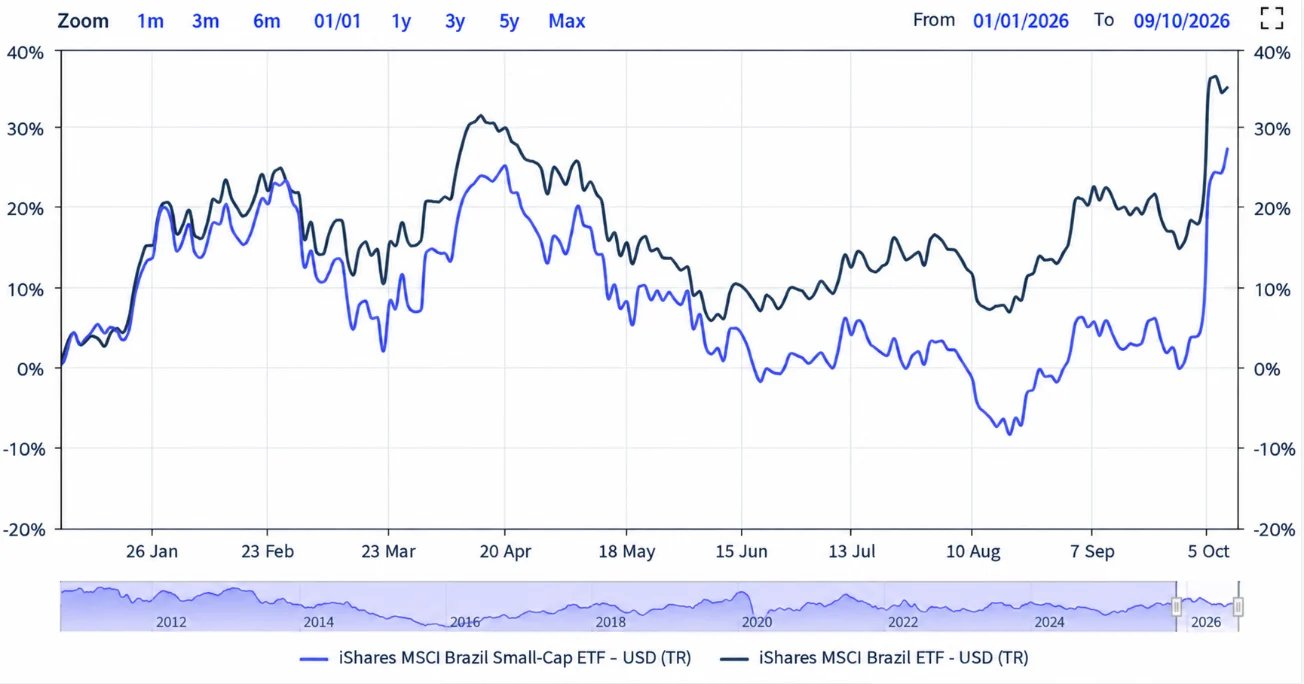
This prospect explains the outperformance of stocks that are most exposed to the domestic economy, which are particularly sensitive to interest rates. Banks gained 12% over the week and real estate nearly 20%, while small caps also benefited from the enthusiasm. The dollar-denominated EWZS ETF, which tracks the MSCI Brazil Small Cap index, soared 25% over the week, nearly twice the gain posted by the EWZ ETF, which tracks the MSCI Brazil index. Materials was the only sector to decline, hurt by falling metal prices.
Bolsonaro’s first-round result prompted JPMorgan to raise its recommendation on Brazilian stocks Monday, October 5, from “Neutral” to “Overweight.” The bank then estimated the MSCI Brazil’s upside at 12% in the very short term, followed by around 20%, supported by the prospect of tighter fiscal policy and a stronger real, which could facilitate continued monetary easing. It therefore favored rate-sensitive stocks and considered valuations attractive, at 8.9x projected earnings over the next 12 months, compared with around 10x now. JPMorgan nevertheless noted that economic growth continued to slow and that corporate earnings remained under pressure.
The question now is whether the markets’ expectations will be confirmed at the polls. The runoff is scheduled for October 25, and no new poll has been published since the first round. Online betting platforms nevertheless assign Bolsonaro an approximately 87% probability of victory, following favorable momentum since the beginning of the week.
A potential victory would thus extend the political shift toward governments on the right that favor economic liberalization in Latin America, a trend that began in 2023 with Javier Milei’s rise to power in Argentina and continued more recently with the election of De la Espriella in Colombia last June.