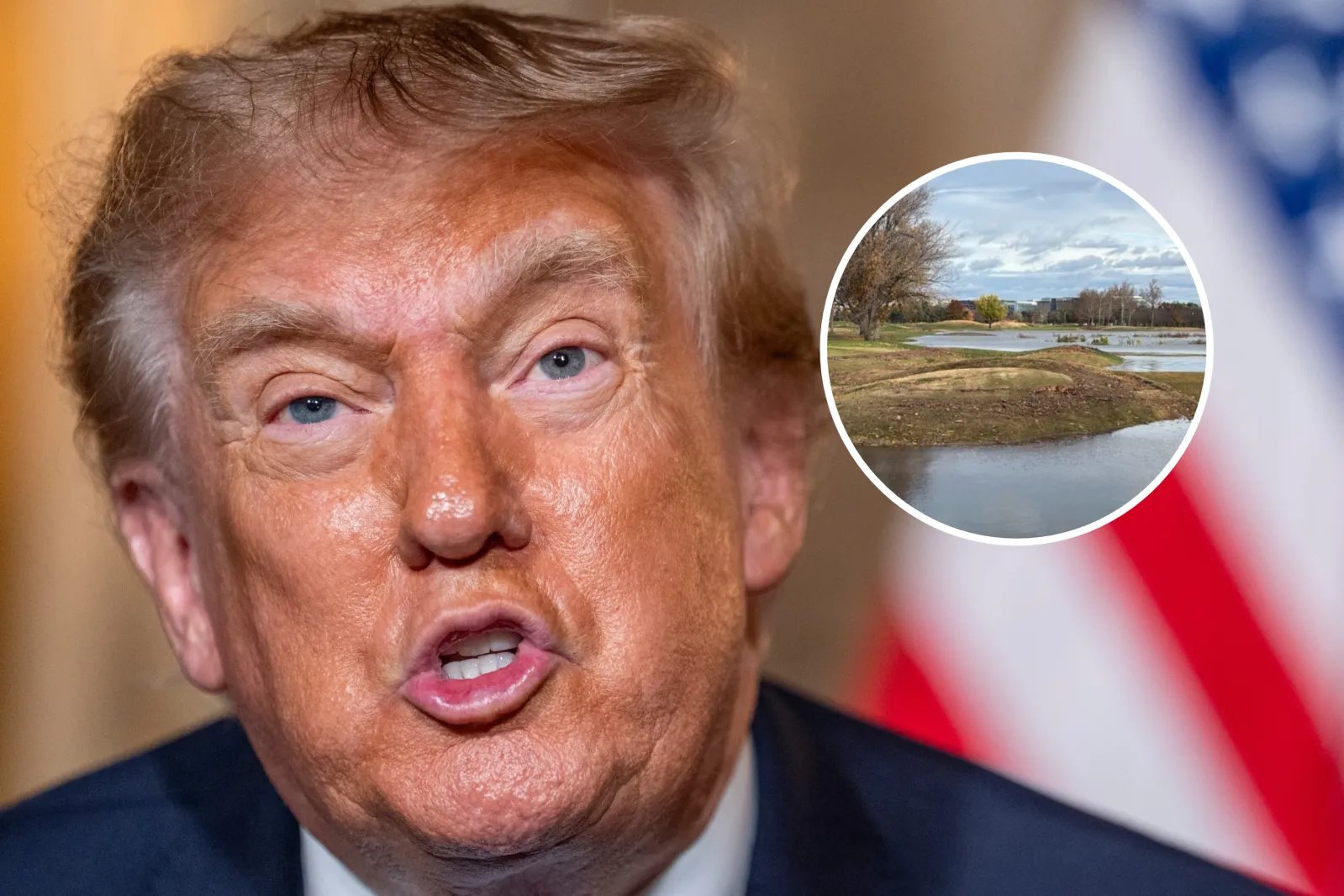
President Donald Trump said Saturday that a storm had destroyed East Potomac Golf Links in Washington, D.C., flooding the public course and collapsing seawalls along the Potomac River.
The damage could affect a legal battle filed by the D.C. Preservation League and local golfers in February that has restricted the administration’s plans to replace the historic complex with a championship-level venue.
Trump wrote in a Truth Social post that the area he calls “Trash Island” had been “completely destroyed” by an “act of God,” with eroding seawalls collapsing beside the Potomac and sections of the adjoining road giving way.
Read More on News
“Almost everything is submerged and obliterated by the tides,” he added in his post, arguing that the barrier must be “substantially lifted” to protect the land and trees.
“God must have been watching the problems we’ve been having with a judge who did everything politically possible to stop a Great Golf Course from being built,” Trump wrote.
No independent engineering report or damage estimate accompanied his Truth Social post. The photograph attached to the president’s post showed extensive standing water around mature trees but could not establish the condition of the entire site.
The National Park Service (NPS) had removed about 430 healthy, non-invasive trees from East Potomac Golf Links and planned to cut down hundreds more, according to an October 13 ruling by U.S. District Judge Ana C. Reyes of the U.S. District Court for the District of Columbia.
Reyes, who was appointed by President Joe Biden, subsequently halted further tree removal and temporarily protected public access to the park.
On Saturday, the president wrote on Truth Social that the Department of the Interior (DOI) had closed the property and was asking Reyes to let the project begin immediately, but no corresponding request was visible on the latest publicly available court docket reviewed by Newsweek, which was last updated on November 27 and listed November 25 as the date of the most recent known filing.
He also suggested the administration could take the dispute to the appellate courts.
Golf operations have already stopped, while golfers and other visitors face continued uncertainty over access to the federally controlled Hains Point property.
Newsweek emailed the plaintiffs’ representatives, NPS, DOI and the agency’s National Capital Region on Saturday morning for comment.

How the Legal Fight Began
The D.C. Preservation League and golfers Alex Dickson and Dave Roberts sued the DOI and NPS on February 13.
Their case alleges violations of the National Environmental Policy Act, National Historic Preservation Act and Administrative Procedure Act.
An amended complaint also challenged the alleged dumping of about 30,000 cubic yards of material at the course and argued that building the replacement layout required congressional authority. Those remain the plaintiffs’ allegations in an ongoing case.
Trump wants the existing complex replaced by a championship-level course designed by Tom Fazio.
Opponents contend that the change would diminish an affordable municipal facility and alter historically significant public land. Trump has said the finished course would remain open to everyone.
The dispute also reaches beyond golf. Hains Point contains roads, walking and cycling routes, fishing areas, picnic spaces, a playground and a waterfront promenade.
Tree Cutting Prompted Stronger Restrictions
The conflict escalated after the administration removed more than 400 trees.
Reyes described the cutting as happening at “breakneck speed” and rejected the administration’s argument that the work was unrelated to the wider course redesign.
On October 26, she issued a preliminary injunction barring the government from removing or damaging additional trees.
Officials were also required to give 10 business days’ notice before making an irreversible alteration to the course, including changes to its vegetation, landforms, pathways or structures.
“The Court still does not speak for the trees,” Reyes wrote. “It speaks only for the rule of law.”
Trump’s own statements became significant because government lawyers maintained that no final redevelopment plan existed, while the president publicly announced an immediate start and a 15-month closure.
“Rarely, if ever, has the United States Department of Justice urged a federal court not to believe the sitting President,” Reyes wrote when explaining the contradiction.

Park Access And Golf Operations Split
A second ruling came before the administration’s planned November 15 closure.
Reyes ordered the course and the portion of East Potomac Park south of Buckeye Drive to remain publicly accessible through December 12 when she extended her temporary restraining order. She also ordered the acting NPS director to testify on December 8.
In her ruling, she concluded that the stated staffing and safety grounds were likely pretexts for advancing the redesign and that the plaintiffs were likely to succeed on parts of their environmental and administrative claims.
The order did not require the government to operate the golf facilities.
National Links Trust ended its management role, leaving the clubhouse closed and the grounds without regular staff, although golfers continued using parts of the course and undertook limited upkeep themselves.
Nor did Reyes prohibit necessary repairs. Her order allowed limited closures for active seawall work and imminent dangers, with notice required if officials restricted access in response to a threat.
What the Storm Could Change
That exception may now become the crucial part of the case.
Evidence of collapsed infrastructure could support urgent stabilization work, but it would not automatically permit construction of the proposed Fazio course.
The government may have to demonstrate which measures address immediate hazards and which form part of the disputed redesign.
In his Saturday Truth Social post, Trump predicted that Reyes would ultimately be “very proud of the final product.”
“It would be a shame to have to use the Appellate Courts on such a ridiculous and frivolous case,” he wrote.
For now, the immediate issue is narrower: whether the administration can substantiate the claimed destruction and persuade the court that its proposed response remains within federal law.
Newsweek’s reporters and editors used Martyn, our AI assistant, to produce this story. Learn more about Martyn here. Contact Newsweek editors for this story: Matthew Robinson and Anthony Murray.