Key Points
-
SpaceX had about $23 billion in revenue over its past four reported quarters, against about $104 billion for Tesla.
-
SpaceX’s connectivity segment, home to Starlink, earned about $5.3 billion in operating income over that time, more than Tesla’s $4.4 billion.
-
Tesla posted an operating margin of just 1.4% on its second-quarter 2026 sales.
- 10 stocks we like better than Space Exploration Technologies ›
At Wednesday’s closing price of about $168 a share, SpaceX (NASDAQ:SPCX) had a market value of about $2.27 trillion. Tesla (NASDAQ:TSLA), the other huge company Elon Musk runs as CEO, closed at about $378, for a market value of about $1.49 trillion. That leaves SpaceX almost $800 billion ahead.
But SpaceX’s business is much smaller. It pulled in about $23 billion over its past four reported quarters, less than a quarter of the $104 billion Tesla took in. And SpaceX lost more than $8 billion over that stretch, while Tesla made about $3.8 billion.
Missed Nvidia in 2009? This Rare Signal Is Flashing Again. In 2009, a “Double Down” signal flashed for a little-known chipmaker called Nvidia. For the first time in years, that same “Total Conviction” signal is flashing for a company 1/100th the size of Nvidia. Continue »
Investors are paying nearly 99 times trailing sales for SpaceX and about 14 times sales for Tesla. Simply put, the market values every dollar of SpaceX’s sales at about seven times what it pays for a dollar of Tesla’s.
This looks crazy at first glance. But the two stocks are priced on really different things, and I’d say the gap matters more for SpaceX shareholders than for Tesla’s.
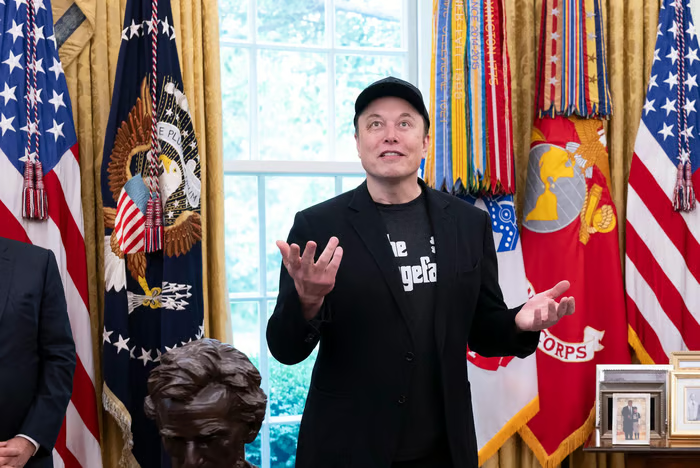
Image source: The White House.
Tesla’s price rests on what comes next
Tesla is still mainly a car company, with auto sales making up almost three-quarters of its revenue in the past four quarters.
And Tesla has been getting less profitable. Its operating margin stayed around 6% in the back half of 2025, at 5.8% and then 5.7%. But it shrank in the first quarter of 2026, to 4.2%, and the second quarter’s margin was just 1.4%. This came even though revenue in the April-to-June period rose 26% year over year, to $28.2 billion.
Even Tesla’s latest profit leaned on SpaceX. Tesla invested $2 billion in SpaceX in March, and an unrealized gain on the stake ($763 million after tax) made up around two-thirds of Tesla’s $1.1 billion in second-quarter net income.
At around 165 times its expected 2027 earnings, Tesla stock isn’t priced on cars. Investors are paying for autonomy and robots — a Robotaxi service that was running in seven major U.S. metros as of Tesla’s July update, and the Cybercab it began making in the second quarter. Tesla also said in July that it expected to start producing its Optimus humanoid robot later this year.
None of them is likely a big source of revenue yet. They might become big businesses, and the stock’s price already assumes they will.
Starlink already earns more than Tesla
SpaceX’s price, by contrast, rests partly on a business that’s already very profitable.
Showing how far Starlink has come, SpaceX’s connectivity segment (which is mainly the satellite internet service) earned around $5.3 billion in operating income over the last four quarters. All of Tesla earned around $4.4 billion of operating income over the same stretch. And Starlink’s margins are widening while Tesla’s shrink. The segment’s operating margin was around 36% a year ago and again in the first quarter of 2026, before rising to about 39% in the second quarter. Over that year, Starlink’s subscribers doubled to 12 million.
“I think people are really underestimating Starlink here,” Musk said in August, on the call covering SpaceX’s second-quarter results.
Most of SpaceX’s losses come from somewhere else. The artificial intelligence (AI) segment, which includes Grok, X, and the computing capacity SpaceX rents to other companies, lost $3.7 billion from operations in the first half of 2026.
Sure, the segment’s operating loss did fall, to $1.3 billion in the second quarter from $2.5 billion in the first.
What does SpaceX’s price assume?
So the gap looks less odd on profit than on sales.
Still, Starlink’s profits don’t make $2.27 trillion cheap. If SpaceX one day traded at 30 times earnings, a generous price-to-earnings ratio for a business this big, today’s market value would call for about $76 billion in yearly profit. That’s more than three times all the revenue SpaceX generated over the last four quarters.
Even with second-quarter revenue annualized, which gives SpaceX credit for its faster recent growth, the stock trades at around 73 times sales.
In short, SpaceX’s price arguably assumes two things at once: Starlink keeps growing quickly for years, and the AI segment goes from big losses to large profits. Just the first shows up in the company’s results now.
I think that’s what the gap with Tesla boils down to. Investors seem to trust growth they can already see in SpaceX’s results more than growth Tesla is still promising, and I get why.
But Starlink alone might not be enough to justify a $2.27 trillion valuation. I think the stock’s price still relies on an AI turnaround that hasn’t come yet.
Should you buy stock in Space Exploration Technologies right now?
Before you buy stock in Space Exploration Technologies, consider this:
The Motley Fool Stock Advisor analyst team just identified what they believe are the 10 best stocks for investors to buy now… and Space Exploration Technologies wasn’t one of them. The 10 stocks that made the cut could produce monster returns in the coming years.
Consider when Netflix made this list on December 17, 2004… if you invested $1,000 at the time of our recommendation, you’d have $375,887!* Or when Nvidia made this list on April 15, 2005… if you invested $1,000 at the time of our recommendation, you’d have $1,459,146!*
Now, it’s worth noting Stock Advisor’s total average return is 955% — a market-crushing outperformance compared to 215% for the S&P 500. Don’t miss the latest top 10 list, available with Stock Advisor, and join an investing community built by individual investors for individual investors.
*Stock Advisor returns as of October 9, 2026.
Daniel Sparks has clients with positions in Tesla. The Motley Fool has positions in and recommends Tesla. The Motley Fool has a disclosure policy.